


Quick answer: Particle board and MFC should be stored flat, off the ground, fully supported across their surface, and kept away from direct moisture and sharp humidity swings before cutting or fabrication. Panels brought into a new climate — especially after ocean freight — perform best when allowed to acclimatize to the workshop’s ambient humidity for a short period before machining, which reduces the risk of movement after the furniture is assembled.
How particle board and MFC are stored and handled between arrival and fabrication has a direct effect on the finished product — even when the board itself is high quality. Warping, uneven cutting, and edge damage often trace back to warehouse handling rather than a defect in the panel itself. This is especially relevant for buyers importing board internationally, since panels travel through varying humidity conditions before reaching the factory floor.
Storing Panels Correctly
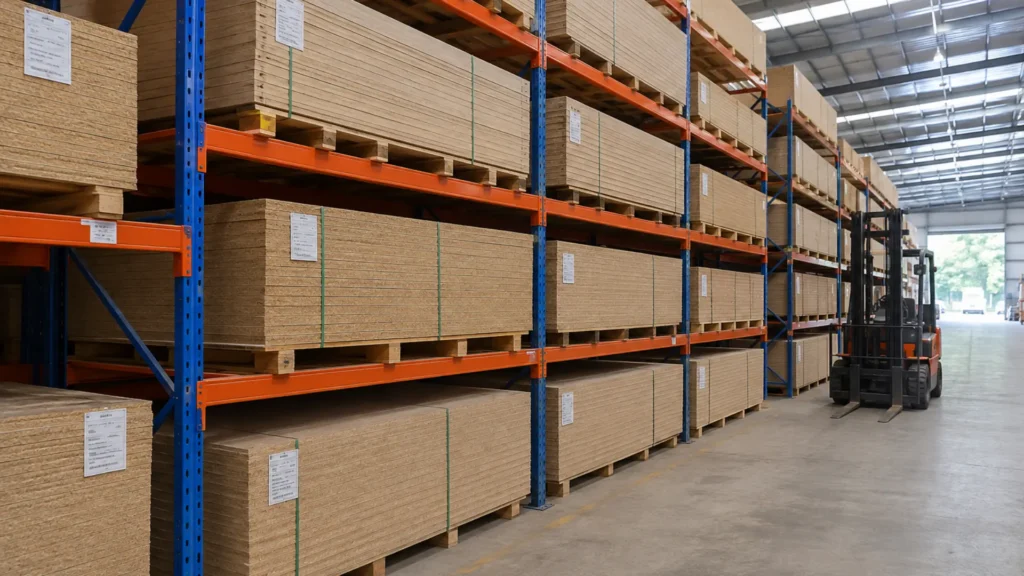
Store flat, not on edge. Panels stored upright or leaned against a wall are prone to bowing over time under their own weight, particularly with longer storage periods. Flat, horizontal stacking distributes weight evenly across the full panel.
Support the full surface. Stacks should rest on a flat, level surface or dedicated pallet racking that supports the entire panel — not just the edges or a few contact points, which can create pressure points and localized warping.
Keep stacks off the floor. Ground-level moisture and temperature fluctuation is one of the most common causes of edge swelling in stored board. Pallets or raised racking keep panels clear of ground-level dampness.
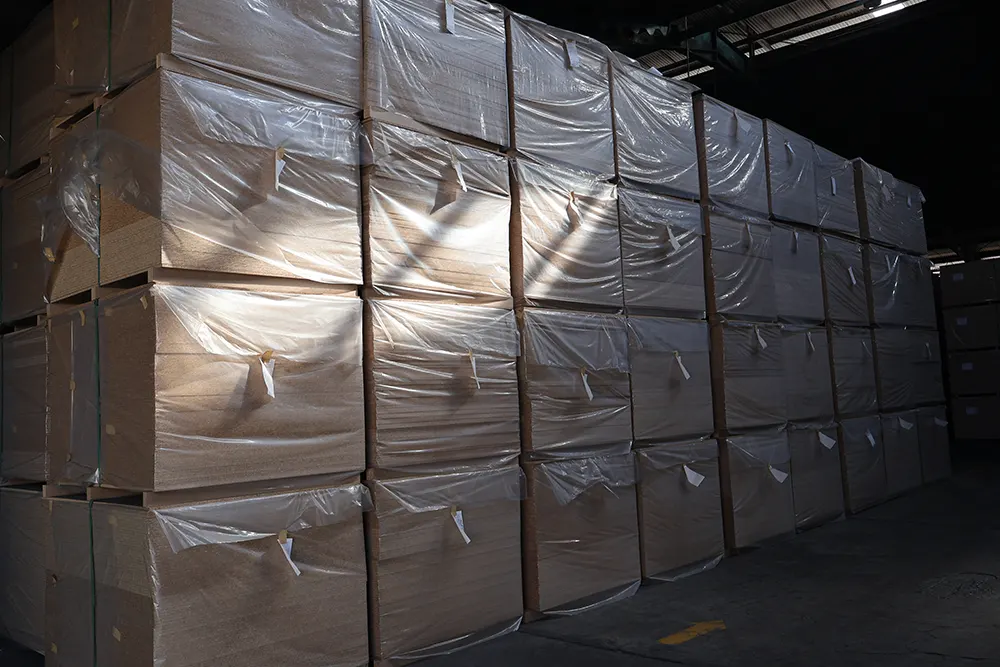
Cover, but allow airflow. Panels should be protected from direct water exposure and dust, but wrapping that traps humidity against the board defeats the purpose — covering should shield without sealing the stack airtight for extended periods.
Rotate stock (FIFO). For distributors and manufacturers holding inventory, using older stock first reduces the chance of panels sitting in storage long enough for environmental exposure to become an issue.
Why Acclimatization Matters
Wood-based panels naturally absorb and release moisture depending on the humidity of their environment, gradually reaching equilibrium with the ambient conditions around them. When board manufactured in one climate is shipped to a different one — for example, from a manufacturing facility to a workshop in a different country or region — it carries the moisture content of its origin until it has time to adjust.
If a panel is cut and fabricated into furniture before it acclimatizes, it may continue absorbing or releasing moisture afterward, causing slight dimensional movement even in a well-made piece. This shows up as sticking doors, gaps at joints, or subtle warping that appears weeks after assembly rather than immediately.
Practical approach: allow newly received panels to sit, unwrapped from any airtight packaging, in the environment where they’ll be fabricated for a period before cutting — long enough for the stack to reach the room’s ambient temperature and humidity. Exact acclimatization time varies by climate difference, board thickness, and how the stock was stored in transit, so it’s worth building a buffer into production scheduling for imported board rather than treating it as an immediate-use material on arrival.
Handling During Fabrication
Support panels during cutting. Unsupported overhang during table saw or CNC cutting increases the risk of chipping and, on longer cuts, panel flex that affects cut accuracy.
Lift, don’t drag. Dragging sheets across each other or across a rough floor surface is a common cause of surface scratching on melamine-faced panels — lifting and carrying, or using a sheet cart, protects the decorative face.
Handle laminated faces with clean gloves. Oils and residue from bare hands can transfer to a melamine surface, which is usually a non-issue for finished furniture but worth avoiding during extended handling and fabrication.
Getting It Right From the Warehouse to the Workshop
Good storage and handling practice protects the investment a furniture manufacturer makes in quality board — but it starts with board that’s manufactured and packaged well in the first place. PT Rimba Partikel Indonesia (RPI) has produced particle board and MFC in Kendal, Central Java since 1990, with export packaging designed to protect panels through the full journey from factory to warehouse.
For guidance on handling a specific order or grade, reach out to RPI’s team on WhatsApp.