


Quick answer: Screw holding capacity — how firmly a panel grips a screw or fastener without pulling loose — depends mainly on board density, thickness, and where the fastener is placed (face vs. edge). Under JIS A 5908:2022, standard particle board of 15mm+ thickness must achieve a minimum face screw holding strength of 400N. Higher-density and HMR-grade boards generally hold fasteners more securely, which is why hardware placement and pre-drilling technique matter as much as the board grade itself.
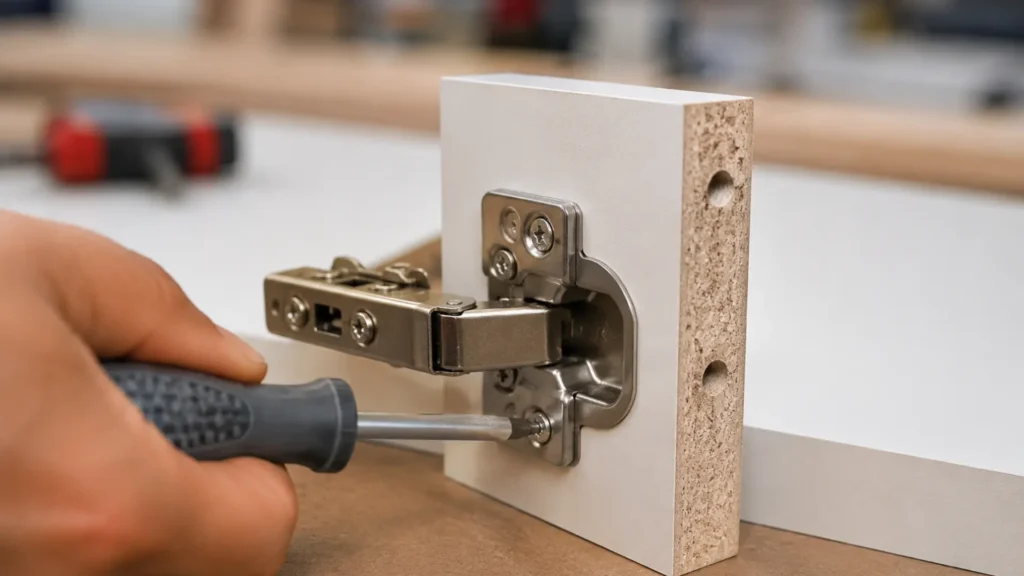
For furniture manufacturers, screw holding capacity is one of the most practical performance questions when specifying particle board or MFC — it directly affects how well hinges, drawer slides, shelf pins, and cam-lock fittings stay secure over years of daily use. Unlike solid wood, engineered panels behave differently depending on where and how a fastener is driven, which makes this worth understanding before finalizing hardware and joinery decisions.
What Determines Screw Holding Strength
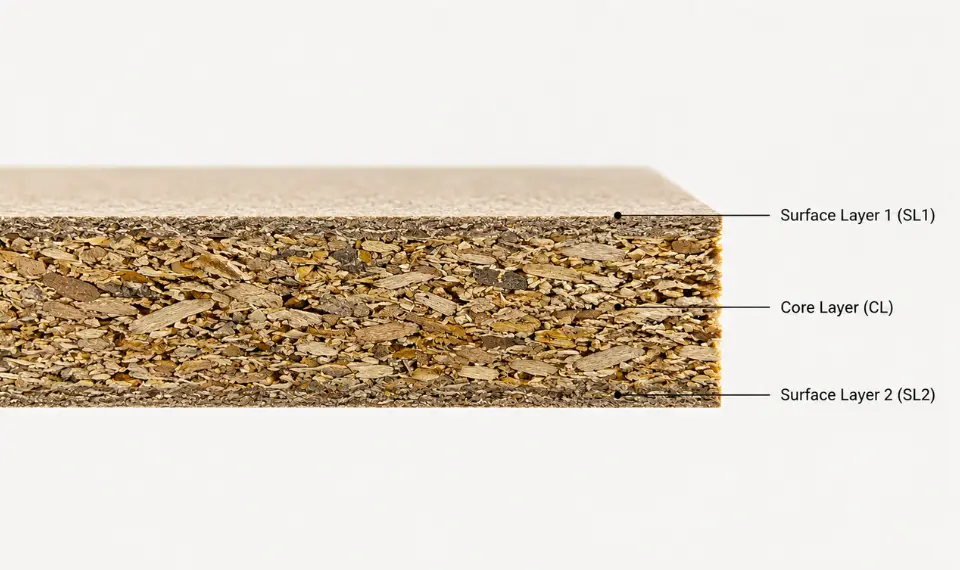
Density. Higher-density board holds fasteners more securely than lower-density board, because there’s more material gripping the screw threads. RPI’s particle board spans a density range of 0.40–0.90 g/cm³, and the higher end of that range performs noticeably better under repeated hardware stress.
Thickness. Thicker panels give a fastener more material depth to bite into, which generally improves holding strength, especially for face fixings.
Face vs. edge fixing. Screws driven into the face of a panel (perpendicular to the surface) generally hold better than screws driven into the edge, because edge fixing engages fewer of the panel’s internal particles along the fastener’s length. This is why cabinet hardware is typically designed to fix into faces wherever possible, with edge fixing reserved for joinery like cam locks and dowels engineered specifically for that purpose.
Board grade. HMR (moisture-resistant) grade board, which uses a denser resin system than standard board, tends to have higher internal bond strength — which correlates with better screw retention, in addition to its moisture performance benefits.
The JIS Standard for Screw Holding
Under JIS A 5908:2022, the standard governing particle board manufacturing that RPI’s board is certified to, face screw holding strength for board 15mm and thicker must meet a minimum of 400N. This is a laboratory-tested value measured by driving a screw into the board face and pulling it out under controlled force — it gives furniture manufacturers a consistent, comparable benchmark when evaluating board from different suppliers.
Practical Guidance for Furniture Manufacturers
Pre-drill pilot holes. Driving a screw directly into particle board or MFC without a pilot hole increases the risk of splitting the surrounding material and reduces effective holding strength. A correctly sized pilot hole lets the screw thread engage the material cleanly.
Use furniture-specific screws where possible. Confirmat screws and similar coarse-thread fasteners designed for engineered wood distribute holding force differently than standard wood screws, and are the industry standard for cabinet and flat-pack furniture joinery for this reason.
Avoid repeated fastening in the same hole. Each time a screw is removed and re-driven into the same hole, the surrounding particles compress further and holding strength decreases. For components likely to be disassembled and reassembled (like flat-pack furniture), this is a factor worth designing around — cam-lock and dowel systems are often used specifically to reduce reliance on repeated screw fixing.
Match board grade to the application’s fastener load. Hardware-heavy components — hinged doors, drawer runners, wall-mounted units — benefit from higher-density or HMR-grade board even outside wet environments, simply for the fastener performance advantage.
Consistent Screw Holding Performance, Batch After Batch
For furniture manufacturers, consistency matters as much as the raw number — a board that hits 400N on one batch and falls short on the next creates quality control problems on the production line. PT Rimba Partikel Indonesia (RPI) manufactures particle board and MFC in Kendal, Central Java to JIS A 5908:2022 standards on a ContiRoll Siempelkamp continuous press, with in-house testing to maintain consistent density and bond strength across production runs.
To request current test data or discuss board grade for a hardware-heavy application, contact RPI’s team on WhatsApp.