


Choosing a particle board supplier for export or bulk orders comes down to production standard (JIS or equivalent), formaldehyde emission grade options, consistency across order volumes, and logistics experience. The lowest factory-gate price is rarely the lowest total cost once specification gaps and shipping reliability are factored in.
Sourcing particle board for manufacturing, distribution, or import isn’t just a price comparison — the supplier you choose determines whether every container matches spec, whether you can meet your destination market’s emission regulations, and whether your production schedule holds up over repeat orders. Here’s what actually matters when evaluating particle board suppliers.
What to Look for in a Particle Board Supplier
Production Standard and Testing
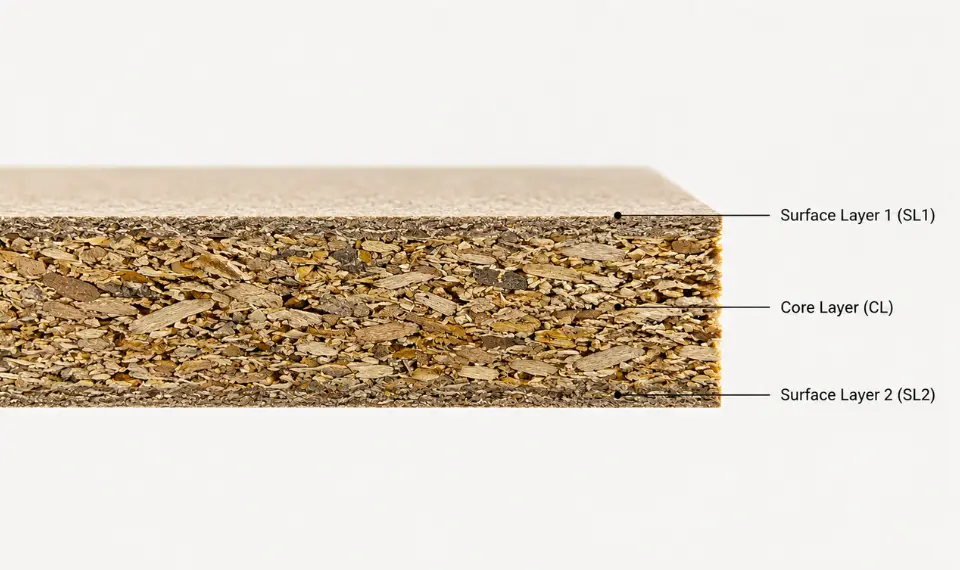
A credible supplier produces to a recognized standard — JIS A 5908:2022 is a common benchmark covering density, moisture content, internal bond strength, and screw-holding strength. Ask whether these properties are lab-tested and documented, not just stated.
Formaldehyde Emission Grade Range
Emission requirements vary significantly by destination market — some require CARB Phase 2/EPA compliance, others accept E1 or E2. A supplier offering only one grade limits which markets you can serve without switching suppliers. Look for a range: E2, E1, E0, E0S, and CARB Phase 2/EPA-compliant options.
Core Grade Options
Standard core suits most furniture and construction applications, but moisture-exposed uses need HMR (High Moisture Resistant) core. A supplier that only produces standard grade can’t serve buyers needing HMR without a second supplier relationship.
Production Consistency
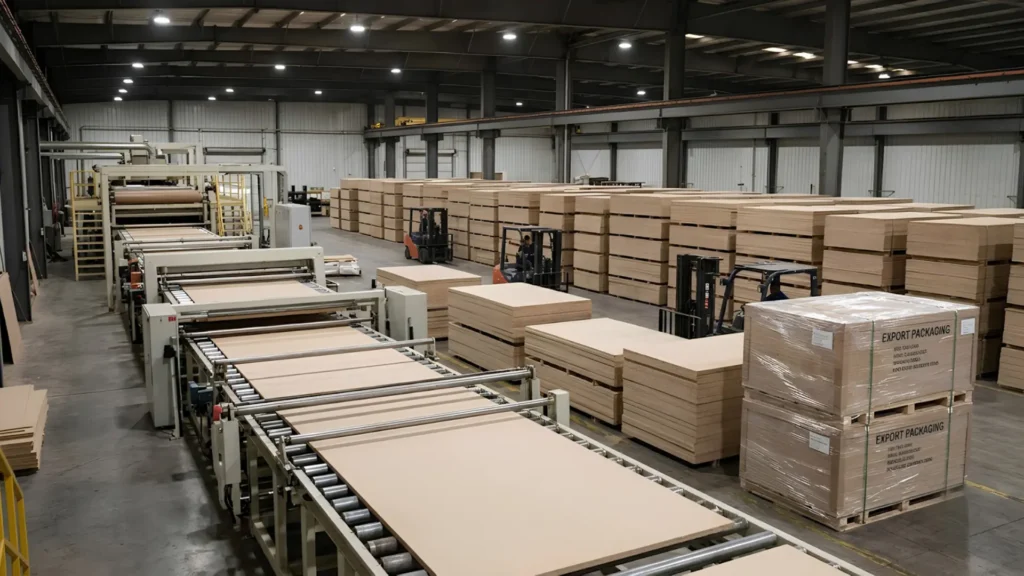
Ask about press technology — continuous presses generally deliver more consistent density and thickness across long runs than older batch systems, which matters directly for container-to-container consistency on repeat orders.
Export and Logistics Track Record
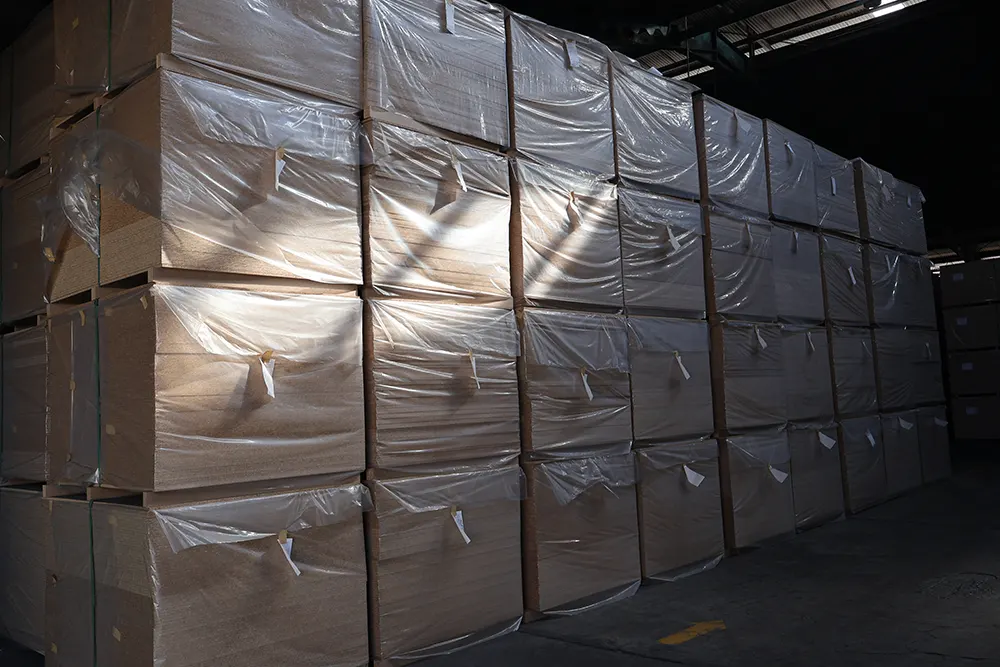
A supplier experienced in export will have clear answers on standard sizes for efficient container loading, typical lead times, and packaging for sea freight — not just a factory price. Logistics inefficiency or unreliable lead times often cost more than a marginally higher factory price.
Questions to Ask Before Committing to a Supplier
- What standard do you produce to, and is it independently certified?
- What emission grades are available, and which markets have you shipped to under each?
- Do you offer HMR core, and what’s the lead time difference vs standard?
- What are your standard sheet sizes and thicknesses, and can you confirm container loading efficiency for my target volume?
- What’s your typical lead time from order confirmation to shipment?
- What raw material sourcing standard do you follow (e.g. FSC)?
Red Flags When Evaluating Suppliers
- No clear certification or test data behind quality claims
- Only one emission grade offered, with no explanation of what it means for your destination market
- Vague answers about press technology or production capacity
- Pricing significantly below market with no explanation — often reflects an unstated lower specification
RPI as a Particle Board Supplier
PT Rimba Partikel Indonesia (RPI) has manufactured particle board since 1990 from its facility in Kendal, Central Java, with Sumitomo Forestry Group as a major shareholder. Production runs on a Siempelkamp ContiRoll continuous press — the first installation of its kind in Asia — at 109,000 m³/year capacity.
RPI produces to JIS A 5908:2022 standards across standard sizes (3×6 to 4×9 ft) and thicknesses (6–30mm), with formaldehyde emission grades from E2 through CARB Phase 2/EPA-compliant, standard and HMR core options, and FSC-certified raw material sourcing (95% planted-tree wood, 5% FSC material). See our full particle board product range for available specifications.
Get a Quote from RPI
Sourcing particle board for export, manufacturing, or distribution? Contact RPI’s team at admin-rpi@rimbapartikel.com or chat with us on WhatsApp with your specification requirements — grade, thickness, size, and volume — for an accurate quote.
FAQ
What standard should a particle board supplier produce to?
JIS A 5908:2022 is a widely recognized benchmark covering density, moisture content, internal bond strength, and screw-holding strength — ask for documented test data, not just a stated claim.
Why does formaldehyde emission grade matter when choosing a supplier?
Destination markets have different regulatory requirements — some require CARB Phase 2/EPA compliance, others accept E1 or E2. A supplier offering a full grade range lets you serve multiple markets without switching suppliers.
How do I know if a particle board supplier can handle export volume reliably?
Ask about press technology (continuous vs batch), standard sizes for container efficiency, typical lead times, and request references for shipments to your region.