


Furniture manufacturing at scale depends on consistent, certified engineered wood material — particle board, MFC, MDF, and MFF each suit different parts of a production line. Getting material selection and supplier reliability right affects production speed, finishing cost, and compliance with destination-market regulations.
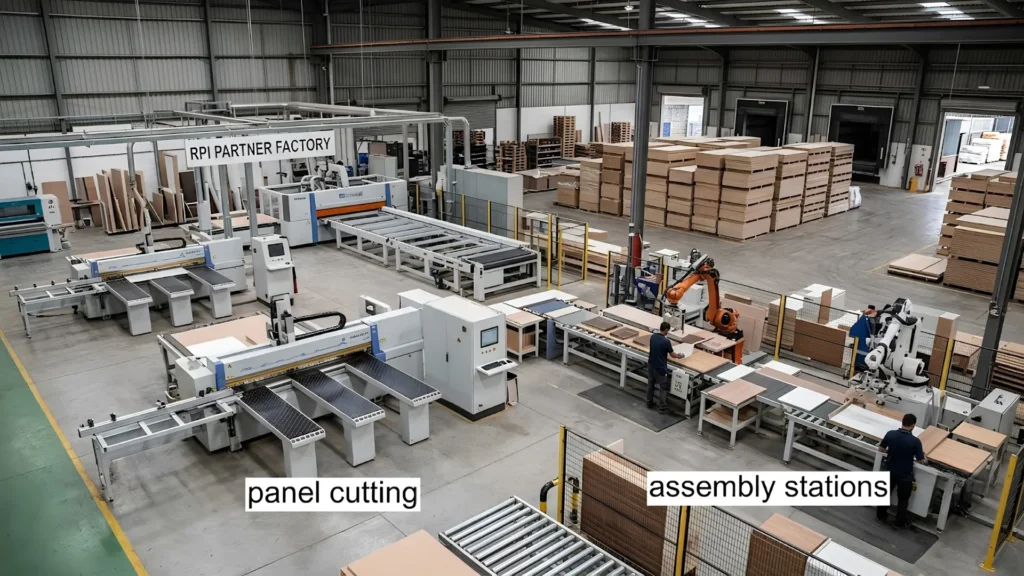
Whether you’re running an RTA (ready-to-assemble) furniture line, a cabinet factory, or a custom furniture workshop, material sourcing decisions ripple through every stage of production — cutting, finishing, assembly, and final compliance. This guide is a starting point for furniture manufacturers evaluating engineered wood material and supplier options, with links to deeper guides on each topic.
The Core Material Decision
Most furniture manufacturing runs on a mix of engineered wood panels rather than a single material:
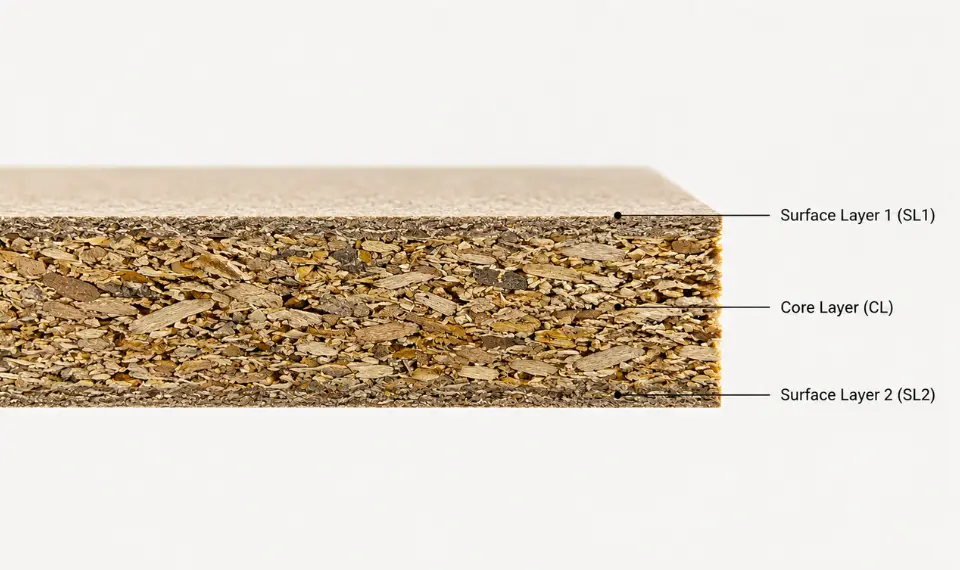
- Particle board with MFC finish — the standard for flat, high-volume panels: wardrobe carcasses, cabinet bodies, shelving. Pre-finished surface means no separate painting or laminating step.
- 中纤板(MDF) — the choice for painted finishes, routed detail, and thinner components.
- Melamine faced MDF (MFF) — MDF core with the same melamine finish as MFC, used where a smoother core or thinner panel (down to 2.5–3mm) is needed.
For a full technical comparison, see our guide on materials for furniture manufacturers, and our particle board vs plywood vs MDF breakdown if plywood is also part of your material mix.
Sourcing Considerations by Production Type
Different manufacturing models put different demands on material sourcing:
- RTA and flat-pack manufacturing — needs consistent thickness and edge quality across high-volume runs, since panels are cut and edge-banded at scale with tight tolerances.
- Cabinet and kitchen manufacturing — needs moisture-resistant (HMR) grade as standard for kitchen lines, plus colour consistency across large orders.
- Custom and hospitality furniture — often needs a wider colour/finish range and smaller, more flexible order volumes than high-volume commodity lines.
- Office and modular furniture — needs predictable specification for repeat orders across standardized product lines.
Certification and Compliance in Manufacturing
For manufacturers selling into regulated markets or supplying retailers with sourcing policies, material certification isn’t optional documentation — it determines which markets you can sell into and which retail partners will accept your product. This covers formaldehyde emission grades (E1, E0, E0S, CARB Phase 2/EPA), FSC-certified sourcing, and — for Indonesian government or BUMN-linked supply chains — TKDN compliance. See our full certifications guide for what each certification actually covers.
Building a Reliable Material Supply Chain
Material consistency across repeat orders is often the biggest operational risk in furniture manufacturing — a colour or thickness mismatch between production batches can hold up an entire order. Working with a supplier who can produce multiple core types (particle board, MFC, MDF/MFF) from one facility simplifies this, since colour matching and lead-time coordination happen with a single partner rather than across multiple vendors.
Sourcing from RPI for Furniture Manufacturing
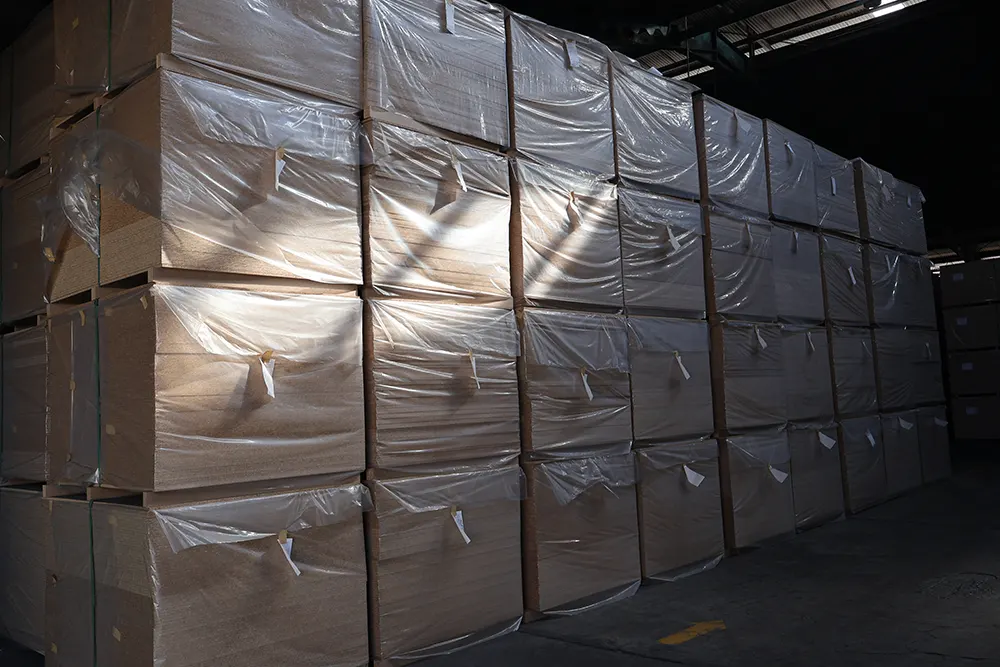
PT Rimba Partikel Indonesia (RPI) supplies particle board, MFC, and melamine faced MDF (MFF) from a single JIS-certified facility in Kendal, Central Java, established in 1990, backed by Sumitomo Forestry Group. Production runs on a Siempelkamp ContiRoll continuous press — the first installation of its kind in Asia — supporting consistent output across large manufacturing orders, with an in-house R&D Division for custom specification development.
Contact RPI’s team at admin-rpi@rimbapartikel.com 或 chat with us on WhatsApp to discuss material sourcing for your production line.
FAQ
What material is most cost-effective for furniture manufacturing at scale?
Particle board with an MFC finish is generally the most cost-efficient choice for high-volume flat-panel furniture, since the pre-finished surface removes a production step compared to raw board that needs painting or laminating separately.
Do furniture manufacturers need different material for export vs domestic sales?
Often yes — export markets frequently require specific formaldehyde emission certification (like CARB Phase 2 for the US), while domestic government or BUMN-linked sales in some countries may require local-content compliance like Indonesia’s TKDN.
Should a furniture manufacturer use one supplier for all core materials?
It simplifies quality and colour consistency across a product range, though it depends on whether a single supplier can reliably cover every material type (particle board, MDF, custom finishes) your production line needs.