

HDF vs MDF vs Particle Board: Complete Comparison Guide

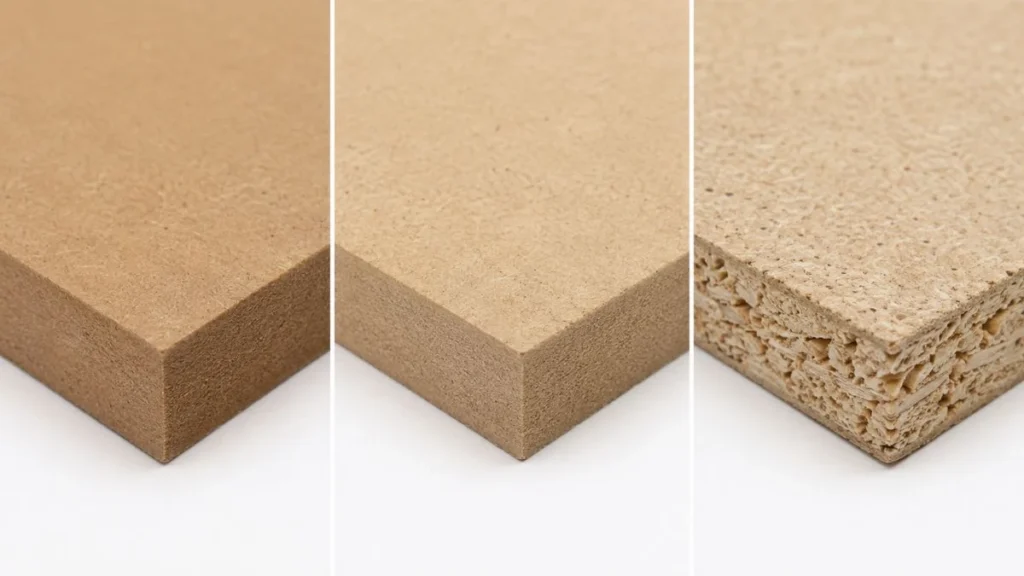
Cross-section comparison of HDF vs MDF vs Particle Board Complete Comparison Guide

If you’re weighing up HDF vs MDF vs particle board for furniture, cabinetry, or an interior project, you’ve run into three very similar-sounding engineered wood panels. They’re all made by binding wood material together under heat and pressure but the raw material, density, and performance differ enough that picking the wrong one can mean a project that warps, sags, or costs more than it needed to. For a related three way breakdown, see 刨花板与中密度纤维板与胶合板的区别. This guide focuses specifically on HDF, MDF, and particle board where each one performs best, and how to choose with confidence.

What Is HDF (High Density Fiberboard)?

HDF is made from fine wood fibers, similar to MDF, but compressed at a much higher density typically 800–1,000 kg/m³, compared to MDF’s 600–800 kg/m³. The result is a thinner, harder, and more rigid panel.

Key characteristics of HDF:

  • Very smooth, dense surface ideal for printing, laminating, or veneering
  • High resistance to impact and wear
  • Typically used in thinner sheets (2.5mm–8mm is common)
  • More expensive per cubic meter than MDF or particle board

Common uses: laminate flooring cores, door skins, high-traffic cabinet backs, pegboard, and packaging inserts where a thin but tough panel is needed.

What Is MDF (Medium Density Fiberboard)?

MDF is made from fine wood fibers combined with resin and wax, then pressed into panels. It sits between HDF and particle board in both density and cost.

Key characteristics of MDF:

  • Smooth, consistent surface with no visible wood grain
  • Machines cleanly ideal for routing, shaping, and detailed edges
  • Heavier than particle board at the same thickness
  • Needs additional finishing (paint, laminate, or veneer) since it has no decorative surface of its own

Common uses: painted furniture, decorative panels, molded or routed components, and cabinet doors with shaped profiles.

什么是刨花板?

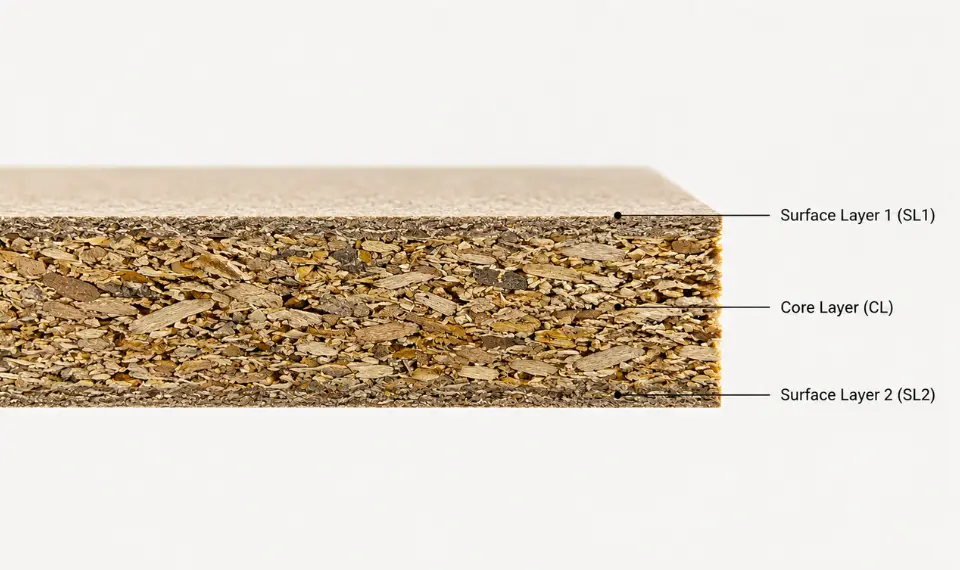
Particle board is made from wood chips and shavings coarser than the fibers used in MDF or HDF bonded with resin and compressed into sheets. This gives it a less uniform internal structure but makes it the most affordable of the three.

Key characteristics of particle board:

  • Lightweight relative to MDF and HDF
  • Lower cost per sheet
  • Often used as the core for MFC板 (melamine faced chipboard), which adds a decorative, scratch resistant surface layer
  • Less suited to fine machining or routing than MDF

Common uses: flat-pack furniture, kitchen and wardrobe cabinetry (usually melamine-faced), shelving, and office furniture.

HDF vs MDF vs Particle Board: Side by Side Comparison

因素HDF中纤板(MDF)刨花板
密度Highest (800–1,000 kg/m³)Medium (600–800 kg/m³)Lowest (450–750 kg/m³)
表面平整度 / 表面光滑度Very smoothSmooth, grain-freeSlightly rougher, usually covered
Machining/routingGood for thin profilesExcellent best for detailed shapingLimited best for straight cuts
重量Heavy for its thickness重型Lightest
防潮性能Moderate (HMR grades available)Moderate (MR grades available)Lowest (HMR grades available)
Typical costHighest per m³中型最低
最适合用于Flooring cores, door skins, thin tough panelsPainted/shaped furniture, decorative panelsBudget furniture, melamine faced cabinetry

Which One Should You Choose?

  • Choose HDF if you need a thin, hard-wearing panel laminate flooring, door skins, or cabinet backs that take daily wear.
  • Choose MDF if your project needs routing, curved profiles, or a paint-ready surface decorative mouldings, shaped cabinet doors, skirting.
  • Choose particle board if cost-efficiency matters most and the panel will be covered with a melamine faced surface flat-pack furniture, wardrobes, and standard kitchen cabinetry. For a deeper look at where particle board outperforms other engineered wood options overall, read Engineered Wood vs Particle Board.

For humid climates or kitchen/bathroom use, look for the moisture-resistant (HMR/MR) grade in any of the three standard grades of all three are sensitive to prolonged moisture exposure.

常见问题解答

Is HDF stronger than MDF?

HDF is denser and harder than MDF, making it more resistant to impact and wear, but MDF is generally preferred where machining and shaping matter more than surface hardness.

Is particle board cheaper than MDF and HDF?

Yes, particle board is typically the most affordable of the three, which is why it’s the standard core material for cost-efficient, melamine-faced furniture.

Can particle board be as durable as MDF or HDF?

With a quality melamine-faced surface and the right grade (such as HMR particle board for moisture-prone areas), particle board can match or exceed the practical durability of MDF for furniture applications at a lower cost.

What is HDF board used for in furniture?

Manufacturers mostly use HDF for thin functional components, such as cabinet backs, drawer bottoms, and door skins, rather than as a primary structural panel like MDF or particle board.

Need particle board or MFC board for your next project?

PT Rimba Partikel Indonesia has been manufacturing high-quality 刨花板 and MFC board since 1990, based in Semarang, Central Java. RPI is certified by JIS (Japan Industrial Standard) since 2007, uses 95% planted-tree wood with 5% FSC-certified material, and runs a 9-feet wide ContiRoll press by Siempelkamp (Germany) the first of its kind in Asia for consistent, large format board production. Whether you need standard, HMR (moisture-resistant), or melamine-faced particle board, RPI supplies furniture manufacturers and interior contractors worldwide. Contact RPI to discuss your project →

滚动至顶部