


Quick answer: Particle board and OSB (Oriented Strand Board) are both engineered wood panels, but they’re built differently and suited to different jobs. Particle board is made from small wood particles pressed into a smooth, uniform panel — ideal for furniture, cabinetry, and surfaces that will be laminated or veneered. OSB is made from larger wood strands layered in cross-oriented patterns, giving it more structural strength — making it the more common choice for construction applications like sheathing and subflooring.
Particle board and OSB are often confused because both are budget-friendly, wood-chip-based alternatives to plywood and solid timber. But they’re manufactured differently, they look and perform differently, and choosing the wrong one for your project can mean paying for strength you don’t need — or not getting the strength you do.
How They’re Made
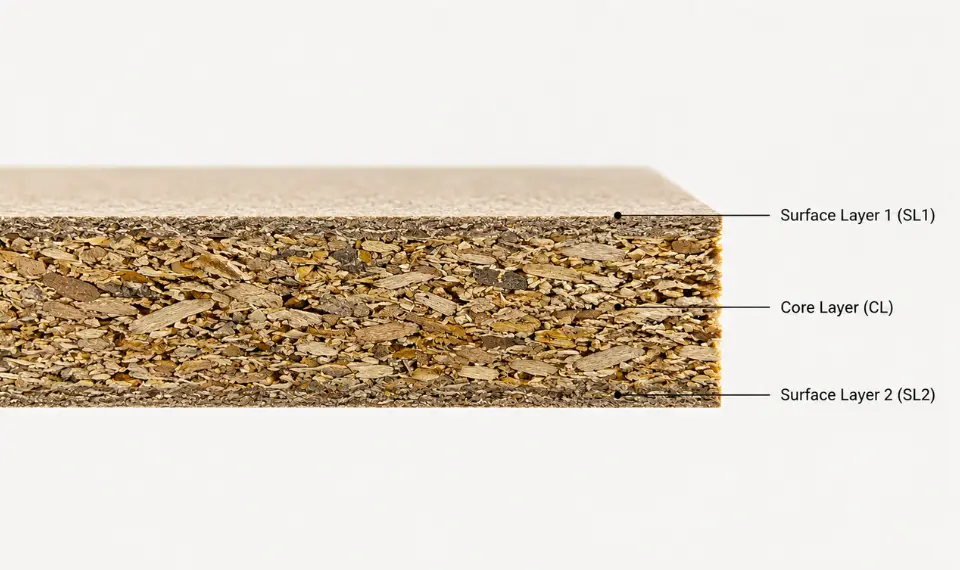
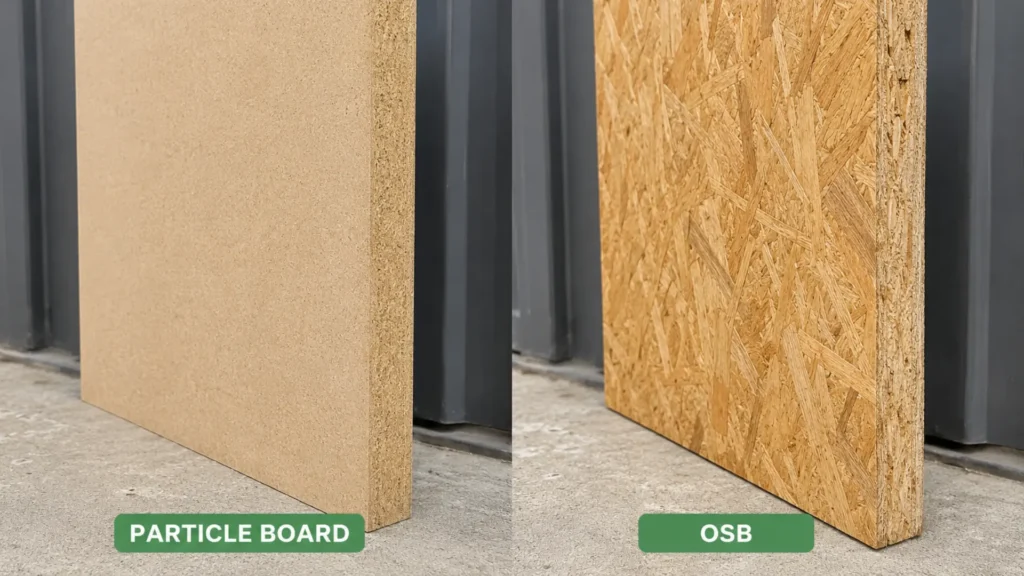
刨花板 is manufactured from small wood particles — sawdust-sized chips and shavings — mixed with resin and pressed under heat into a flat, uniform panel. The fine particles create a smooth, consistent surface that’s easy to laminate, veneer, or coat with melamine.
OSB is manufactured from larger wood strands, typically several centimeters long, arranged in cross-oriented layers (similar in principle to plywood’s cross-grain construction) before being bonded with resin and pressed. This layered, directional structure is what gives OSB its higher structural strength compared to particle board.
Key Differences at a Glance
| 刨花板 | OSB | |
|---|---|---|
| Raw material | Fine wood particles/sawdust | Larger wood strands |
| 表面 | Smooth, ready for laminate/melamine/veneer | Rougher, visible strand pattern |
| Structural strength | Lower — not typically load-bearing | Higher — used in structural applications |
| Typical use | Furniture, cabinetry, shelving, decorative panels | Wall/roof sheathing, subflooring, structural panels |
| Common finish | Melamine-faced (MFC), veneered, laminated | Usually left unfinished or painted |
| Density range | Approx. 0.40–0.90 g/cm³ | Generally similar range, strand-dependent |
When to Choose Particle Board
Particle board is the better choice when the panel’s final surface matters as much as (or more than) its raw structural strength — which describes most furniture and interior applications:
- Kitchen cabinets, wardrobes, and shelving where a melamine-faced or laminated finish is applied
- Flat-pack and modular furniture components
- Interior partitions and non-structural wall panels
- Any application where a smooth, paintable, or laminate-ready surface is required
When to Choose OSB
OSB is the better choice when the panel needs to carry structural load or resist racking forces, which is why it’s more common in construction than furniture manufacturing:
- Roof and wall sheathing
- Subflooring in residential construction
- Structural insulated panels (SIPs)
- Temporary construction hoarding and formwork
Why the Confusion Happens
Both materials are sometimes grouped together as “chipboard” in casual usage, and both sit in the same general price bracket relative to plywood and solid wood — which is likely why buyers researching one often end up comparing it to the other. The manufacturing difference (fine particles vs. large strands) is the clearest way to tell them apart, and it’s also the reason their ideal applications diverge: particle board’s fine, uniform structure suits decorative surfacing, while OSB’s layered strand structure suits structural performance.
For Furniture and Cabinetry, Particle Board and MFC Are the Right Fit
If your project involves furniture manufacturing, cabinetry, or any application where a laminated or melamine-faced finish is the end goal, particle board — and its melamine-faced version, MFC — is the more suitable material rather than OSB.
PT Rimba Partikel Indonesia (RPI) has manufactured particle board and MFC in Kendal, Central Java since 1990, certified to JIS A 5908:2022 standards and produced on a ContiRoll Siempelkamp continuous press. RPI supplies both raw particle board and melamine-faced MFC in standard and moisture-resistant (HMR) grades for furniture manufacturers and distributors worldwide.
To check current specs and availability, contact RPI’s team on WhatsApp.