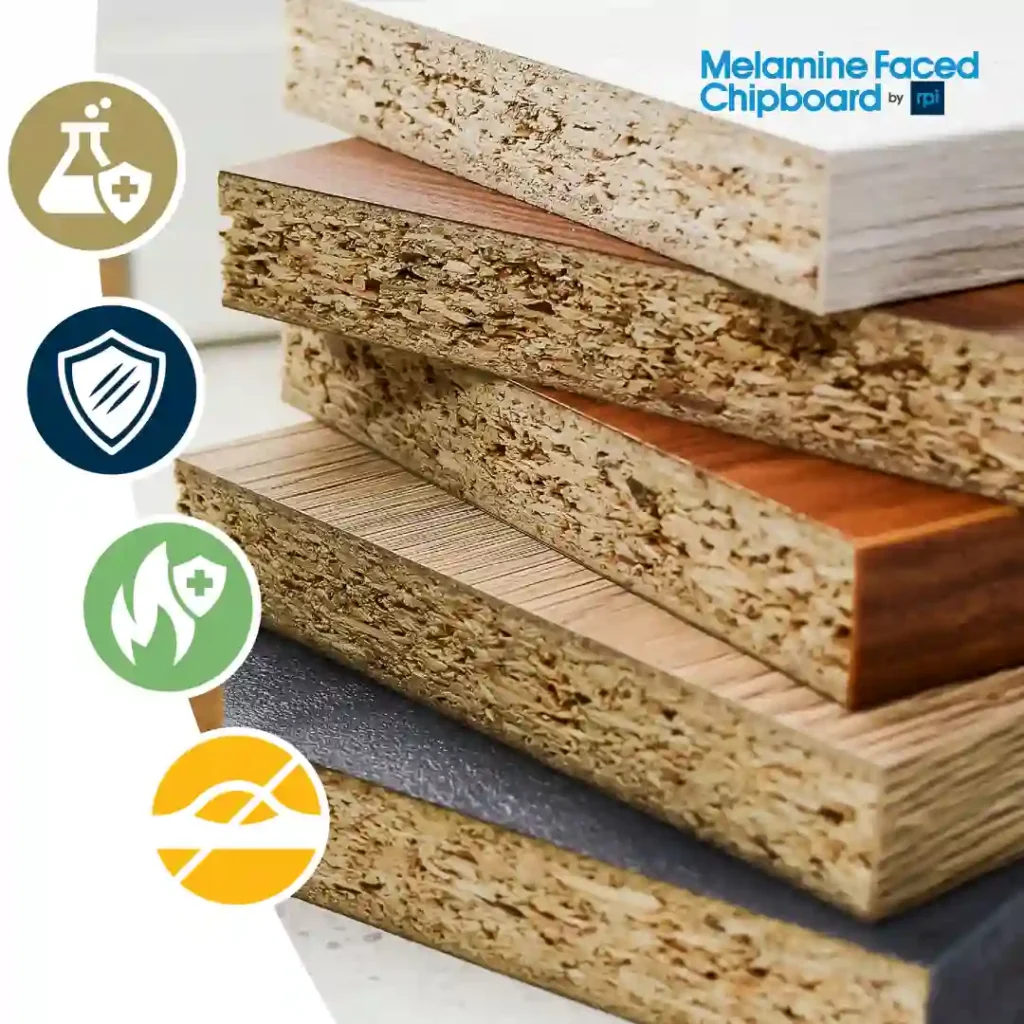



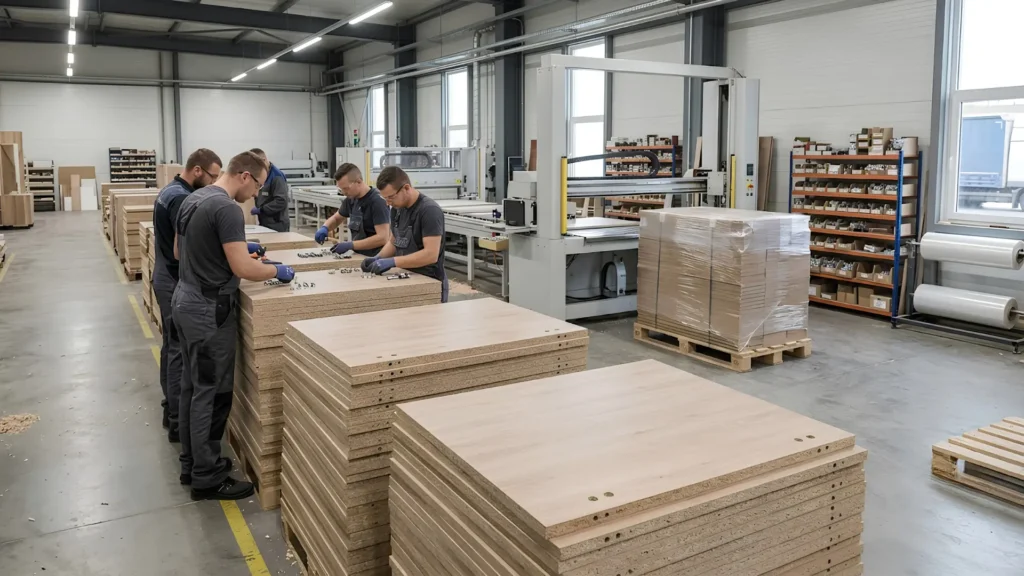
RTA (ready-to-assemble) and flat-pack furniture manufacturing depends on tight dimensional consistency, reliable screw-holding strength for repeated assembly/disassembly, and a pre-finished surface that survives flat-pack shipping without damage — particle board with an MFC finish is the standard specification for most RTA production.
RTA and flat-pack furniture puts specific demands on panel material that don’t apply to built-in or made-to-order furniture: the panels ship disassembled, get handled by the end customer during assembly, and rely on fittings rather than factory joinery for structural integrity. Material specification has to account for all of that, not just the finished look.
Why Dimensional Consistency Matters More for RTA
RTA furniture is designed around pre-drilled fitting positions and CNC-cut panel edges. If panel thickness or dimensions vary even slightly between production batches, pre-drilled holes and edge-banding machinery calibrated for one thickness won’t align correctly on the next batch — leading to assembly issues at the customer’s end, not just a factory-floor problem. This is why press technology matters for RTA manufacturers specifically: a continuous press producing consistent thickness across long runs reduces this risk more than older batch press systems.
Screw-Holding Strength for Repeated Assembly
Unlike built-in furniture assembled once by a professional, RTA furniture is often assembled — and sometimes disassembled and reassembled — by the end customer, sometimes more than once (moving house, reconfiguring a room). This makes screw-holding strength a bigger factor than in single-assembly furniture. Under JIS A 5908:2022, particle board is required to meet a minimum 400N screw-holding strength at 15mm+ thickness — a specification worth confirming explicitly with any supplier, since not all board meets it consistently at scale.
Surface Durability Through Flat-Pack Shipping
Flat-pack panels get handled, stacked, and shipped in ways that finished furniture typically doesn’t. A melamine (MFC) surface holds up well to this handling — it’s scratch- and impact-resistant by design — but panel edges are the more vulnerable point during flat-pack logistics. Specifying quality edge banding, and confirming panel edge condition as part of quality control before packing, reduces the return/replacement rate that can eat into RTA manufacturing margins.
Specification Checklist for RTA/Flat-Pack Manufacturing
- Core: standard particle board for most components; HMR for kitchen/bathroom RTA lines
- 厚度: commonly 15–18mm for carcass panels, with consistent thickness critical for pre-drilled fitting alignment
- 表面: MFC finish to avoid a separate painting/laminating step and provide shipping-resistant durability
- Screw-holding strength: confirm minimum 400N at your specified thickness, tested to JIS A 5908:2022 or equivalent
- Standard sheet sizes: aligning cutting plans to standard sheet sizes reduces waste and keeps unit costs predictable across large production runs
Common Mistakes in RTA Material Sourcing
- Switching suppliers between production runs without confirming thickness and density consistency, causing fitting alignment issues downstream
- Underspecifying screw-holding strength, leading to loosening fittings after repeated assembly/disassembly by end customers
- Skipping edge quality control before flat-pack shipping, increasing damage-related returns
- Not confirming standard sheet size compatibility with existing CNC cutting programs, adding unnecessary setup cost when switching suppliers
Sourcing RTA-Grade Material from RPI
PT Rimba Partikel Indonesia (RPI) produces particle board and MFC to JIS A 5908:2022 standards on a Siempelkamp ContiRoll continuous press — the first installation of its kind in Asia — supporting the thickness and density consistency RTA manufacturers need across large production runs. RPI’s standard sizes (3×6 to 4×9 ft, 6–30mm thickness) align with common RTA cutting plans, with FSC-certified material sourcing and JIS certification.
Contact RPI’s team at admin-rpi@rimbapartikel.com 或 chat with us on WhatsApp to discuss specification for your RTA or flat-pack production line.
FAQ
What panel material is best for flat-pack furniture manufacturing?
Particle board with an MFC (melamine) finish is the standard choice, since it arrives pre-finished (no additional painting or laminating step) and holds up well to the handling involved in flat-pack shipping.
Why does screw-holding strength matter more for RTA furniture than built-in furniture?
RTA furniture is typically assembled by the end customer using screws and fittings rather than factory joinery, and may be assembled or disassembled more than once — making consistent screw-holding strength across the panel more important for long-term reliability.
Does panel thickness consistency really affect RTA assembly?
Yes — RTA furniture relies on pre-drilled fitting positions calibrated to a specific thickness. Even small variations between production batches can cause fitting misalignment during customer assembly.