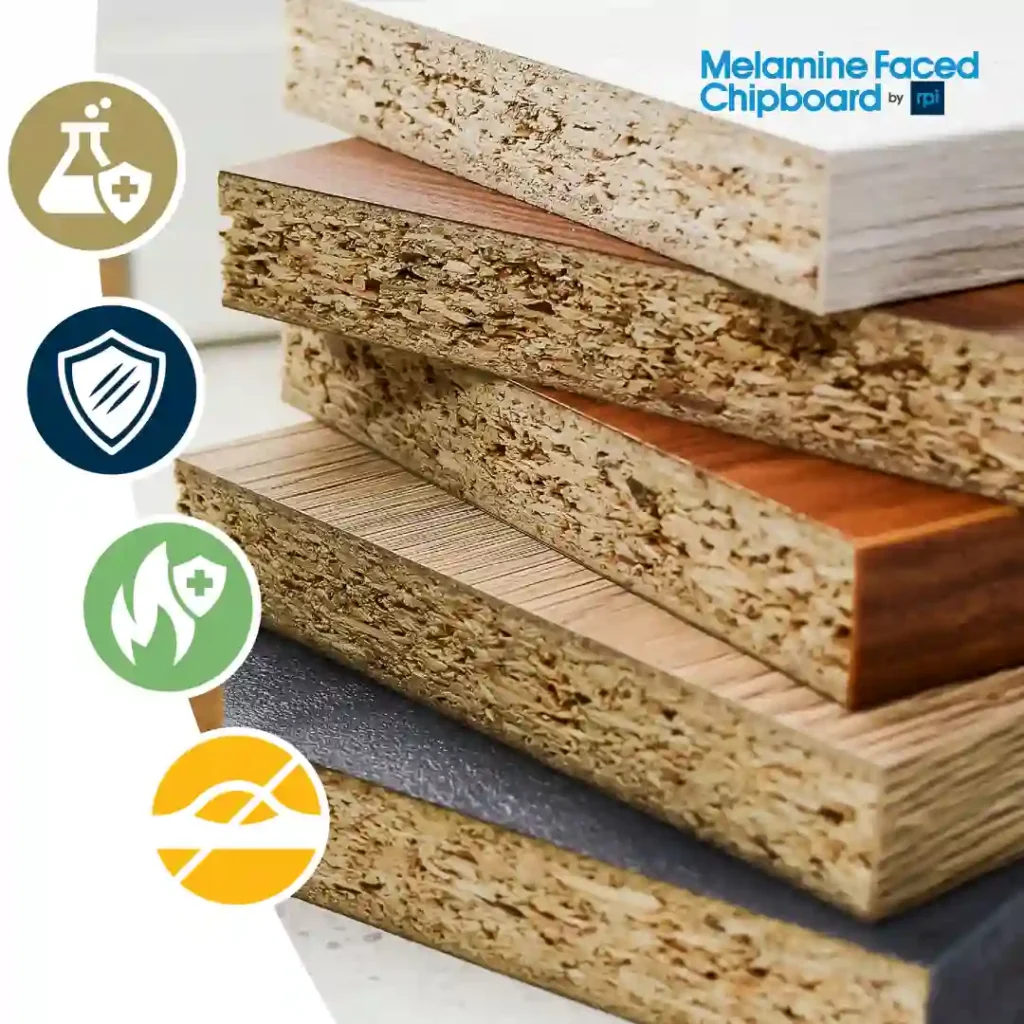



Melamine Faced MDF (MFF) is melamine surfacing applied to an MDF core instead of a particle board core — the same durable, pre-finished melamine surface as MFC, but on a smoother, denser base that supports thinner panels (down to 2.5–3mm) and finer edge detailing.
Melamine faced board isn’t limited to a particle board core. When a project calls for a thinner panel, a smoother substrate, or finer machined edges than particle board allows, MDF is the better core — and melamine faced MDF (MFF) delivers the same scratch-resistant, easy-to-clean melamine surface on that core. This guide covers what MFF is, how it differs from MFC, and where it fits.
What Is Melamine Faced MDF (MFF)?
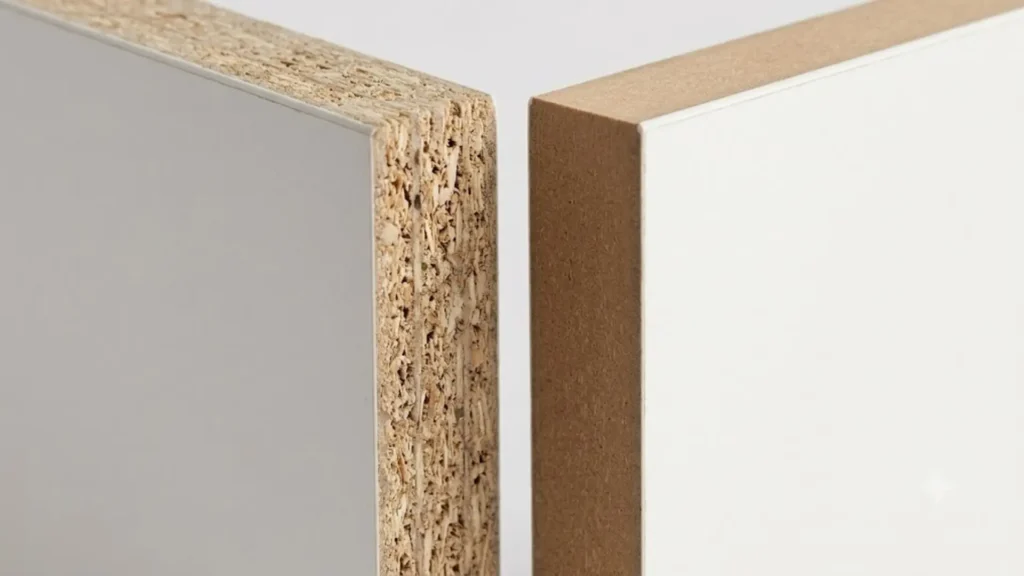
MFF is produced by bonding a decorative melamine resin layer onto an MDF (Medium-Density Fiberboard) core — the same lamination process used for MFC, applied to a different substrate. MDF is made from fine wood fibers bonded with resin, giving it a denser, smoother, and more uniform structure than particle board, which is compressed from larger wood particles.
That structural difference is what makes MFF useful in situations where MFC isn’t the right fit — particularly thinner panels and finer edge or surface detailing.
MFF vs MFC: What Actually Changes
| Faktor | MFC (particle board core) | MFF (MDF core) |
|---|---|---|
| Core material | Partikel Board | MDF (Medium-Density Fiberboard) |
| Minimum practical thickness | Thicker range, standard from 6mm | Can go down to 2.5–3mm |
| Surface smoothness of core | Baik | Higher — finer fiber structure |
| Edge/detail machining | Standar | Better suited to fine detail |
| Lamination | Typically double-sided | Available in the same double-sided finish; production handles the technical detail for thinner boards |
| Sourcing | Core produced in-house | Core sourced from external MDF supplier, melamine pressed in-house |
The melamine surface performance — scratch resistance, cleanability, colour range — is comparable between the two, since it’s the same lamination process. The choice between MFC and MFF comes down to the core, not the finish.
Why Choose Thin MFF (2.5–3mm)?
At 2.5mm or 3mm, MFF functions less like a structural board and more like a surfacing material — similar in role to HPL (High Pressure Laminate), applied as a top layer onto another panel or wood substrate rather than used as a standalone structural piece. This makes it useful for:
- Surfacing existing panels or substrates where a full-thickness board isn’t needed
- Applications where weight matters and a thinner faced layer is preferable to a full board
- Projects requiring a smooth, pre-finished surface without the added bulk of a thicker core
Because bending risk increases as the board gets thinner, laminating at this thickness takes careful process control — RPI’s production team manages the technical detail so the finished panel stays flat and stable.
HMR MDF Core: The Common Choice for Kitchen Applications
For kitchen and moisture-exposed applications, MFF built on HMR (moisture-resistant) MDF core — often referred to as “green MDF” for its distinctive core colour — is the standard specification. The moisture-resistant resin formulation in the MDF core matters here just as much as it does for HMR particle board: it’s what determines whether the panel holds up in a kitchen environment, not the melamine surface alone.
MFF Is a Custom Order Product
Unlike MFC, where RPI manufactures the particle board core in-house, MFF’s MDF core is sourced from an external vendor. This means MFF is produced to order rather than held as ready stock — availability depends on current MDF core stock with RPI’s supplier, and production timelines depend on that raw material availability.
Because specifications (core grade, thickness, single vs double-sided lamination, colour) vary significantly by project, the most efficient way to scope an MFF order is a direct conversation with RPI’s team rather than a fixed price list.
When to Choose MFF Over MFC
- You need a panel thinner than standard particle board thicknesses allow
- The application calls for a smoother core surface or finer edge machining
- You’re specifying a surfacing layer (similar role to HPL) rather than a structural board
- Your project already uses an MDF-based specification and needs a matching melamine finish
For structural furniture panels, wardrobes, and general cabinetry, standard MFC on a particle board core remains the more cost-efficient choice — MFF is the right call when the application specifically benefits from an MDF core.
FAQ
What’s the difference between MFC and MFF?
Both apply a melamine surface using the same lamination process — the difference is the core. MFC uses a particle board core; MFF uses an MDF core, which allows thinner panels and finer edge detailing.
Can MFF be laminated on both sides?
Yes — MFF is available with double-sided lamination, including at thinner thicknesses. The board gets more sensitive to handle as it gets thinner, so RPI’s production team manages the process to keep the finished panel flat and stable.
Is MFF available as ready stock?
No — MFF is a custom-order product, since the MDF core is sourced from an external vendor rather than produced in-house. Availability and lead time depend on current core stock and specification.
Get MFF Specified for Your Project
Interested in melamine faced MDF for your project? Because MFF specifications and lead times depend on current MDF core availability, contact RPI’s marketing team directly via WhatsApp atau admin-rpi@rimbapartikel.com to discuss thickness, core grade, and lamination requirements. For particle board core options, see our MFC board range, or see our guide on choosing an MDF board supplier if you’re evaluating options.