


Quick answer: MFC (Melamine Faced Chipboard) has a particle board core and is the standard choice for most furniture — cabinets, wardrobes, shelving. MFF (Melamine Faced Fiberboard/MDF) has a denser MDF core, machines more cleanly for detailed edges and profiles, and is available in thinner options down to 2.5–3mm for use as a surface layer. Both are melamine-faced products; the difference is what’s underneath the surface.
If you’ve come across both “MFC” and “MFF” while sourcing melamine-faced board, the similar names understandably cause confusion. Both are engineered wood panels finished with the same melamine-faced surface, but the material underneath that surface — and what that means for your application — is genuinely different.
The Core Difference: What’s Underneath the Melamine
Both MFC and MFF start the same way: melamine-impregnated decorative paper is pressed onto a substrate under heat and pressure, creating a hard, decorative, ready-to-use surface. The difference is the substrate itself.
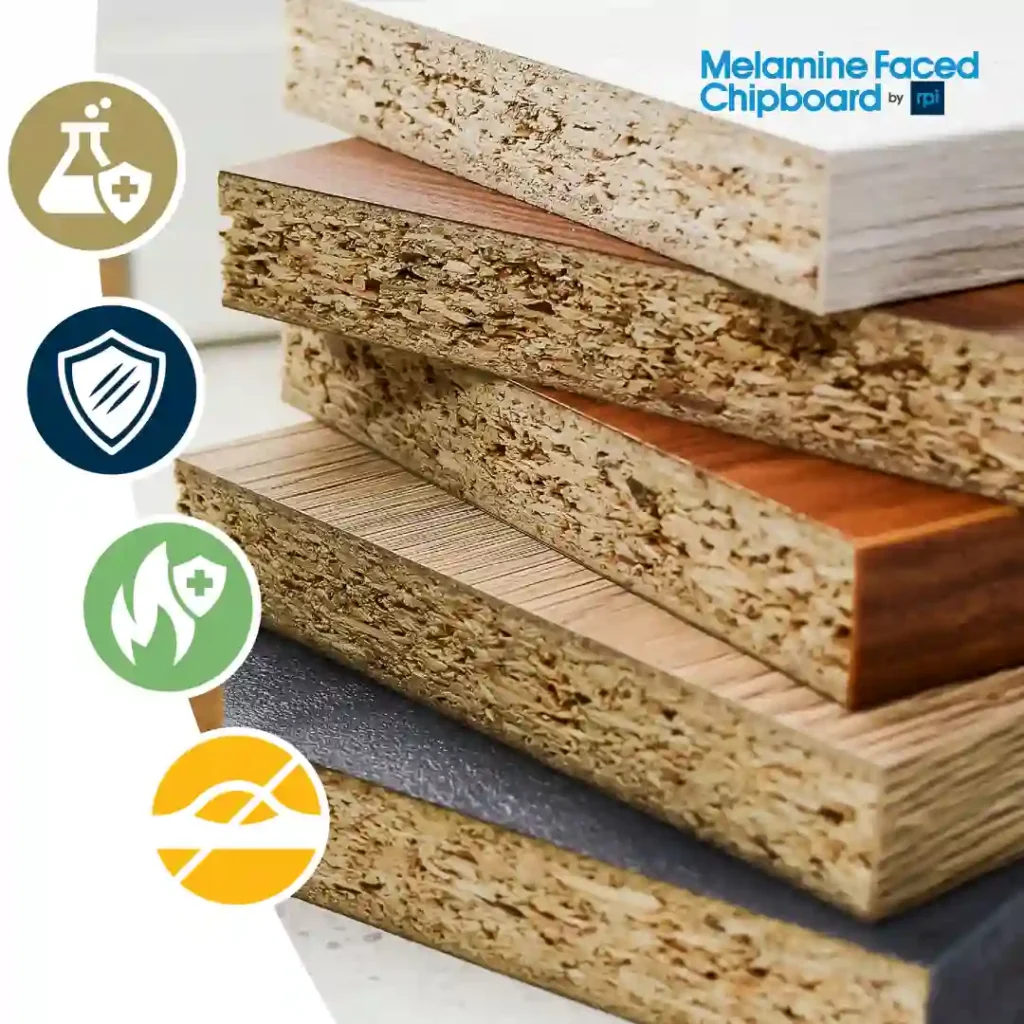
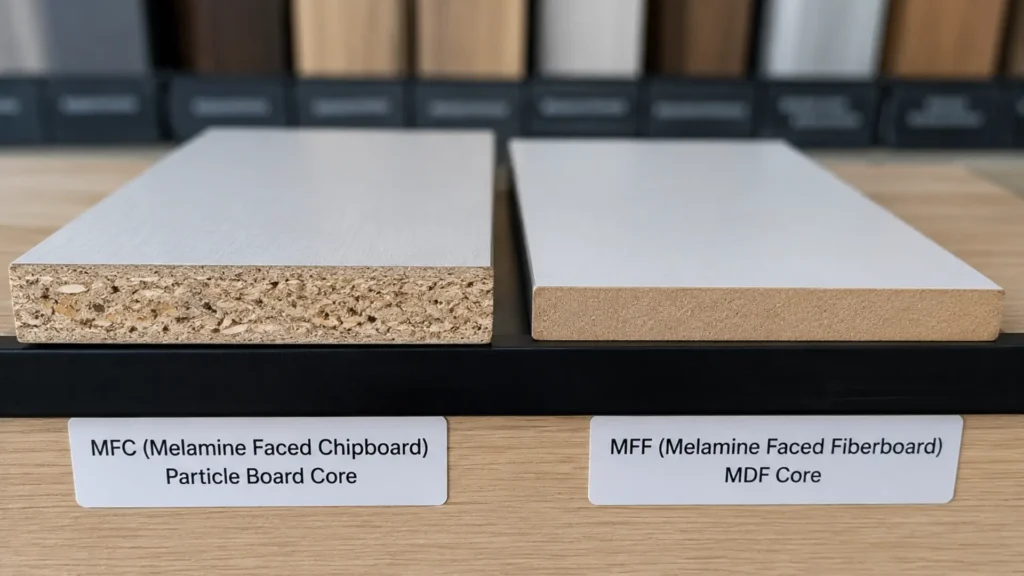
MFC (Melamine Faced Chipboard) uses a particle board core — wood particles bonded with resin and pressed into panels. This is RPI’s primary manufactured product, produced in-house since 2019 in partnership with AICA.
MFF (Melamine Faced Fiberboard, using an MDF core) uses a medium-density fiberboard core instead — finer wood fibers pressed to a denser, more uniform panel. Unlike particle board, RPI sources MDF core from an external vendor and then presses the melamine surface onto it in-house, using the same lamination process as MFC.
Comparing MFC and MFF
| Faktor | MFC (Particle Board Core) | MFF (MDF Core) |
|---|---|---|
| Core material | Particle board, manufactured in-house | MDF, sourced from external vendor |
| Permukaan | Melamine-faced, same process as MFF | Melamine-faced, same process as MFC |
| Density/uniformity | Standard particle board density | Denser, more uniform fiber structure |
| Thinnest option | Standard thickness range | As thin as 2.5–3mm |
| Edge/profile machining | Good for straight cuts | Cleaner for detailed edges and fine profiles |
| Order type | Ready stock and custom | Custom order only, subject to MDF vendor stock |
| Typical role | Standalone structural furniture panel | Often used as a thin surface layer over another substrate |
When MFC Is the Right Choice
MFC is the practical default for most furniture manufacturing:
- Cabinet carcasses, wardrobes, and shelving where the panel itself provides structure
- Applications needing standard to thick panel dimensions
- Projects where ready-stock availability and shorter lead times matter
- Cost-sensitive production runs at volume
When MFF Is the Right Choice
MFF’s denser MDF core and thinner options make it suited to different needs:
- Applications requiring a very thin, melamine-faced surface layer — MFF’s 2.5–3mm option functions similarly to HPL, applied as a top layer onto another panel or substrate rather than used as a standalone structural board
- Components where a smoother, denser core benefits fine edge detail
- Projects where the specific MDF core grade (RPI’s most-requested is HMR — often called “green MDF” — commonly used for kitchen set interiors) fits the application’s moisture exposure
Because MFF is a custom-order product dependent on external MDF vendor stock, lead times and exact specifications should be confirmed directly with RPI’s team rather than assumed from a general guide — availability varies by current vendor stock levels.
Is MFC Better Than MFF?
Neither is universally “better” — they solve different problems. MFC is the standard structural panel choice for the majority of furniture applications, offering broader stock availability and standard thickness ranges. MFF earns its place specifically where a thin, dense, melamine-faced surface layer is needed, or where MDF’s finer core structure benefits the application. Most furniture manufacturers use MFC as their primary material and consider MFF for specific components where its thinner profile or denser core is genuinely required.
Sourcing Both, From One Manufacturer
PT Rimba Partikel Indonesia (RPI) produces both MFC and MFF in Kendal, Central Java, using the same melamine lamination process on the same production line — MFC with an in-house-manufactured particle board core, and MFF with an externally sourced MDF core. This means consistent surface quality across both products, whichever core your application calls for.
Since MFF availability depends on current MDF vendor stock, contact RPI’s team on WhatsApp to confirm current lead times and specifications for your order.