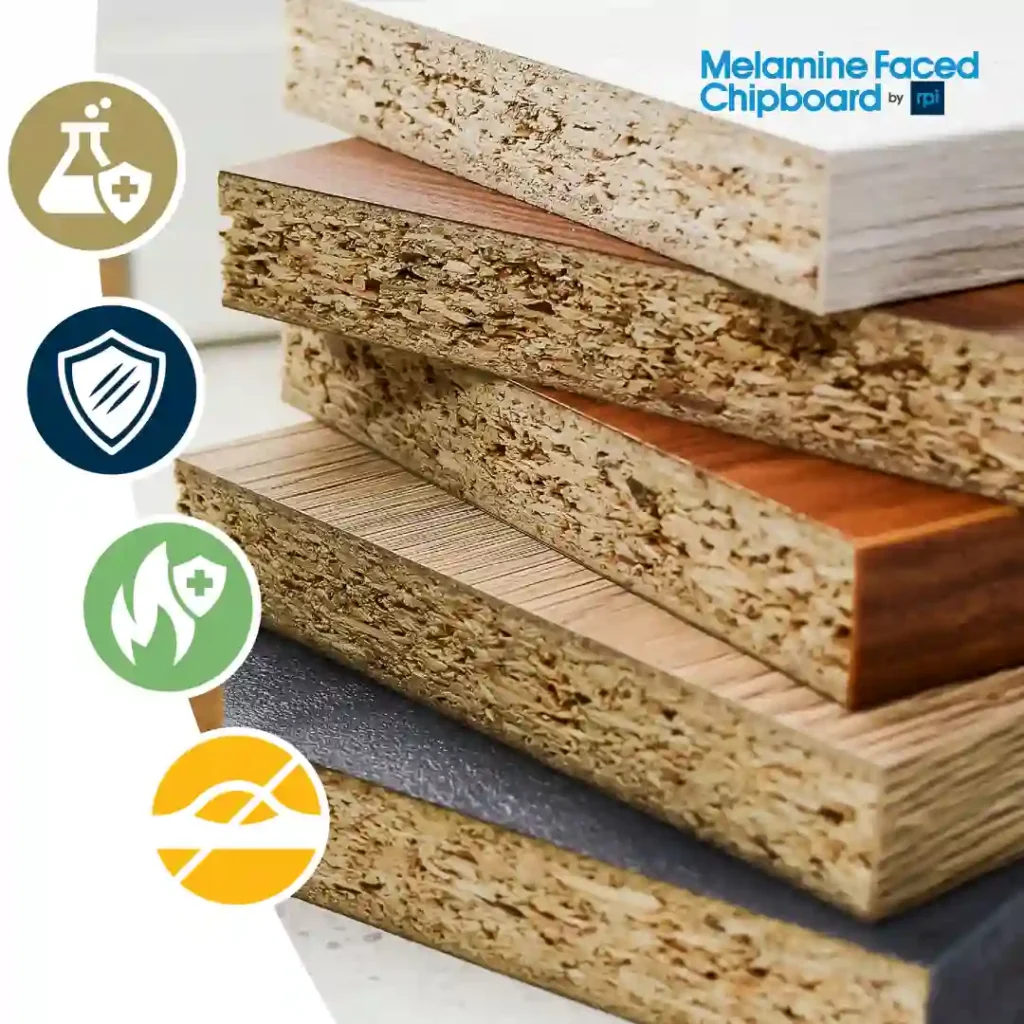



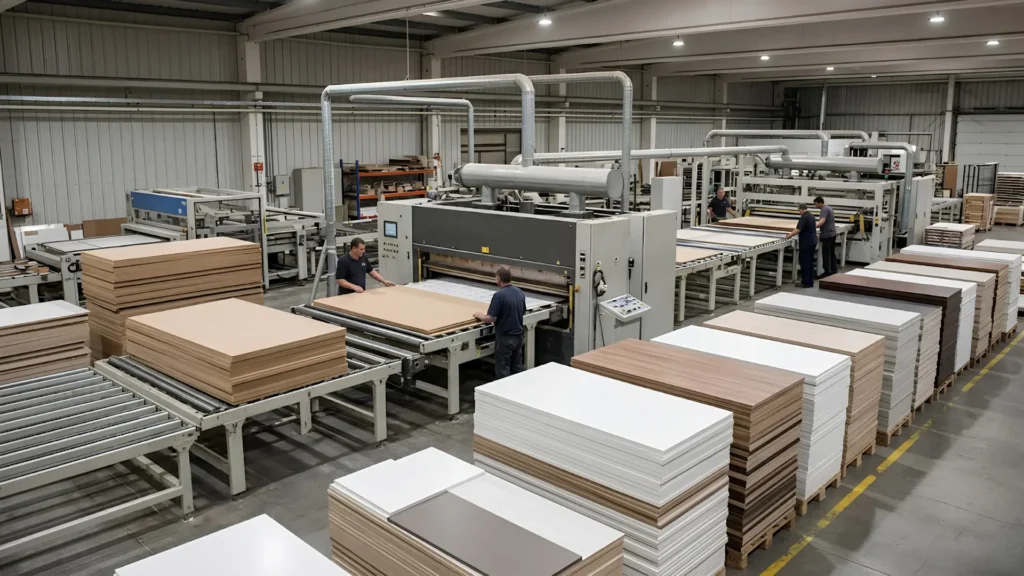
Choosing an MDF board supplier for melamine-faced (MFF) panels comes down to four factors: core grade options (standard vs HMR/moisture-resistant), thickness range including thin specifications, lamination consistency, and how clearly they communicate custom lead times — since MDF-core melamine panels are typically made to order rather than held as ready stock.
If you’re sourcing melamine-faced MDF panels — whether for kitchen sets, furniture, or interior fit-outs — the supplier relationship works differently than sourcing a stocked commodity. Because the MDF core itself is usually sourced from a separate vendor before lamination, supplier reliability depends as much on how they manage that supply chain as on the lamination quality itself. Here’s what to check.
What to Look for in an MDF/MFF Supplier
Core Grade Range
Standard MDF suits dry, low-moisture applications, but a large share of real-world demand — especially kitchen sets — calls for HMR (High Moisture Resistant) MDF, often recognizable by its green-tinted core. A supplier that only offers standard grade limits what you can specify for moisture-exposed furniture.
Thickness Range, Including Thin Specifications
MDF supports a wider thickness range than particle board, including thin boards (down to 2.5–3mm) used more like a surfacing layer than a structural panel. If your project needs a thin, melamine-faced surface layer rather than a full-thickness board, confirm the supplier can actually produce at that thickness — not every lamination line can handle it well.
Lamination Consistency
Melamine lamination onto MDF requires careful process control, particularly at thinner thicknesses where the board is more sensitive to handle. Ask how the supplier manages this — a supplier that can speak concretely about their process (rather than just confirming “yes we can do it”) is a better sign of real production capability.
Clear Custom Lead Times
Because MDF-core melamine board is generally produced to order — the core itself often sourced from an external vendor before lamination — lead time depends on that vendor’s stock availability as much as the supplier’s own production schedule. A reliable supplier will be upfront about this dependency rather than quoting a fixed lead time that doesn’t account for it.
Questions to Ask Before Committing
- What MDF core grades do you offer, and do you stock HMR/moisture-resistant as standard?
- What’s the thinnest board you can laminate reliably, and can it be done double-sided?
- Is your MDF core sourced in-house or from an external vendor — and how does that affect lead time?
- What’s your typical lead time for a custom MDF/MFF order, from confirmation to shipment?
- Can you match colour and finish consistency with an existing particle-board-core (MFC) order, if I’m using both?
Red Flags When Evaluating Suppliers
- Vague answers about MDF core sourcing or grade options
- No clear explanation of how thin they can laminate, or unwillingness to discuss production limits
- Fixed lead-time promises that don’t acknowledge external MDF supply dependency
- Reluctance to explain how double-sided lamination is achieved at thinner thicknesses
RPI as an MDF/MFF Supplier
PT Rimba Partikel Indonesia (RPI) produces melamine faced MDF (MFF) by sourcing MDF core from an external vendor and laminating it in-house at its JIS-certified facility in Kendal, Central Java, established in 1990. RPI’s MFF range covers standard and HMR (moisture-resistant, commonly “green MDF”) core, including thin specifications down to 2.5–3mm — RPI’s production team manages the technical process required to laminate reliably at that thickness. Because MFF is a custom-order product dependent on current MDF core availability, RPI checks vendor stock and confirms production timelines directly with each order rather than quoting from a fixed catalogue.
Get an MDF/MFF Quote from RPI
Sourcing melamine-faced MDF for your project? Because specification and lead time depend on current MDF core availability, contact RPI’s marketing team directly via WhatsApp atau admin-rpi@rimbapartikel.com to discuss core grade, thickness, and timeline. For particle-board-core melamine panels (MFC), see our MFC board range; for more on how MFF compares to MFC, see our melamine faced MDF guide.
FAQ
Is MDF board always in stock, or made to order?
Melamine-faced MDF (MFF) is generally made to order, since the MDF core is typically sourced from an external vendor before lamination — unlike particle-board-core MFC, which can be produced from in-house stock.
What MDF grade is best for kitchen cabinets?
HMR (High Moisture Resistant) MDF — often called “green MDF” for its core colour — is the standard choice for kitchen and other moisture-exposed applications, rather than standard-grade MDF.
Can a supplier laminate MDF as thin as 2-3mm?
Not every supplier can do this reliably — thinner boards require more careful process control. Ask specifically about their thinnest reliable lamination thickness rather than assuming standard capability extends that far.