


Particle board, plywood, and MDF are all engineered wood panels but differ in strength, surface finish, and cost. Particle board suits flat furniture panels and budget projects, plywood suits structural and load-bearing uses, and MDF suits detailed, paintable surfaces — the right choice depends on the application, not which material is “best” overall.
If you’re sourcing panels for furniture, cabinetry, or construction, these three materials come up constantly — and they’re often compared as if one is simply “better” than the others. In practice, each is engineered differently and suits different jobs. This guide breaks down how they compare so you can match the material to your project instead of guessing.
What Each Material Actually Is
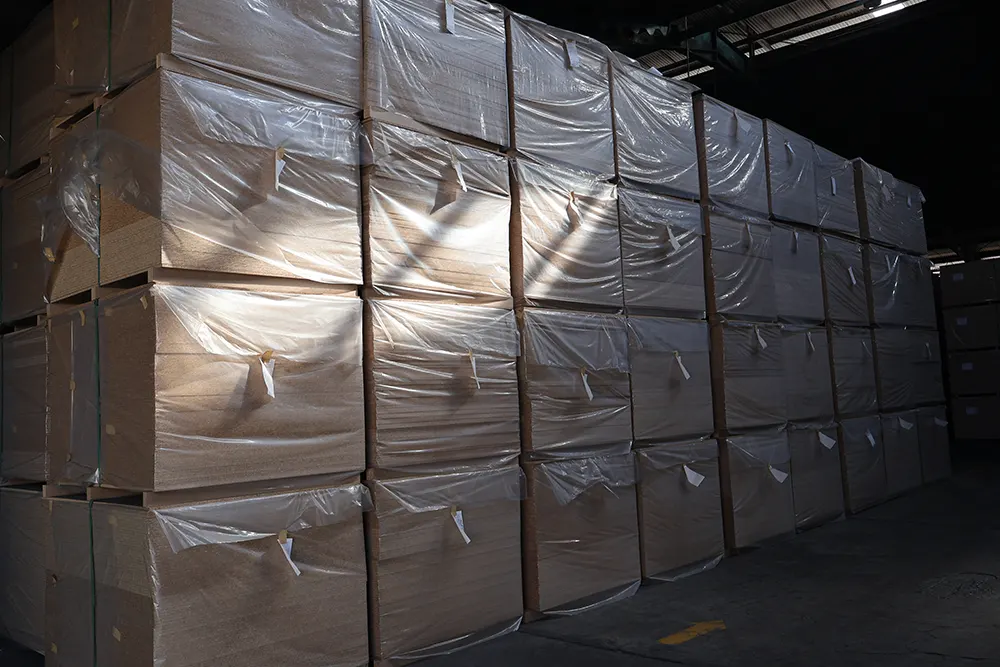
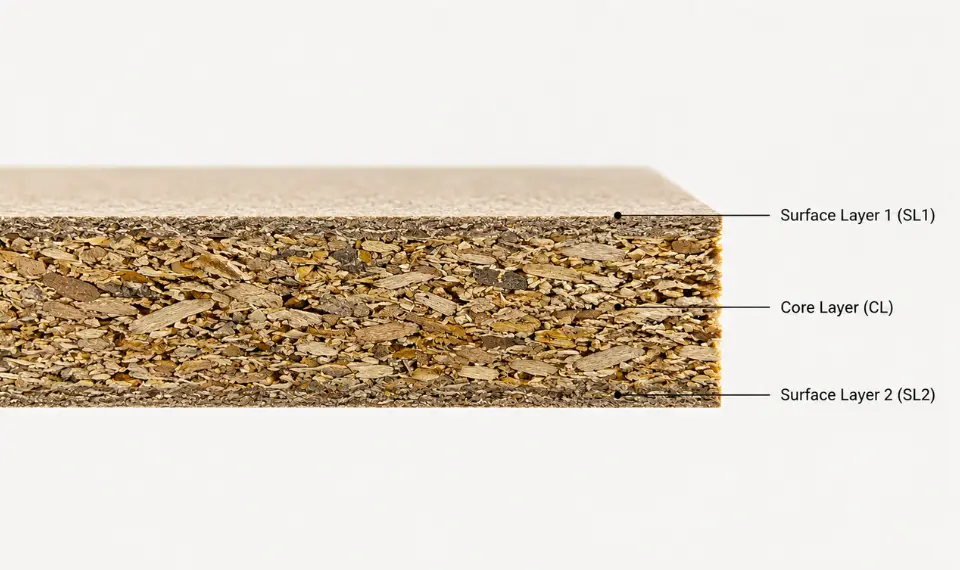
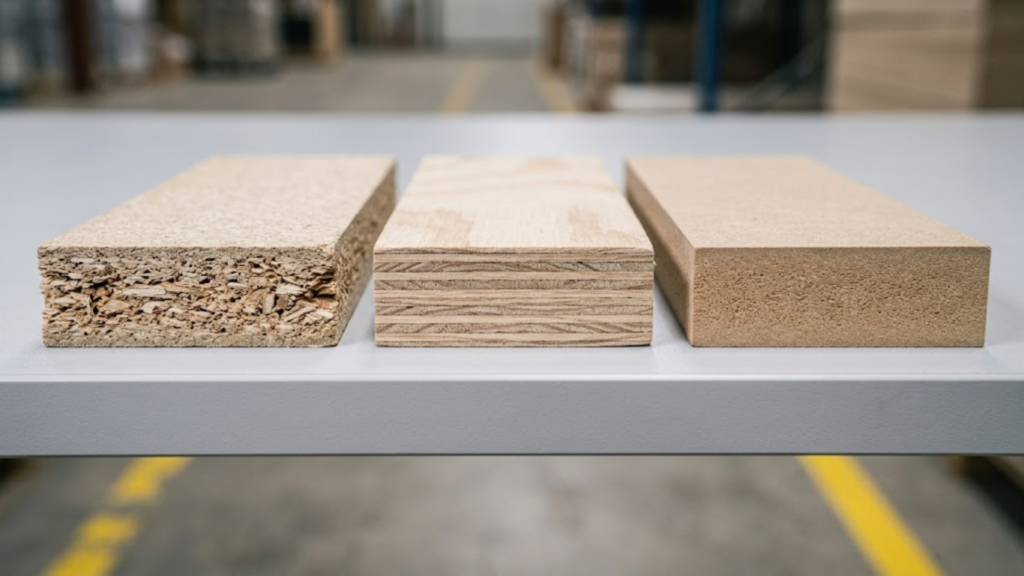
Particle board is made by compressing wood particles and resin under heat and pressure. It has a relatively uniform, flat core, which makes it ideal for large flat panels.
Plywood is made from thin layers (plies) of wood veneer glued together with the grain direction alternating between layers. This cross-grain structure gives plywood higher strength and better screw-holding than particle board or MDF.
MDF (Medium-Density Fiberboard) is made from wood fibers (finer than particle board’s wood particles) bonded with resin under heat and pressure. It has a smooth, dense, uniform surface, which makes it excellent for painted finishes and detailed machining like routing.
For a closer look at particle board specifications and grades, see our particle board product range.
Side-by-Side Comparison
| Factor | Particle Board | Plywood | MDF |
|---|---|---|---|
| Strength / load-bearing | Lower | Highest | Medium |
| Screw-holding strength | Moderate (min. 400N at 15mm+ under JIS) | Highest | Moderate |
| Surface smoothness | Good with melamine/laminate face | Visible wood grain, less uniform | Excellent, ideal for paint |
| Weight | Moderate | Lighter for equivalent strength | Heaviest |
| Cost | Lowest | Highest | Mid-range |
| Moisture resistance | Poor unless HMR grade | Better, especially marine-grade | Poor unless moisture-resistant grade |
| Best surface finish | Melamine (MFC), laminate | Veneer, paint, stain | Paint, routed detail |
When to Choose Particle Board
- Flat furniture panels: wardrobes, cabinet carcasses, shelving
- Projects where a melamine (MFC) finish is the end surface — particle board is the standard core for MFC
- Budget-sensitive, high-volume furniture production
- Applications where the panel will be fully faced (not left exposed)
When to Choose Plywood
- Structural or load-bearing applications: flooring substrates in high-load areas, shelving with heavy or uneven loads
- Curved or moldable panel applications, since plywood can bend more than particle board or MDF
- Outdoor or higher-moisture applications, especially with marine-grade plywood
- Anywhere screw-holding strength under repeated stress matters most
When to Choose MDF
- Detailed edge profiles, routed designs, or painted furniture where a perfectly smooth surface matters
- Cabinet doors and trim where paint (not laminate) is the intended finish
- Projects needing consistent density throughout the panel, with no internal voids
Choosing by Application, Not by “Best” Material
A common mistake is treating this as a single winner-takes-all comparison. In practice:
- A wardrobe carcass with an MFC finish → particle board core is standard and cost-effective
- A kitchen cabinet door meant to be painted → MDF gives the cleanest result
- A structural shelf under heavy, uneven load → plywood’s cross-grain strength wins
- A humid-area application (kitchen, bathroom) → whichever material you choose, specify the moisture-resistant (HMR) grade rather than standard
For particle board specifically, RPI produces to JIS A 5908:2022 standards across a range of thicknesses (6–30mm) and emission grades (E2 through CARB Phase 2/EPA-compliant), so the “particle board” column above reflects a wide performance range depending on the grade specified — not a single fixed standard.
FAQ
Is particle board weaker than plywood?
Yes, generally — plywood’s cross-grain layered structure gives it higher strength and screw-holding capacity. Particle board is still suitable for flat, evenly-loaded furniture panels, just not for high-stress structural applications.
Is MDF better than particle board for furniture?
Neither is universally “better” — MDF suits painted, detailed furniture, while particle board (especially with an MFC finish) suits cost-efficient flat panels with a durable, pre-finished surface that doesn’t need painting.
Can particle board be used for flooring like plywood?
Particle board is used in flooring, typically as a subfloor/underlayment layer or in lower-load residential applications, but plywood is generally preferred for higher-load or long-span flooring. See our guide on particle board as subfloor and underlayment for details.
Get the Right Material for Your Project
Not sure which core material fits your project? Contact RPI’s team at admin-rpi@rimbapartikel.com or chat with us on WhatsApp — we can help match the specification (thickness, grade, core type) to your application. RPI is a JIS-certified manufacturer based in Kendal, Central Java, established in 1990, producing particle board and MFC with FSC-certified materials.