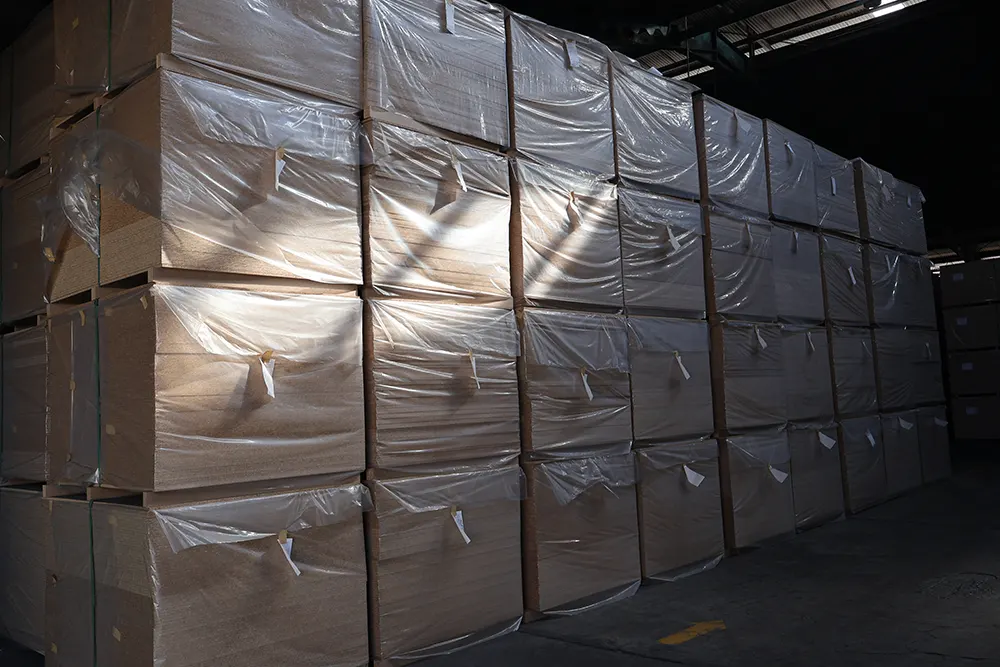



18mm chipboard flooring is one of the most widely used materials for flooring underlayment and subfloor construction in residential and commercial projects. It offers a practical balance of structural performance, cost efficiency, and ease of installation — making it a standard specification across a wide range of flooring applications.
This guide covers everything you need to know: what 18mm chipboard flooring is, how it compares to other thicknesses, load capacity, moisture resistance options, installation requirements, and what to look for when sourcing it.
What Is 18mm Chipboard Flooring?
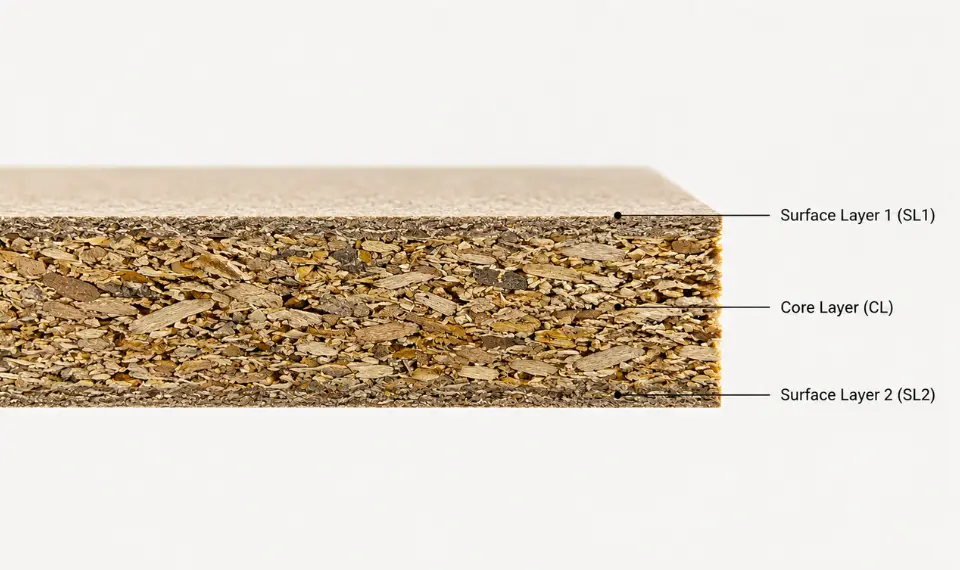
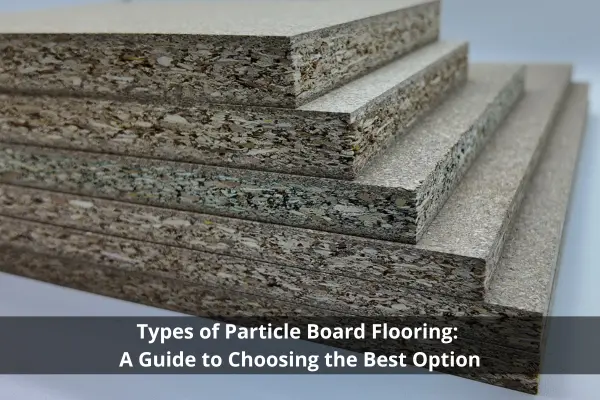
Chipboard flooring — also called particle board flooring or P5 flooring board — is an engineered wood panel manufactured from compressed wood chips and resin binders, pressed under heat and high pressure into flat sheets. When used as flooring, it serves as either a subfloor base or an underlayment layer beneath the final floor finish.
18mm is the most commonly specified thickness for chipboard flooring because it provides sufficient stiffness and load-bearing performance across standard joist spacings of 400mm to 600mm, without being unnecessarily heavy or expensive.
Why 18mm Is the Most Common Specification
Chipboard flooring is available in several thicknesses — typically 15mm, 18mm, 22mm, and 25mm. Each has its place depending on joist spacing and load requirements.
| Thickness | Joist Spacing | Load Application |
|---|---|---|
| 15mm | Up to 450mm | Light residential, low traffic |
| 18mm | Up to 600mm | Standard residential flooring |
| 22mm | Up to 600mm | Heavy residential, light commercial |
| 25mm | Up to 600mm | Heavy commercial, high load |
18mm hits the practical sweet spot for most residential applications — strong enough for standard spans, light enough to handle easily, and cost-effective compared to thicker alternatives.
For joist spacings greater than 600mm or heavy commercial load applications, 22mm should be specified instead.
P4 vs P5: Which Grade for Flooring?
Not all chipboard is suitable for flooring. The European standard EN 312 classifies chipboard into grades based on application. For flooring specifically, two grades are relevant:
P4 — Load-Bearing Chipboard for Dry Conditions
For use in dry environments where moisture is not a concern. Standard grade, lower cost.
P5 — Load-Bearing Chipboard with Moisture Resistance (HMR)
This is the grade commonly specified for flooring, particularly in the UK and markets following European standards. P5 chipboard has a moisture-resistant core — identifiable by its green-tinted cross-section — which prevents swelling and structural degradation in conditions where humidity fluctuates, such as ground floor installations.
For flooring applications in tropical climates like Indonesia, we strongly recommend using P5 equivalent (HMR grade) as the minimum specification.
Full guide: What is HMR Particle Board and when should you use it? →
Key Specifications: 18mm Chipboard Flooring
| Property | Specification |
|---|---|
| Thickness | 18mm (±0.3mm tolerance) |
| Standard sheet size | 2400 x 600mm (T&G) or 2440 x 1220mm |
| Density | 640–700 kg/m³ (P5/HMR grade) |
| Weight per sheet (2400×600) | Approx. 16–17 kg |
| Maximum joist spacing | 600mm |
| Edge profile | Tongue and groove (T&G) or square edge |
| Moisture resistance | P5/HMR grade recommended for flooring |
| Standard | EN 312, JIS A 5908 |
Tongue and Groove vs Square Edge
18mm chipboard flooring is available in two edge profiles:
Tongue and Groove (T&G)
Manufacturers design the long edges with a tongue on one side and a groove on the other, allowing the panels to interlock when installed side by side.This creates a stronger, more rigid floor with better load distribution between panels. T&G is the standard for flooring applications — it prevents differential movement between panels under load and gives a smoother, more stable finished surface.
Square Edge
Straight edges with no interlocking profile. This panel works well in applications where all edges are supported and tongue-and-groove (T&G) joints are unnecessary.
Less common for flooring but used in some flat-roof decking and industrial applications.
For residential and commercial flooring underlayment, always specify tongue and groove 18mm chipboard.
Load Capacity and Structural Performance
An 18mm P5 chipboard floor installed over 600mm joist centres can support standard floor loads, including approximately 1.5 kN/m² for residential applications and up to 2.0–2.5 kN/m² for light commercial environments.
Factors that affect load performance:
- Joist spacing: Closer spacing (400mm) significantly increases effective load capacity
- Support at all edges: Panels should be fully supported at all edges — unsupported edges reduce stiffness
- Adhesive between panels: Using flooring adhesive at T&G joints substantially improves rigidity and reduces squeaking over time
- Moisture content at installation: Installing chipboard flooring that has absorbed moisture leads to swelling and squeaking after the floor dries — always store panels flat and dry before installation
Moisture Resistance: Why It Matters for Flooring
Flooring is one of the most demanding applications for chipboard in terms of moisture exposure — particularly ground floor installations, rooms above garages, and any area near plumbing.
Standard chipboard (P4 grade) is not suitable for these environments. When standard particle board absorbs moisture, it swells — primarily at the edges — and can lose significant structural integrity. Once swollen, it does not fully recover when dried.
P5/HMR chipboard resists this process through a denser resin system that reduces water uptake. The green-tinted core of HMR board is the identifying marker — if the cross-section is pale beige or yellow, it is standard board, not HMR.
For all ground floor applications and bathrooms, specify P5/HMR 18mm chipboard as a minimum.
Installation Guide: 18mm Chipboard Flooring
1. Storage and acclimatisation
Store panels flat, dry, and off the ground for at least 48 hours before installation. Chipboard that absorbs moisture from storage will swell after installation.
2. Joist preparation
Check that all joists are level within ±3mm over 3 metres. Pack or trim joists where necessary. Joists should be dry and free from rot.
3. Laying direction
Lay panels with the long edge perpendicular to the joists. Stagger the end joints between rows by at least 600mm to avoid continuous joints across the floor.
4. Adhesive at T&G joints
Apply a continuous bead of flooring adhesive (PVAc or specialist flooring adhesive) to the groove before pushing the tongue into place. This eliminates movement at panel joints and prevents squeaking.
5. Fixing
Fix panels to joists using ring-shank nails (minimum 65mm) at 150–200mm centres along joists, or screws at 300mm centres. Do not rely on adhesive alone for fixing to joists.
6. Expansion gap
Leave a 10–12mm expansion gap at all perimeter walls to allow for seasonal movement.
7. Protection after installation
Protect the floor from moisture and site traffic immediately after installation. Do not allow the floor to get wet before the final floor finish is applied.
Common Problems and How to Avoid Them
Squeaking
Cause: Movement at T&G joints or between panel and joist. Prevention: Use flooring adhesive at all T&G joints and ensure all panels are properly fixed to joists.
Edge swelling
Cause: Moisture absorption, usually from wet trades on site or damp storage. Prevention: Specify P5/HMR grade, protect immediately after installation, ensure subfloor is dry before laying.
Panel movement
Cause: Insufficient fixings or unsupported edges. Prevention: Fix at 150–200mm centres to joists and ensure all panel edges are supported.
Differential deflection between panels
Cause: Panels not properly interlocked or joists not level. Prevention: Check joist levels before laying, use T&G profile, glue all joints.
18mm Chipboard Flooring vs Alternatives
| Material | Cost | Moisture Resistance | Strength | Best For |
|---|---|---|---|---|
| 18mm P5 Chipboard | Low | Good (HMR) | Medium | Standard residential flooring |
| 18mm Plywood | Medium–High | Good–Very Good | High | Heavy load, structural, wet areas |
| 22mm P5 Chipboard | Low–Medium | Good | Medium–High | Heavy residential, light commercial |
| OSB/3 18mm | Low–Medium | Good | Medium–High | Alternative to chipboard, structural |
| Concrete screed | High | Excellent | Very High | Ground floor, commercial |
For standard residential flooring where cost efficiency is the priority, 18mm P5 chipboard is the most widely used and cost-effective solution. For heavier loads or areas with direct water risk, plywood is the better specification.
Particle Board vs MDF vs Plywood: Full Comparison →
Chipboard Flooring for Different Applications
Domestic upper floors (timber joist construction) 1
8mm T&G P5 chipboard at 600mm joist centres is the standard specification for upper floor decking in domestic construction. It is cost-effective, quick to install, and provides a stable base for all floor finishes including carpet, engineered wood, vinyl, and tile (with appropriate preparation).
Ground floor (suspended timber)
Specify P5/HMR grade as a minimum for all ground floor applications due to the risk of moisture from below the floor. Ensure adequate subfloor ventilation to prevent moisture accumulation.
First fix decking during construction
18mm chipboard is widely used as temporary decking during construction to provide a safe working platform. Use P5/HMR grade if the floor will be exposed to weather during the construction programme.
Flat roof decking
22mm or 25mm square-edge chipboard is used as structural decking on flat roofs. 18mm is generally not specified for roof decking due to load and deflection requirements.
Frequently Asked Questions
What is the maximum span for 18mm chipboard flooring?
18mm P5 chipboard flooring is rated for joist centres up to 600mm for standard domestic loads. For heavier loads or spans greater than 600mm, specify 22mm. Always check with your structural engineer for specific load requirements.
Does 18mm chipboard flooring need to be glued?
It does not need to be glued to the joists, but applying adhesive at T&G joints is strongly recommended. Glued T&G joints significantly improve floor stiffness and virtually eliminate squeaking.
Can 18mm chipboard flooring be used in bathrooms?
P5/HMR grade 18mm chipboard can be used in bathrooms as a subfloor base, but it must be fully protected from direct water contact. For wet rooms or shower areas, a fully waterproofed substrate is more appropriate.
How do I identify P5/HMR chipboard flooring?
Look at the cross-section of a cut panel. P5/HMR chipboard has a distinctive green-tinted core from the moisture-resistant resin. Standard P4 chipboard has a pale beige or yellow-brown core.
What is the difference between P4 and P5 chipboard flooring?
P4 is standard load-bearing chipboard for dry conditions. P5 is load-bearing chipboard with moisture resistance (HMR grade) — the correct specification for most flooring applications, particularly ground floors and areas with moisture risk.
Can chipboard flooring be used under underfloor heating?
Yes, but with important caveats. Chipboard has lower thermal conductivity than screed, which reduces the efficiency of underfloor heating slightly. Moisture content must be controlled carefully — underfloor heating will dry out the panels, and significant moisture changes cause movement. Consult the underfloor heating manufacturer’s guidance for chipboard installations.
Choosing the Right Chipboard for Flooring Applications
For flooring underlayment, the resin system used in the chipboard core matters as much as the thickness. Chipboard produced with Melamine Urea Formaldehyde (MUF) resin — commonly referred to as M-Type — offers better moisture resistance and higher internal bond strength compared to standard Urea Formaldehyde (UF) resin board. This makes it particularly well-suited for P5/HMR flooring specifications where dimensional stability under varying humidity conditions is critical.
PT Rimba Partikel Indonesia produces M-Type particle board using MUF resin at our facility in Kendal, Central Java — available in standard flooring-relevant thicknesses from 15mm to 25mm, with controlled formaldehyde emission grades from E1 to E0S. For projects that require P5/HMR performance with documented technical specifications, our team can provide full product data sheets and certification documentation.
📞 Phone: +62 24 866 2990 📧 Email: admin-rpi@rimbapartikel.com 🔗 View Particle Board Specifications → 🔗 Contact Us →