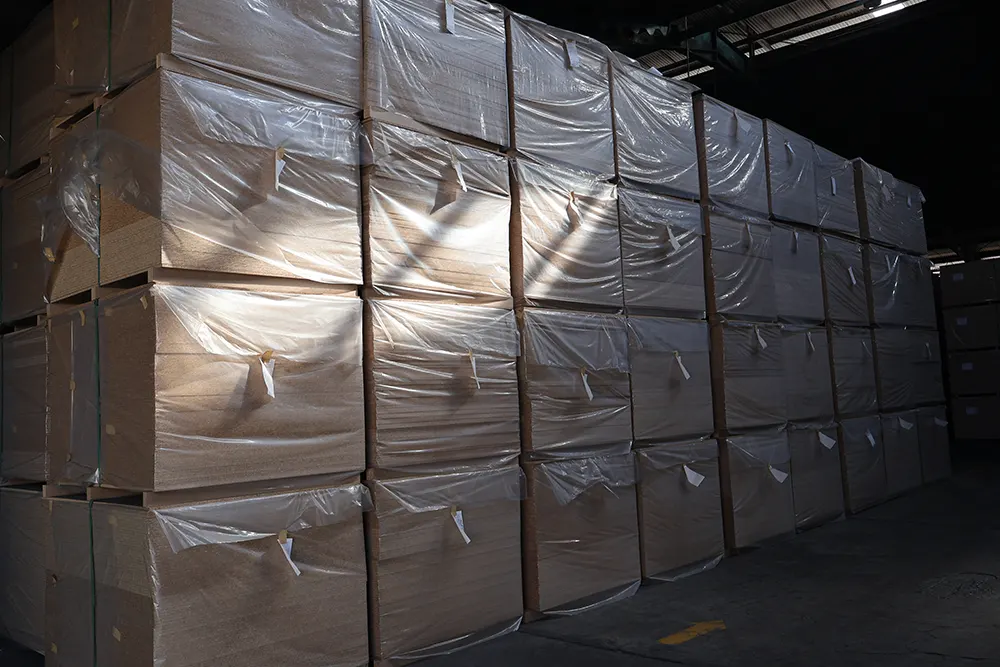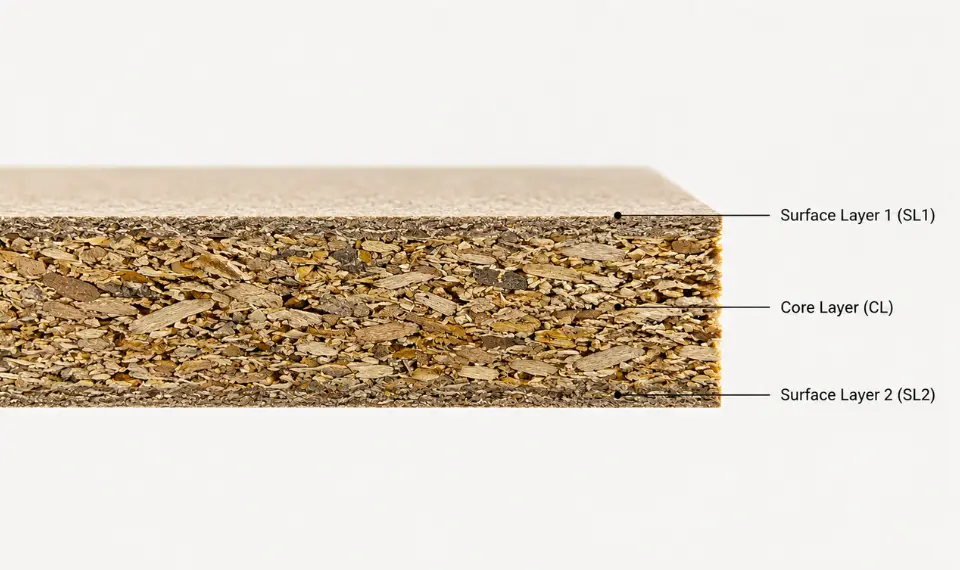



Particle board can be used as a subfloor or underlayment layer, but performance depends heavily on grade — standard particle board is only suitable for dry, low-moisture areas, while HMR (moisture-resistant) particle board is required anywhere humidity or occasional water exposure is a factor.
Particle board is a common choice for subflooring and underlayment because it’s flat, consistent, and cost-effective at scale. But subfloor applications put different demands on a panel than furniture does — sustained load, potential moisture from the slab below, and the finished flooring material sitting directly on top. This guide covers what actually matters when specifying particle board for this use.
Subfloor vs Underlayment: What’s the Difference?
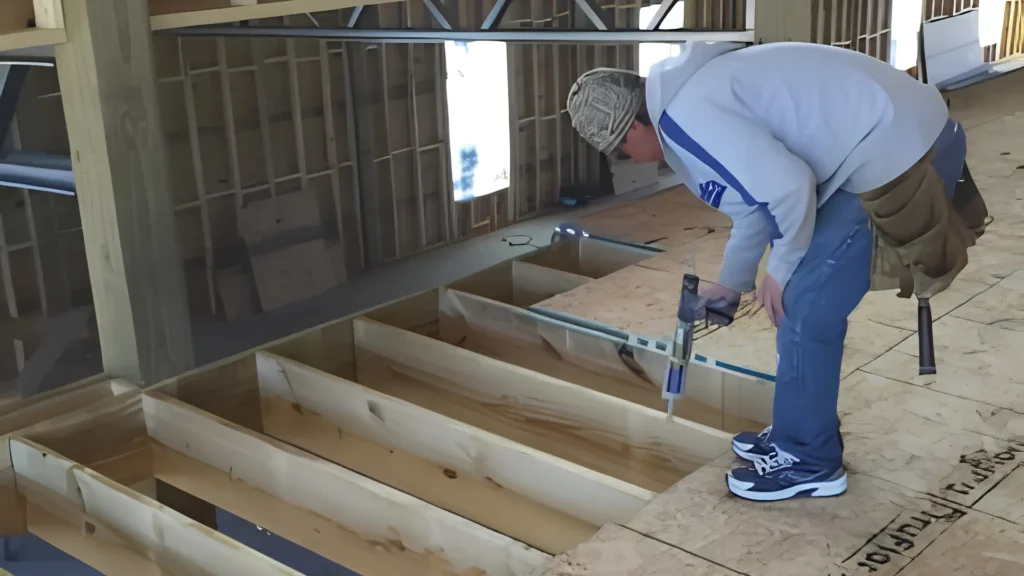
- Subfloor is the structural layer that sits on top of floor joists and carries the load of the finished floor and everything on it.
- Underlayment is a thinner layer placed on top of an existing subfloor to create a smooth, stable surface for the finished flooring (vinyl, laminate, carpet) to sit on.
Particle board is used in both roles, but the specification requirements differ — subfloor applications generally call for thicker, higher-density board, while underlayment prioritizes a smooth, flat surface over raw load-bearing strength.
Why Grade Matters More Than Thickness Here
The single biggest factor in subfloor/underlayment performance isn’t thickness — it’s moisture grade:
- Standard particle board will swell, delaminate, or lose structural integrity if exposed to sustained moisture, whether from humidity, a concrete slab that hasn’t fully cured, or a plumbing leak.
- HMR (High Moisture Resistant) particle board uses a different resin formulation specifically designed to resist swelling from humidity and moisture exposure, making it the appropriate choice for any subfloor or underlayment application where moisture risk exists — kitchens, bathrooms, laundry areas, or any ground-level installation near a slab.
For dry, upper-level rooms with no moisture exposure risk, standard grade may be sufficient — but for most real-world installations, especially anywhere the flooring material itself is moisture-sensitive (vinyl, laminate), HMR is the safer specification.
Technical Specifications Relevant to Subfloor Use
Under the JIS A 5908:2022 standard, particle board is manufactured to defined benchmarks that matter directly for subfloor performance:
- Density: 0.40–0.90 g/cm³ — higher density generally means better load distribution
- Internal bond strength: minimum 0.2 N/mm² — resistance to delamination under sustained load
- Screw holding strength: minimum 400N for boards 15mm and thicker — relevant for fastening to joists
- Moisture content: kept within 5–13% at manufacture — affects dimensional stability after installation
Choosing Thickness for Subfloor and Underlayment
- Underlayment: typically thinner (6–12mm), since it sits on an existing structural subfloor and mainly needs to provide a smooth, stable surface.
- Subfloor: typically thicker (18mm and above), since it carries structural load directly across floor joists.
Always check local building code requirements for subfloor thickness and span ratings — these vary by region and joist spacing, and particle board specification should match the structural engineering requirement, not just general guidance.
Installation Considerations
- Acclimate the board to the installation environment before fitting, since particle board can expand or contract slightly with humidity changes.
- Leave expansion gaps at panel edges per manufacturer guidance, to accommodate minor dimensional movement.
- Seal cut edges on HMR board where practical — even moisture-resistant grades benefit from edge protection in consistently damp conditions.
- Never install directly over a slab that hasn’t fully cured, regardless of grade — residual moisture from curing concrete can compromise any particle board, HMR included, if installed too early.
Common Mistakes
- Using standard-grade particle board in a bathroom or kitchen subfloor to save cost, then dealing with swelling and delamination within a few years.
- Under-specifying thickness for the actual joist span, leading to excessive flex or “bounce” in the finished floor.
- Installing before the slab has cured, trapping moisture against the underside of the board.
- Skipping expansion gaps, which can cause buckling as the board responds to humidity changes over time.
FAQ
Can particle board be used as a subfloor in a bathroom?
Only with HMR (moisture-resistant) grade — standard particle board is not suitable for bathroom subfloor applications due to sustained moisture exposure.
What thickness of particle board is used for subflooring?
18mm and above is typical for structural subfloor applications, though the correct thickness depends on joist spacing and load requirements specific to your project.
Is particle board or plywood better for subflooring?
Plywood generally has higher structural strength and is often preferred for higher-load or long-span subfloor applications, while particle board is a cost-effective option for standard residential spans with appropriate grade and thickness. See our particle board vs plywood vs MDF comparison for a full breakdown.
Get Subfloor-Grade Particle Board from RPI
For subflooring or underlayment projects, contact RPI’s team at admin-rpi@rimbapartikel.com or chat with us on WhatsApp to specify the right grade and thickness for your application. See our full particle board product range for available grades and specifications. RPI is a JIS-certified manufacturer based in Kendal, Central Java, established in 1990, producing particle board to JIS A 5908:2022 standards with FSC-certified materials, including HMR grade for moisture-exposed applications.