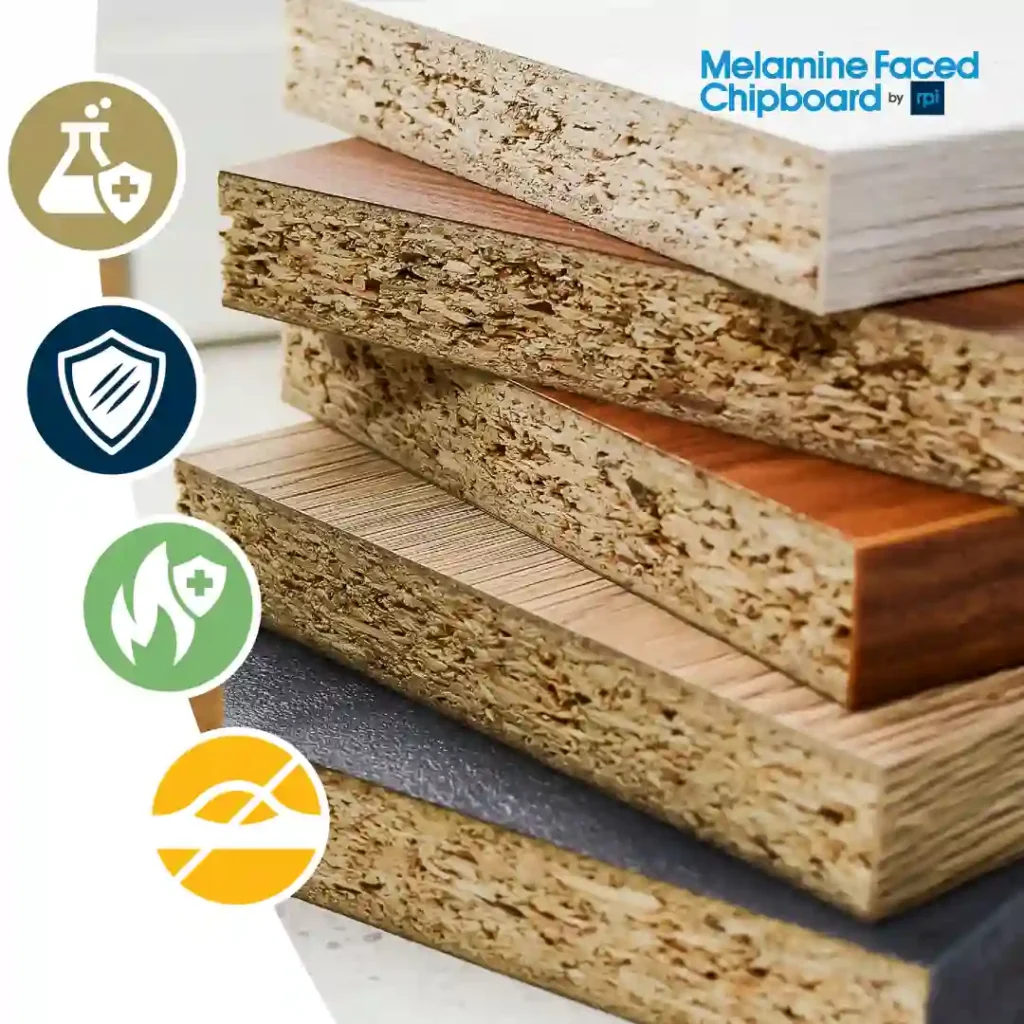



Quick answer: MFF (Melamine Faced Fiberboard) uses a dense, homogeneous MDF/HDF core — with no wood chips or voids — which makes it the more reliable material for curved cuts, circular profiles, and routed edge details than particle board-core MFC. For straight-cut cabinet carcasses, MFC remains the more economical choice; for anything that needs to be shaped, MFF is built for it.
Not every furniture component is a flat, straight-edged panel. Round table tops, curved cabinet doors, routed profile edges, and decorative 3D wall panels all put different demands on a board than a straight-cut cabinet side — and the material that handles straight cuts well doesn’t automatically handle curves and profiles just as cleanly.
Why Core Structure Determines Machinability
Particle board — the core used in standard MFC — is made from wood particles of varying sizes bonded together, which leaves a naturally coarser, less uniform internal structure. This works well for flat, straight-cut panels, but when a router bit or curved saw blade cuts across that structure, it can catch on larger particles, leading to chipping, tear-out, or a rougher edge that needs more finishing work.
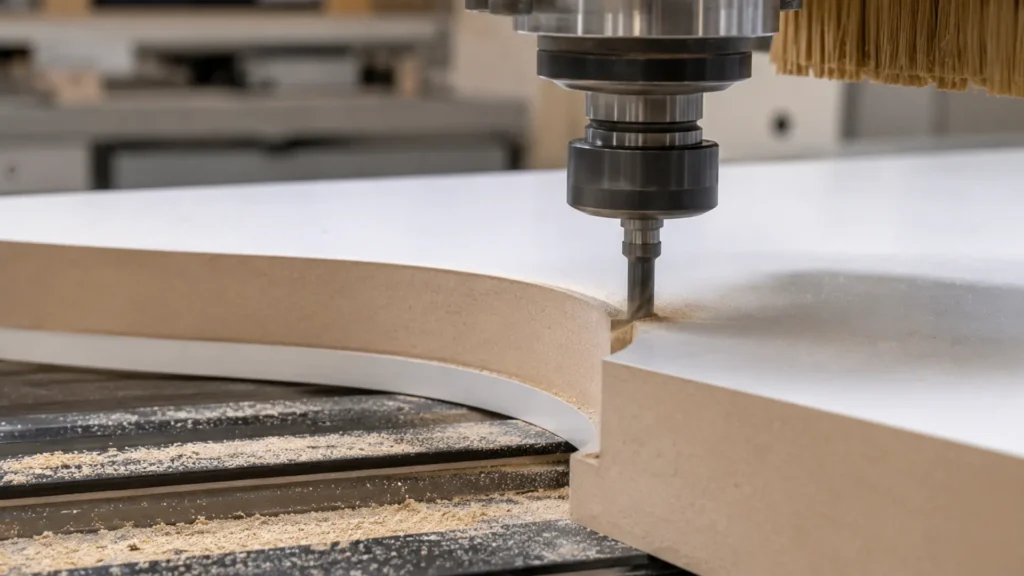
MFF’s core is different by design: fine wood fiber, pressed to a dense, uniform structure (typically 650–800 kg/m³) with no voids and no coarse particles to catch a cutting tool. This homogeneous structure is what allows a router to follow a curved profile cleanly, and what lets a circular saw or CNC cut a smooth circle or arc without the edge fraying or chipping.
Where This Difference Actually Matters
Round and curved table tops. A circular or organically shaped table top needs a clean curved edge all the way around. MFF’s fine, uniform core cuts this shape without the chip-out risk that a coarser particle board core carries.
Classic and profiled cabinet doors. Raised-panel, shaker-profile, or carved-detail cabinet doors are routed to create the profile itself — grooves, bevels, and decorative edges cut directly into the panel face. This kind of detailed routing is where MFF’s dense core shows its advantage most clearly.
Curved retail and display fixtures. Boutique and café interiors often call for rounded shelving, curved counters, or organic-shaped display structures. MFF’s machinability supports these shapes without the extra sanding and edge repair that a rougher core would require.
Decorative 3D wall paneling. Panels with routed geometric or textured patterns rely on clean, consistent cuts across the whole surface — a core that machines predictably at every point of the design is essential here.
What This Doesn’t Mean for MFC
This isn’t a case for replacing MFC with MFF across the board. For straight-cut cabinet carcasses, wardrobe sides, and shelving — the majority of furniture volume — MFC’s particle board core is perfectly suited to the job and remains the more cost-effective choice. The distinction is specifically about shaped, curved, or routed components, where the core structure has a direct, visible impact on the finished edge quality.
Practical Considerations for Machining MFF
Edge finishing is still required. Even with MFF’s clean-cutting core, exposed cut edges should be finished with PVC edging or a resin profile rather than left raw — this protects the edge and gives a finished appearance, regardless of how cleanly the initial cut was made.
Router bit selection matters. A sharp, appropriately sized router bit suited to fiberboard machining will get the cleanest results; using a worn or mismatched bit on any engineered panel — MFF included — increases the risk of surface burn or an uneven profile.
Double-sided lamination supports visible components. Because curved and routed pieces (table tops, display shelving) are often visible from multiple angles, MFF’s standard double-sided melamine face is well suited to components where both sides are on display.
Sourced for Precision Machining
PT Rimba Partikel Indonesia (RPI) produces MFF using MDF core sourced from local Indonesian suppliers, then melamine-laminated in-house at RPI’s Kendal, Central Java facility on the same production line used for MFC. Thickness options run from 2.5mm up to 25mm, giving furniture manufacturers flexibility for both thin surfacing applications and structural curved components.
To discuss specifications for a curved or routed furniture project, contact RPI’s team on WhatsApp.