


Furniture manufacturers choosing between particle board, MFC (melamine faced chipboard), and MDF-based materials should match the choice to the production line — particle board and MFC suit high-volume flat-panel furniture with a pre-finished surface, while MDF suits painted, detailed, or thin-panel components. Sourcing from one supplier that offers both simplifies specification consistency across a product range.
For furniture manufacturers, material choice isn’t just a spec sheet decision — it affects production speed, finishing cost, and consistency across every unit that comes off the line. This guide compares the core engineered wood materials furniture manufacturers actually specify, and what to look for when sourcing them at production volume.
Daftar Isi
- Why Engineered Wood Dominates Furniture Manufacturing
- Particle Board and MFC: The Standard for High-Volume Flat-Panel Furniture
- MDF: The Choice for Detail, Paint, and Thin Components
- Choosing Between Them by Production Line, Not by Preference
- What to Look for When Sourcing at Manufacturing Volume
- Sourcing from RPI for Furniture Manufacturing
- FAQ
Why Engineered Wood Dominates Furniture Manufacturing
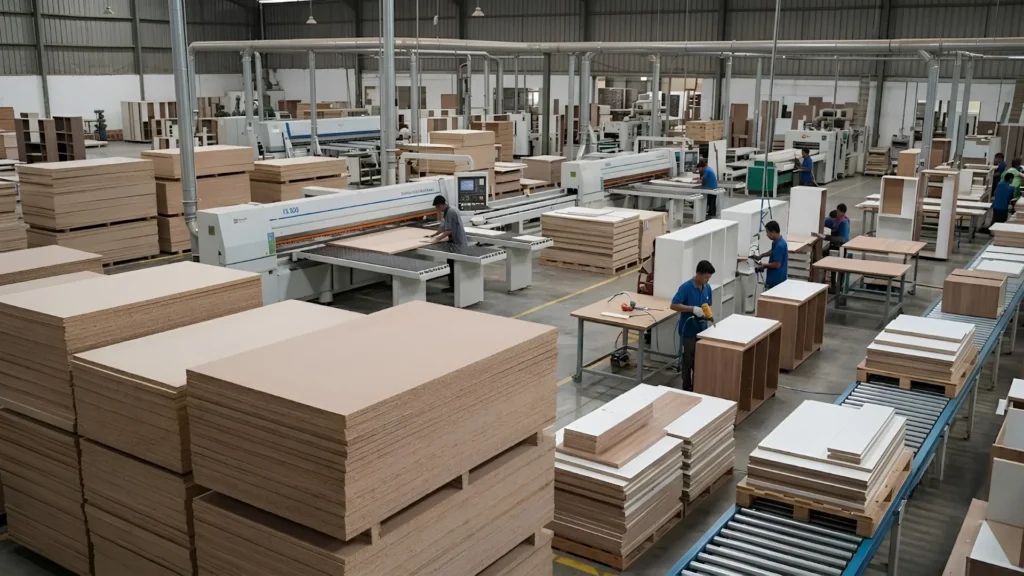
Engineered wood panels — particle board, MDF, and their melamine-faced variants — are the backbone of modern furniture manufacturing for a simple reason: consistency at scale. Solid wood varies piece to piece; engineered panels don’t. For a manufacturer running repeat production, that consistency is what makes tight tolerances, automated cutting, and predictable finishing possible.
Particle Board and MFC: The Standard for High-Volume Flat-Panel Furniture
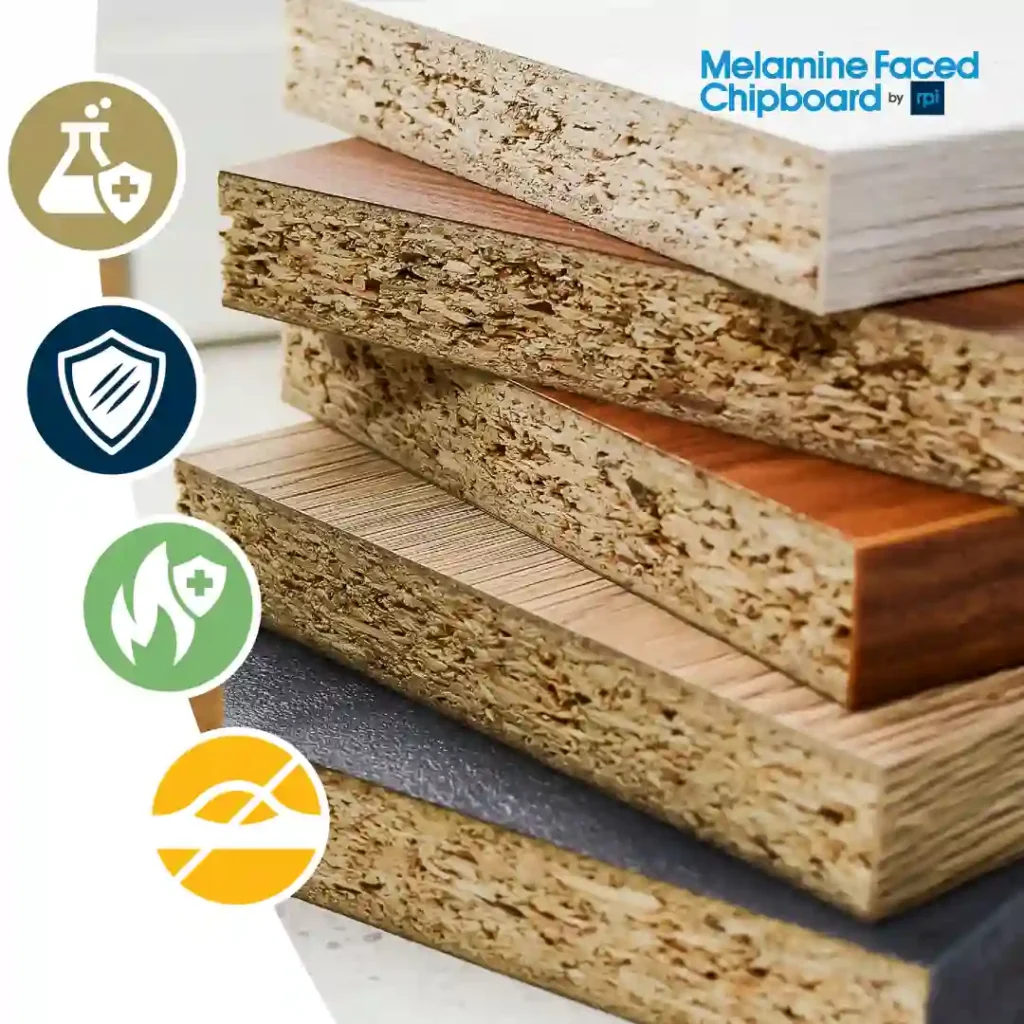
For wardrobes, cabinet carcasses, shelving, and RTA (ready-to-assemble) furniture, particle board with a melamine faced (MFC) surface is the standard specification across most manufacturers. The reasons are production-specific:
- No secondary finishing required — MFC arrives with the finished surface already applied, removing a painting or laminating step from the production line.
- Consistent screw-holding and machining behavior — particle board’s uniform core (JIS A 5908:2022 standard: minimum 400N screw-holding at 15mm+ thickness) machines predictably across large production runs.
- Cost efficiency at volume — particle board is generally the most cost-effective core for flat panels produced at scale.
For moisture-exposed lines — kitchen or bathroom furniture manufacturers specifically — HMR (High Moisture Resistant) particle board is the correct specification rather than standard grade.
MDF: The Choice for Detail, Paint, and Thin Components
MDF’s finer, denser fiber structure makes it the better choice when a production line needs:
- Painted finishes — MDF’s smooth surface takes paint far more evenly than particle board.
- Routed or detailed edge profiles — cabinet doors, trim, and decorative components with machined detail typically specify MDF.
- Thin components — MDF supports thinner panels than particle board, useful for surfacing applications or lightweight components. RPI’s melamine faced MDF (MFF) is available down to 2.5–3mm.
For manufacturers producing painted cabinet doors alongside MFC-faced carcasses, MDF and particle board often sit side by side on the same production line, each specified for the component it suits best.
Choosing Between Them by Production Line, Not by Preference
| Component | Typical Material |
|---|---|
| Wardrobe/cabinet carcass | Particle board core with MFC finish |
| Rak | Particle board (standard) or HMR (moisture areas) |
| Painted cabinet doors | MDF |
| Routed or detailed trim | MDF |
| Kitchen/bathroom carcass | HMR particle board or HMR MDF (MFF) |
| Thin surfacing layer | Thin MFF (MDF core) |
For a deeper technical comparison including plywood, see our full particle board vs plywood vs MDF breakdown.
What to Look for When Sourcing at Manufacturing Volume
- Consistency across production runs — ask about press technology (continuous vs batch); this directly affects density and thickness consistency between orders.
- Certification your market requires — formaldehyde emission grade (E1, E0, E0S, CARB Phase 2/EPA) and FSC-certified sourcing are increasingly required by retailers and export markets, not optional extras.
- Ability to supply multiple core types from one source — a supplier offering particle board, MFC, and MDF/MFF lets you standardize specification and colour matching across your full product range instead of managing multiple vendor relationships.
- Custom capability for non-standard specifications — thin MDF, specific colour matching, or non-standard thickness runs benefit from a supplier with in-house R&D rather than a purely catalogue-based supplier.
Sourcing from RPI for Furniture Manufacturing
PT Rimba Partikel Indonesia (RPI) supplies particle board, MFC, and melamine faced MDF (MFF) from a single JIS-certified facility in Kendal, Central Java, established in 1990, with FSC-certified material sourcing and an in-house R&D Division for custom specification development. Production runs on a Siempelkamp ContiRoll continuous press — the first installation of its kind in Asia — supporting consistent density and thickness across large production orders.
Contact RPI’s team at admin-rpi@rimbapartikel.com atau chat with us on WhatsApp to discuss material specification across your production line.
FAQ
Should furniture manufacturers use particle board or MDF?
It depends on the component: particle board (typically with an MFC finish) suits flat, high-volume panels like carcasses and shelving, while MDF suits painted or detailed components. Many manufacturers use both across different parts of the same product line.
Why do furniture manufacturers prefer melamine faced board over raw particle board?
MFC arrives pre-finished, removing a painting or laminating step from production — this speeds up manufacturing and gives consistent surface durability without additional finishing cost.
Can one supplier provide both particle board and MDF-based materials?
Yes — sourcing both from a single supplier (like RPI, which offers particle board, MFC, and MFF) simplifies specification consistency and colour matching across a full furniture product range.