

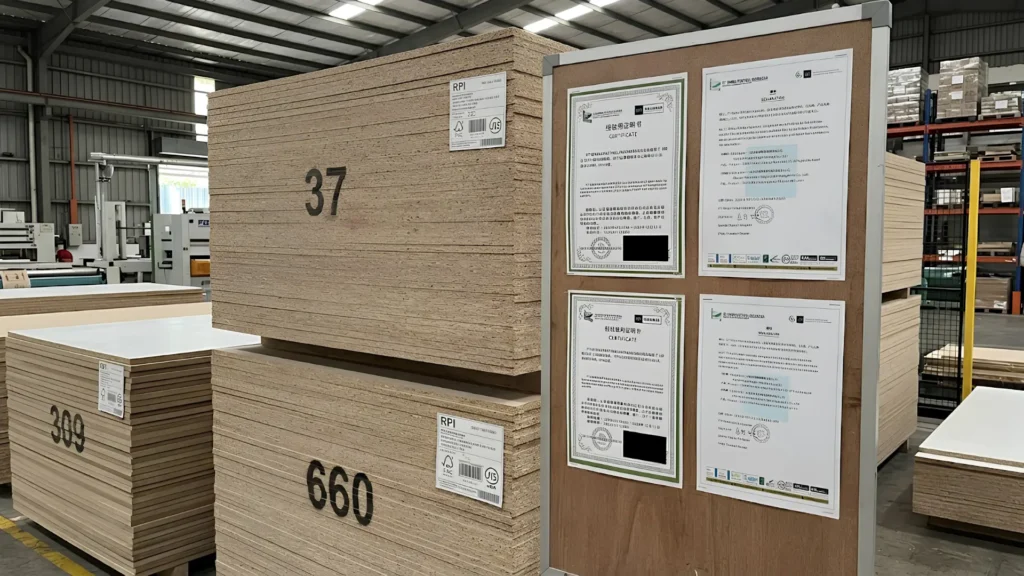
RPI’s particle board and MFC are backed by six certification categories: TKDN (Indonesian local-content compliance), JIS U-13/M-18 (Japanese panel strength standards), CARB Phase 2 and US-EPA (US formaldehyde emission limits), FSC Chain of Custody (traceable, sustainable timber sourcing), ISO 9001/14001/45001 (quality, environmental, and safety management), and KAN/Wood Legal accreditation (Indonesian timber legality). Together, these cover the compliance requirements most export and procurement buyers ask for.
When you’re evaluating a particle board or MFC supplier for export, government procurement, or a retailer with compliance requirements, certifications aren’t paperwork — they’re what determines whether a shipment clears customs, passes an audit, or meets a retailer’s sourcing policy. This guide explains what each of RPI’s certifications actually covers and why it matters to a buyer.
JIS Certification: Panel Strength and Quality Standards
JIS (Japanese Industrial Standards) certification, audited by JQA, sets defined benchmarks for panel density, moisture content, internal bond strength, and screw-holding strength — not just a general quality claim. RPI holds two specific JIS certifications:
- JIS U-13 — covers RPI’s particle board and MFC product line
- JIS M-18 — covers a separate product line specification
For a buyer, JIS certification means the board has been independently tested against a defined standard, rather than relying on the manufacturer’s own claims. It’s a common requirement for buyers in markets where JIS-equivalent panel standards are expected, and a strong general signal of production consistency for any market.
CARB Phase 2 and US-EPA: Formaldehyde Emission Compliance
Formaldehyde emission limits are one of the strictest compliance requirements for panel products entering the US market:
- CARB Phase 2 — California Air Resources Board’s stricter, second-phase formaldehyde emission limit, more demanding than CARB Phase 1
- US-EPA compliance — aligned with US Environmental Protection Agency formaldehyde emission requirements for composite wood products
RPI’s particle board and MFC are produced to meet both. For buyers shipping into the US or supplying US-market retailers, CARB Phase 2 and EPA compliance are typically non-negotiable requirements, not optional certifications — a supplier without them can be a hard blocker for US-bound orders regardless of price or other specifications.
FSC Chain of Custody: Traceable, Sustainable Sourcing
RPI holds FSC-COC (Chain of Custody) certification — a more specific credential than generic “FSC certified” claims. Chain of Custody certification tracks FSC-certified material through every stage from forest to finished product, rather than just certifying that some FSC material is used somewhere in the supply chain. This matters increasingly for buyers with sustainability sourcing policies, retail partners requiring traceable timber, and export markets with deforestation-linked import regulations.
RPI’s raw material sourcing is 95% from planted trees, with 5% FSC-certified material, aligned with the Sumitomo Forestry Group Procurement Policy.
ISO 9001, ISO 14001, and ISO 45001: Management System Certifications
These three ISO certifications cover different aspects of how RPI operates as a manufacturer, not the product itself:
- ISO 9001 (Quality Management) — demonstrates a documented, audited quality management system behind production consistency
- ISO 14001 (Environmental Management) — demonstrates a structured approach to environmental impact management, relevant to sustainability-focused procurement
- ISO 45001 (Occupational Health & Safety) — demonstrates a certified workplace safety management system, increasingly requested by buyers conducting supplier audits that include labor and safety practices
For procurement teams running supplier audits, these three certifications often matter as much as the product specifications themselves.
TKDN: Indonesian Local Content Compliance
TKDN (Tingkat Komponen Dalam Negeri), regulated by Indonesia’s Ministry of Industry (Kemenperin), certifies the percentage of local Indonesian content in a product — a requirement for government procurement and many state-owned enterprise (BUMN) tenders in Indonesia. RPI’s TKDN figures vary by product line:
| Produk | TKDN Percentage |
|---|---|
| Particle Board U-Type | 93.41% |
| MFC U-Type | 45.92% |
| Particle Board M-Type | 59.29% |
| MFC M-Type | 44.54% |
For buyers subject to a minimum TKDN threshold in Indonesian government or BUMN procurement, these figures determine eligibility before price or specification is even considered.
KAN Accreditation and Wood Legal Certification
KAN (Komite Akreditasi Nasional) is Indonesia’s national accreditation body, and Wood Legal certification verifies the legality of the timber supply chain under Indonesian regulation — relevant for both domestic compliance and export markets with anti-illegal-logging import requirements (such as the EU Timber Regulation or US Lacey Act framework). Combined with FSC-COC, this gives buyers documentation covering both sustainability and legality of the wood supply chain.
Why Certification Depth Matters More Than a Single Badge
A common mistake when evaluating suppliers is treating certification as a single checkbox. In practice, different certifications answer different buyer questions:
- Will this pass customs/import compliance? → CARB Phase 2, US-EPA, Wood Legal
- Does this meet a strength/quality standard? → JIS U-13/M-18
- Can I verify sustainable sourcing to my retail partners? → FSC-COC
- Will this pass a supplier quality/safety audit? → ISO 9001, 14001, 45001
- Does this qualify for Indonesian government procurement? → TKDN
A supplier with a broad certification portfolio like this can usually answer “yes” across multiple buyer requirements at once, rather than requiring you to source different products from different suppliers to cover each compliance need.
FAQ
What’s the difference between CARB and CARB Phase 2?
CARB Phase 2 is a stricter second-phase formaldehyde emission limit from the California Air Resources Board, more demanding than the original CARB Phase 1 standard — RPI’s products are certified to the Phase 2 level.
Is FSC-COC different from being “FSC certified”?
Yes — Chain of Custody (COC) certification tracks FSC material through the full supply chain from forest to finished product, which is a more specific and verifiable claim than a general FSC-certified label.
Does TKDN apply outside Indonesia?
TKDN is specifically an Indonesian local-content compliance requirement, most relevant for Indonesian government and state-owned enterprise procurement — it’s not a factor for buyers outside that specific procurement context.
Request Certification Documentation from RPI
For certification documents, TKDN figures, or compliance details relevant to your procurement or import requirements, contact RPI’s team at admin-rpi@rimbapartikel.com atau chat with us on WhatsApp. Learn more about RPI as a company, including its history, facilities, and manufacturing capability.