


Quick answer: Properly exported particle board and MFC panels are stacked on pallets, wrapped in moisture-resistant film, and fitted with corner and edge protectors before container loading — protecting against moisture swelling, edge chipping, and surface scratches during weeks at sea. Panel-based products like particle board and MFC are generally exempt from ISPM 15 wood-packaging treatment rules, since the manufacturing process itself removes the pest risk that rule targets — but it’s worth confirming with your destination country’s import requirements.
Panels that look flawless leaving the factory can arrive damaged if packaging is treated as an afterthought. For buyers new to importing engineered wood panels, understanding what proper export packaging looks like helps you evaluate supplier quotes that may look identical on price but differ significantly in how well your shipment survives the journey.
What Can Go Wrong Without Proper Packaging
Moisture damage. Particle board and MFC absorb ambient humidity if left unprotected, especially on long sea routes through humid climates. Swelling, warping, and delamination at the edges are the most common results of inadequate moisture barrier packaging.
Edge and corner damage. Panel corners and edges are the most vulnerable points during loading, transit, and unloading. Without protection, chipping and crushing at these points can render otherwise good sheets unsellable.
Surface scratching. Melamine-faced surfaces can pick up scuff marks and fine scratches from sheet-to-sheet contact if slip sheets or interleaving material aren’t used between panels.
Standard Export Packaging Elements
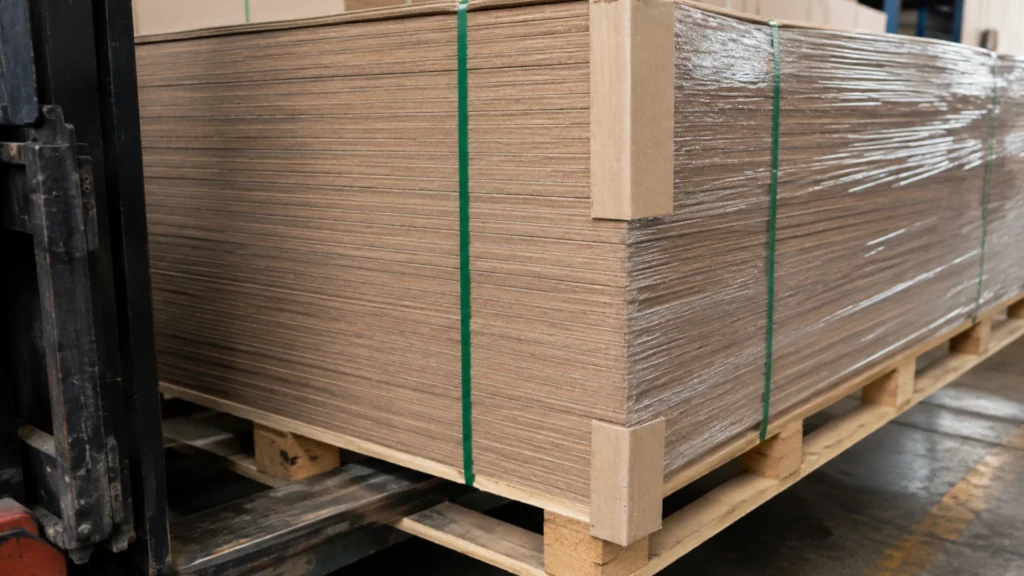
Palletizing. Sheets are stacked flat on export-grade pallets rather than loose-loaded, which keeps the stack stable, distributes weight evenly, and speeds up unloading with forklifts at the destination port.
Moisture-resistant wrapping. A plastic film wrap around the palletized stack acts as a moisture barrier during transit, particularly important for shipments crossing humid regions or spending extended time on deck or in port storage.
Corner and edge protectors. Cardboard or plastic corner guards and edge strips absorb impact during handling and prevent the sharp point-loading that causes chipping.
Strapping. Steel or plastic strapping bands secure the stack to the pallet, preventing shifting inside the container during rough seas or sudden stops during inland transport.
Interleaving or slip sheets (for decorative-face MFC in particular) protect the melamine surface from contact scratching between adjacent sheets in the stack.
Do You Need ISPM 15 Fumigation Marks?
ISPM 15 is an international standard requiring heat treatment or fumigation of raw wood packaging materials (like solid wood pallets and crates) to prevent the spread of pests. Manufactured wood-based panels — including particle board, MFC, MDF, and plywood — are generally considered outside ISPM 15’s scope, because the high-heat pressing process used to manufacture them already eliminates the pest risk the standard targets. This applies to the panels themselves; if your shipment uses solid wood pallets or crating (rather than particle-board pallets or plastic pallets), those specific components may still need ISPM 15 compliance marks. Always confirm current requirements with your destination country’s customs authority, since rules can vary and change.
What to Ask Your Supplier Before You Order
- What packaging materials are used as standard, and what upgrades (extra wrapping, reinforced corners) are available for higher-value or long-transit orders?
- Is a packing list with pallet counts and weights provided before shipment?
- Are pallets suitable for the destination country’s import handling equipment?
- Does the quote include packaging cost, or is it billed separately?
Asking these questions upfront avoids surprises when the shipment arrives and helps you compare suppliers on more than just the per-sheet price.
Export-Ready Packaging, Built Into Every Order
PT Rimba Partikel Indonesia (RPI) has exported particle board and MFC from its Kendal, Central Java facility since 1990, backed by Sumitomo Forestry as a major shareholder. Every export order is palletized, wrapped, and protected to standard export practice before loading, with a packing list provided ahead of shipment so buyers know exactly what to expect on arrival.
To discuss packaging specifications for your next order, message RPI’s export team on WhatsApp.