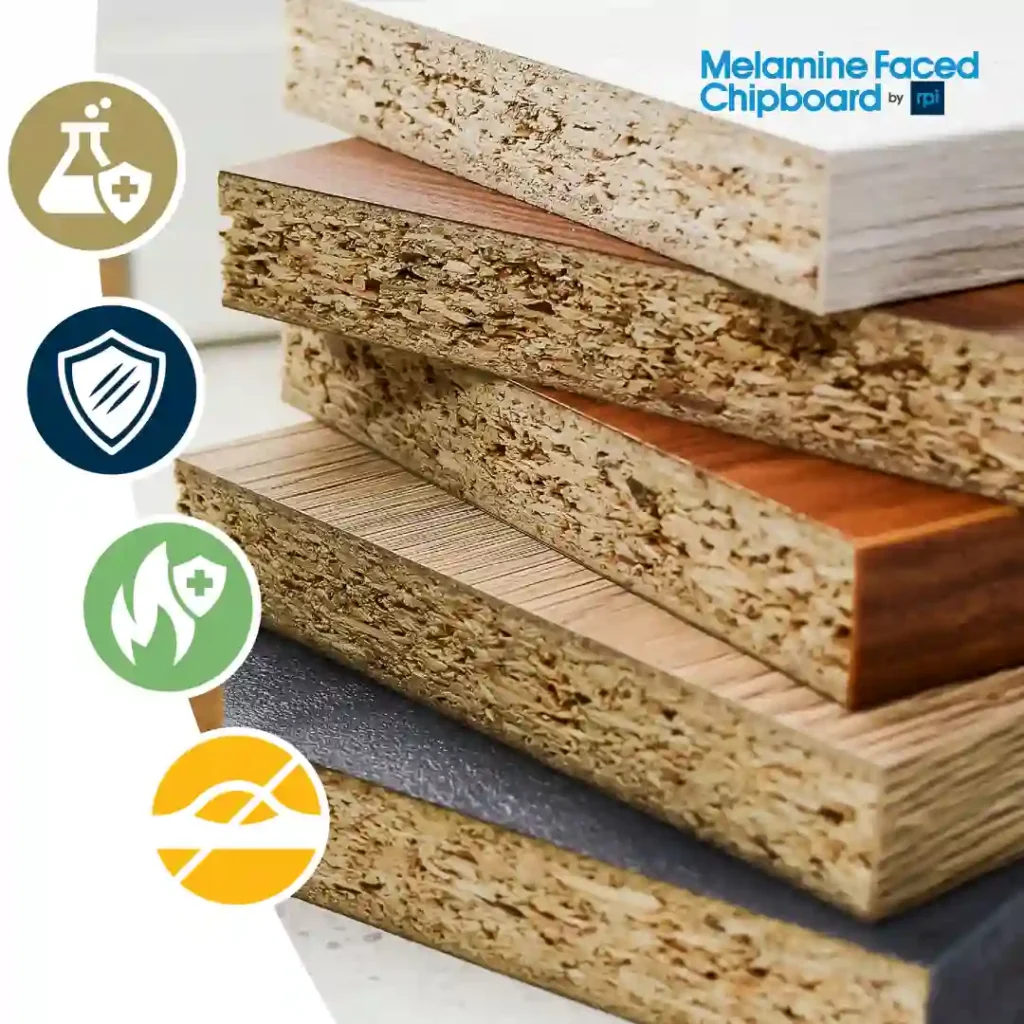



Choosing a melamine faced chipboard (MFC) supplier for export or bulk orders comes down to five factors: production certification (JIS, FSC), press technology and consistency, core grade options (standard vs HMR), catalogue depth, and export/logistics experience. Price alone is a poor way to compare suppliers, since specification differences change the real cost.
If you’re sourcing melamine faced chipboard for import, distribution, or manufacturing, the supplier you choose affects far more than price — it affects consistency across container loads, compliance with your market’s regulations, and how reliably your production schedule holds up. This guide covers what to actually check before committing to a supplier — see our MFC board product range for a look at core, colour, and specification options while you evaluate.
What to Look for in an MFC Supplier
Production Certification
Look for JIS certification (JIS A 5908 for the particle board core, JIS A 1460 for formaldehyde emission grading) and FSC-certified raw material sourcing. These aren’t just paperwork — JIS certification means the core board has been produced and tested against defined density, internal bond, and screw-holding benchmarks, not just a general claim of quality.
Press Technology
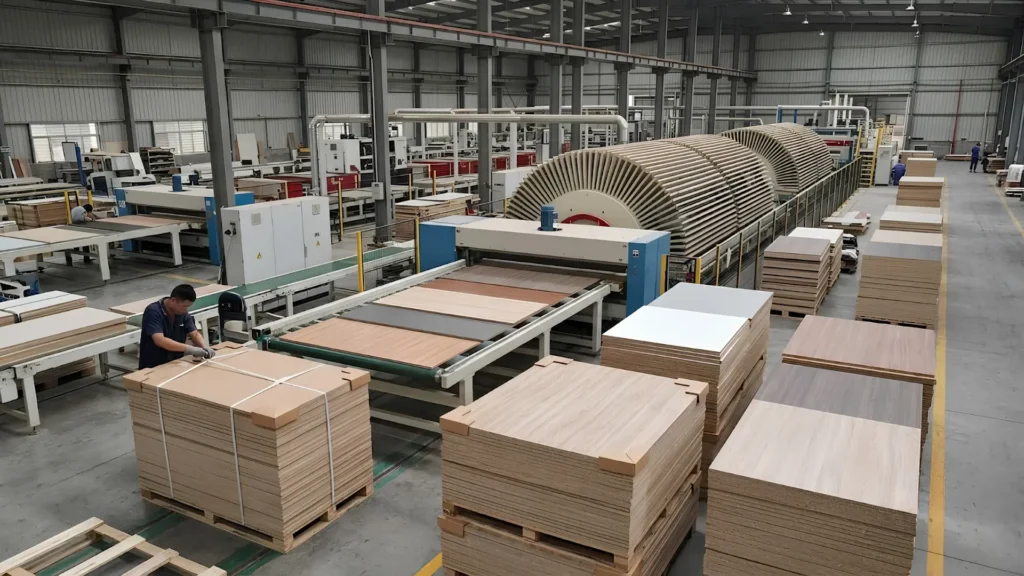
Ask what press technology a supplier uses. Continuous presses (like a Siempelkamp ContiRoll) produce more consistent density and thickness across long production runs than older batch hydraulic presses — which matters directly for container-to-container consistency on repeat orders.
Core Grade Range
A supplier offering only standard-grade core limits what you can sell into. Look for suppliers offering HMR (High Moisture Resistant) core alongside standard, and multiple formaldehyde emission grades (E2 through E0S, CARB Phase 2/EPA-compliant) so you can meet different destination market requirements without switching suppliers.
Catalogue Depth and Custom Capability
A narrow colour range limits your ability to serve different retail or project segments. Check whether the supplier offers both ready-stock (for faster turnaround) and custom colour/pattern/emboss options (for differentiated or large orders), and whether they have in-house R&D capability to develop variations rather than just reselling a fixed range.
Export and Logistics Experience
A supplier with genuine export experience will be able to speak concretely about container loading efficiency, standard packaging for sea freight, and typical lead times — not just factory-gate pricing. This matters more than it might seem: a cheaper factory price with inefficient packaging or unreliable lead times often costs more overall once logistics and delays are factored in.
Questions to Ask Before Committing to a Supplier
- What press technology do you use, and is it continuous or batch?
- What emission grades do you produce, and are they lab-tested and certified?
- Do you offer HMR core, and is it available in the same lead time as standard?
- What’s your minimum order quantity for custom colours vs ready-stock?
- What’s your typical lead time from order confirmation to shipment?
- Can you provide references or examples of export shipments to my region?
Red Flags When Evaluating Suppliers
- Vague or unverifiable claims about certification without documentation
- No clear answer on core grade options beyond “standard”
- Reluctance to discuss production technology or capacity
- Pricing that seems significantly below market without a clear explanation (often signals a lower, unstated specification)
RPI as a Melamine Faced Chipboard Supplier
PT Rimba Partikel Indonesia (RPI) has produced MFC since 2019 in partnership with AICA, from a facility in Kendal, Central Java established in 1990, with Sumitomo Forestry Group as a major shareholder. Production runs on a Siempelkamp ContiRoll continuous press — the first installation of its kind in Asia — at 109,000 m³/year capacity, producing to JIS A 5908:2022 standards with FSC-certified materials.
RPI’s range covers both ready-stock Solid Colours and custom Premium, Stone, Wood & Non-Wood designs across 150+ colour and pattern variants, on standard particle board or HMR core, with an in-house R&D Division for custom specification development.
Get a Quote from RPI
Sourcing melamine faced chipboard for export, distribution, or manufacturing? Contact RPI’s team at admin-rpi@rimbapartikel.com atau chat with us on WhatsApp with your specification requirements — core grade, thickness, colour range, and order volume — for an accurate quote.
FAQ
What certifications should an MFC supplier have?
Look for JIS certification covering both the core board (JIS A 5908) and formaldehyde emission grading (JIS A 1460), plus FSC-certified raw material sourcing for sustainability compliance.
Does press technology really affect MFC quality?
Yes — continuous press technology generally produces more consistent density and thickness across long production runs than older batch press systems, which matters for consistency across repeat or large-volume orders.
How do I compare MFC suppliers on price fairly?
Compare like-for-like specifications first — core grade, emission grade, thickness, and colour type (ready-stock vs custom) — since price differences often reflect specification differences rather than genuine value differences.