


Particle board merupakan salah satu panel kayu olahan yang paling banyak digunakan dalam industri furnitur dan konstruksi interior. Material ini terjangkau, memiliki kualitas yang konsisten, dan mudah dikerjakan. Namun, sebagian besar panduan di internet hanya mengulang penjelasan umum tentang kepadatan, kegunaan, serta kelebihan dan kekurangannya, tanpa pernah menjelaskan bagaimana papan ini sebenarnya diproduksi.
Daftar Isi
- Sebenarnya, Apa Itu Particle Board?
- Bagaimana Particle Board Dibuat? Proses Produksinya
- Dari Mana Asal Bahan Bakunya?
- Spesifikasi Particle Board
- Pengujian Kualitas: Bagaimana Setiap Batch Diverifikasi
- Keuntungan dari Papan Partikel
- Pilihan Laminasi: HPL, PVC, MFC, dan Kertas
- Aplikasi Umum
- Particle Board vs MDF vs Plywood
- Mengapa Memilih Particle Board RPI?
- Pertanyaan yang Sering Diajukan
- Kesimpulan
Sebenarnya, Apa Itu Particle Board?
Particle board adalah panel kayu olahan (engineered wood). Proses pembuatannya dilakukan dengan menyusun kembali material kayu menjadi bentuk papan. Pertama, partikel kayu direkatkan menggunakan resin sintetis. Selanjutnya, campuran tersebut dipres pada suhu dan tekanan tinggi hingga menjadi lembaran papan yang rata dan seragam.
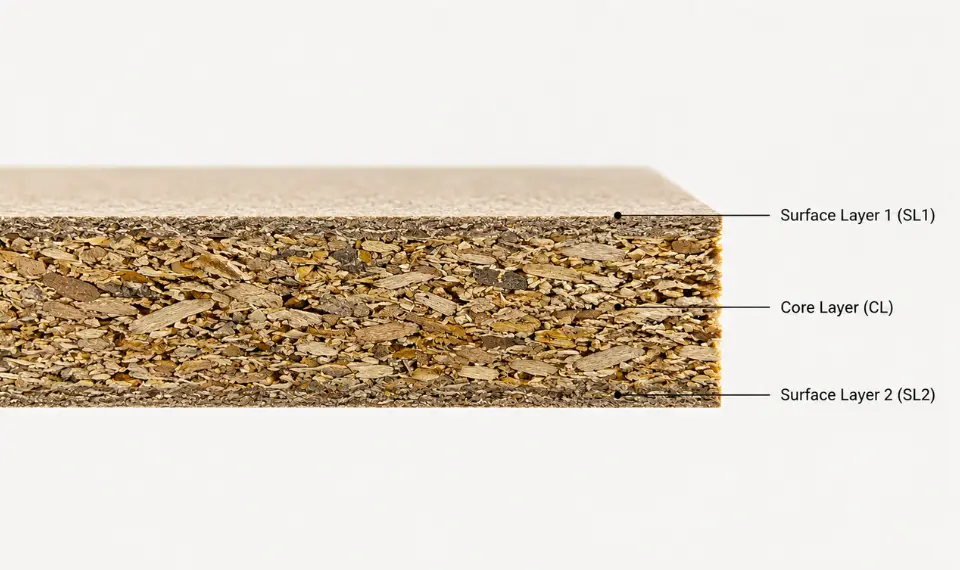
Berbeda dengan kayu solid, particle board bukanlah material yang tersusun dari satu bagian utuh. Sebaliknya, particle board terdiri dari tiga lapisan yang berbeda, di mana setiap lapisan memiliki ukuran partikel dan fungsi yang berbeda pula.
Struktur Tiga Lapis
- Lapisan Permukaan 1 (SL1): lapisan paling atas yang terbuat dari partikel kayu halus untuk menghasilkan permukaan yang halus, siap dicat, dan siap dilaminasi.
- Lapisan Inti (CL): lapisan tengah yang paling tebal, terbuat dari partikel kayu yang lebih kasar untuk memberikan ketebalan, volume, dan kekuatan pada papan.
- Lapisan Permukaan 2 (SL2): the bottom layer, mirroring SL1 for balanced structure and dimensional stability.
Hasilnya, desain tiga lapis ini membuat particle board memiliki permukaan yang halus dan bebas cacat di kedua sisinya, sekaligus menjaga lapisan intinya tetap efisien secara struktural—sebuah detail penting yang sering kali tidak dijelaskan dalam kebanyakan panduan pembelian.
Bagaimana Particle Board Dibuat? Proses Produksinya
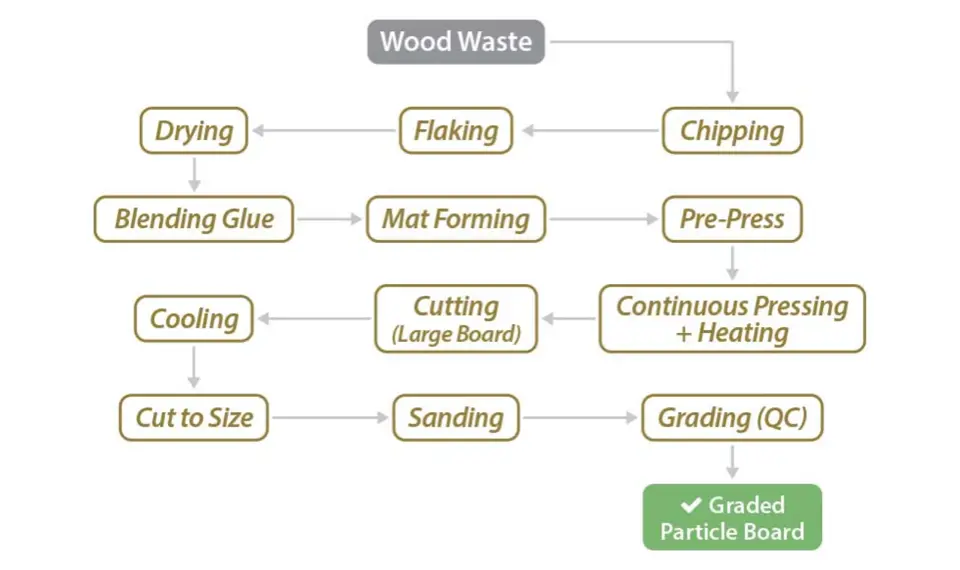
Proses pembuatan particle board terdiri dari beberapa tahapan industri yang saling berurutan. Berikut adalah urutan lengkap proses yang digunakan di PT Rimba Partikel Indonesia (RPI)di fasilitas produksi Kendal, mulai dari bahan baku kayu hingga menjadi panel jadi:
- Tempat Penampungan Kayu (atau Area Penyimpanan Log): pabrik menerima, memilah, dan menyimpan kayu gelondongan serta limbah kayu sebagai bahan baku.
- Mesin Flaker (Mesin Pembuat Serpihan Kayu): mesin mengolah kayu menjadi serpihan (flakes) dan kepingan kayu (chips).
- Mesin Blender (Mesin Pencampur): operator mencampurkan serpihan kayu dengan resin sintetis (urea formaldehida atau melamin urea formaldehida).
- Mesin Pengering (Dryer): mesin pengering menurunkan kadar air partikel kayu yang telah dilapisi resin hingga mencapai tingkat kelembapan yang sesuai.
- Mesin Press ContiRoll: mesin press membentuk partikel kayu menjadi hamparan (mat) yang berkesinambungan, kemudian memadatkannya dengan suhu dan tekanan tinggi hingga menjadi papan yang padat dan kokoh.
- Pendinginan: papan didinginkan agar struktur dan dimensinya menjadi stabil sebelum diproses lebih lanjut.
- Pemotongan Sesuai Ukuran: mesin memotong dan merapikan papan yang telah didinginkan sesuai dengan ukuran standar lembaran.
- Pengamplasan: mesin pengamplas menghaluskan permukaan papan sehingga siap untuk proses laminasi atau finishing.
Yang menarik, mesin ContiRoll milik RPI dipasok oleh Siempelkamp (Jerman) dengan lebar 9 kaki, menjadikannya mesin press pertama dengan lebar tersebut yang dipasang di Asia. Lebar ekstra ini memungkinkan produksi panel berukuran lebih besar tanpa sambungan tambahan, sesuatu yang tidak dapat dicapai oleh sebagian besar mesin press standar.
Dari Mana Asal Bahan Bakunya?
Sebagian besar panduan hanya menjelaskan bahwa particle board dibuat dari “limbah kayu” tanpa menjelaskan apa yang sebenarnya dimaksud dengan limbah tersebut. Padahal, dalam praktiknya, bahan baku particle board berasal dari empat sumber utama berikut:
| Sumber | Deskripsi |
|---|---|
| Kayu Campuran | Potongan kayu dari berbagai jenis pohon |
| Limbah Kayu Basah | Limbah kayu dari industri rumahan |
| Limbah Industri | Sisa potongan dari industri pengolahan kayu |
| Limbah Veneer | Sisa potongan kayu dari industri plywood |
Dengan memanfaatkan keempat sumber bahan baku tersebut, produsen dapat mengolah kayu yang sebelumnya berpotensi menjadi limbah. Pendekatan ini mengurangi ketergantungan pada kayu primer (virgin timber) sekaligus menjaga biaya produksi tetap efisien dan stabil.
Spesifikasi Particle Board
Tidak semua particle board memiliki spesifikasi yang sama. Perbedaannya dapat dilihat dari ketebalan, jenis perekat, dan tingkat emisi formaldehida—faktor-faktor yang secara langsung menentukan kesesuaian papan untuk berbagai jenis aplikasi atau proyek.
| Spesifikasi | Rentang Standar |
|---|---|
| Ketebalan | 6 / 9 / 12 / 15 / 18 / 20 / 25 / 30 mm |
| Ukuran Lembaran | 4×6, 4×8, 4×9, 3×6, 3×8, 3×9, 3×10 kaki (ft) |
| Jenis Perekat | Urea Formaldehida (UF) atau Melamin Urea Formaldehida (MUF) |
| Kekuatan Rekat | Tipe 13, Tipe 18, dan HMR (tahan lembap) |
| Emisi Formaldehida | JIS F** (E0S), F*** (E0), F** (E1), E2, CARB Phase 2 / EPA** |
Untuk kabinet dapur dan kamar mandi, selalu pastikan bahwa papan yang digunakan memiliki klasifikasi HMR (Ketahanan Tinggi terhadap Kelembapan) Particle board standar tidak dirancang untuk penggunaan di lingkungan dengan kelembapan tinggi secara terus-menerus. Pelajari lebih lanjut tentang HMR Particle Board →
Pengujian Kualitas: Bagaimana Setiap Batch Diverifikasi
Lembar spesifikasi hanya memiliki arti jika produk benar-benar diuji di pabrik. Setiap batch particle board harus lolos pengujian sesuai standar yang diakui sebelum meninggalkan pabrik. Berikut adalah proses pengendalian mutu yang sebenarnya berdasarkan standar JIS A 5908:2022:
| Titik Pemeriksaan | Metode Pengujian | Standar |
|---|---|---|
| Kerapatan | JIS A 5908:2022 | 0.40–0.90 g/cm³ |
| Kadar Air | JIS A 5908:2022 | 5–13% |
| MOR (Kuat Lentur) | JIS A 5908:2022 | ≥12,0 N/mm² (non-JIS) / ≥13,0 N/mm² (JIS) |
| Ikatan Internal (IB) | JIS A 5908:2022 | Min 0.2 N/mm² |
| Daya Cengkeram Sekrup (≥15 mm) | JIS A 5908:2022 | Min. 400 N (Minimum 400 N) |
| Emisi Formaldehida | JIS A 1460:2021 | E0S ≤0,3 mg/L, E0 ≤0,5 mg/L, E1/E2 ≤1,5 mg/L (rata-rata) |
| CARB/EPA emission | Korelasi berdasarkan JIS A 1460:2021 | ≤0,09 ppm (Phase 2) |
Pada akhirnya, hasil pengujian MOR, Internal Bond (IB), dan daya cengkeram sekrup menjadi penentu apakah sebuah papan mampu mencengkeram sekrup dengan kuat serta tahan terhadap lendutan saat menerima beban. Materi pemasaran yang tidak menyertakan data pengujian tersebut hanya menggambarkan material, tetapi tidak membuktikan kualitasnya.
Keuntungan dari Papan Partikel
- Terjangkau: harganya jauh lebih ekonomis dibandingkan kayu solid maupun MDF, terutama untuk produksi dalam skala besar.
- Ringan dan mudah diolah: densitasnya yang rendah membuatnya lebih mudah diangkut, dipotong, dan dipasang.
- Kekuatan yang memadai untuk penggunaan standar: jika dipasang dengan benar, material ini memberikan dasar yang kokoh untuk furnitur dan konstruksi ringan.
- Fleksibilitas finishing yang tinggi: dapat dilapisi dengan kertas dekoratif, melamin, PVC, atau HPL, sehingga memberikan kebebasan dalam pilihan desain.
Pilihan Laminasi: HPL, PVC, MFC, dan Kertas
Produsen jarang membiarkan particle board tanpa lapisan akhir. Sebaliknya, jenis lapisan laminasi yang digunakan menentukan daya tahan, ketahanan terhadap kelembapan, serta tampilan akhirnya:
- HPL (High Pressure Laminate): extremely hard wearing and durable, suited to high traffic surfaces.
- PVC: tahan terhadap kelembapan dan awet, sehingga menjadi pilihan yang umum untuk berbagai aplikasi praktis.
- MFC (Melamine Faced Chipboard): telah dilaminasi dengan melamin sejak proses produksi, sehingga proses finishing menjadi lebih sederhana dan efisien. Lihat seluruh keunggulan MFC →
- Laminasi Kertas: digunakan untuk memberikan warna atau motif serat kayu tertentu pada permukaan. Cocok untuk menciptakan tampilan yang bersih dan minimalis. Particle Board Putih merupakan salah satu pilihan laminasi kertas yang populer.
Aplikasi Umum
- Furnitur: cocok untuk meja, rak buku, dan kabinet, di mana efisiensi biaya dan fungsionalitas menjadi prioritas utama.
- Finishing Interior: panel dinding, sistem lemari pakaian, dan inti pintu.
- Kabinet: kabinet dapur dan kamar mandi, dipilih karena efisien dari segi biaya serta memiliki permukaan yang halus untuk proses laminasi.
- Lapisan bawah: sebagai lapisan dasar yang rata di bawah lantai laminasi atau lantai kayu solid. Lihat panduan kami tentang lantai chipboard 18 mm →
Particle Board vs MDF vs Plywood
| Bahan | Terbaik untuk | Keterbatasan Utama |
|---|---|---|
| Partikel Board | Furnitur berlapis melamin, proyek dengan anggaran terbatas | Ketahanan terhadap kelembapan lebih rendah (kecuali tipe HMR) |
| MDF | Permukaan yang dicat atau dibentuk dengan router | Lebih berat, ketahanan terhadap kelembapan lebih rendah |
| Plywood | Penggunaan struktural atau penahan beban | Biaya lebih tinggi |
Untuk melihat perbandingan lengkap ketiga material secara berdampingan, lihat panduan kami Panduan Perbandingan Particle Board vs MDF vs Plywood → Untuk mengetahui alternatif lain yang juga banyak digunakan, baca Particle Board vs Blockboard → atau HDF vs MDF vs Particle Board →
Mengapa Memilih Particle Board RPI?
PT Rimba Partikel Indonesia telah memproduksi particle board di Kendal, Jawa Tengah sejak tahun 1990. Fasilitas seluas 11 hektare tersebut mencakup lini produksi, gudang penyimpanan, dan area penimbunan kayu (log yard).
- High quality: setiap lembar papan melalui pengawasan mutu yang ketat sebelum dikirim kepada pelanggan.
- Bahan baku pilihan: kualitas papan dimulai dari pemilihan sumber bahan baku limbah kayu yang dilakukan secara cermat.
- Inovasi Teknologi: peralatan modern, termasuk mesin ContiRoll Press selebar 9 kaki, menghasilkan presisi yang konsisten pada setiap proses produksi.
- Komitmen terhadap kelestarian lingkungan: proses produksi mengutamakan pemanfaatan material kayu daur ulang serta meminimalkan dampak terhadap lingkungan. Lihat komitmen CSR kami →
- Pengiriman tepat waktu: RPI berkomitmen memberikan pengiriman yang andal dan tepat waktu untuk setiap pesanan.
RPI telah memperoleh sertifikasi ISO 9001, ISO 14001, ISO 45001, JIS U-13, JIS M-18, CARB-P2, US-EPA, dan FSC-COC, dengan kapasitas produksi tahunan mencapai 109.000 m³. RPI melayani pasar domestik Indonesia maupun pelanggan ekspor. Sedang mencari pemasok, bukan sekadar produsen? Lihat Panduan Memilih Supplier Particle Board Terpercaya → or our particle board manufacturer guide →
Ingin mengetahui harga terbaru? Lihat Panduan Harga Particle Board →
Membutuhkan spesifikasi, sampel, atau informasi harga particle board? Hubungi RPI melalui WhatsApp atau kirim email ke alamat di bawah ini.
Pertanyaan yang Sering Diajukan
Particle board terbuat dari apa?
Particle board dibuat dari partikel-partikel kayu berukuran kecil seperti serpihan kayu, serbuk gergaji, dan limbah kayu campuran yang direkatkan menggunakan resin sintetis, kemudian dipadatkan dengan panas dan tekanan tinggi hingga menjadi panel yang kokoh.
Apakah MDF sama dengan particle board?
Tidak. MDF (Medium Density Fiberboard) dibuat dari serat kayu yang lebih halus sehingga memiliki permukaan yang lebih rata dan padat, sehingga lebih cocok untuk proses pengecatan. Sementara itu, particle board dibuat dari serpihan kayu yang lebih besar dan lebih sesuai untuk finishing melamin atau laminasi.
Apakah particle board cukup kuat untuk furnitur?
Ya, untuk penggunaan pada furnitur standar. Particle board mampu menahan beban normal dengan baik pada kabinet, rak, dan meja jika dipasang dengan benar. Namun, material ini tidak dirancang untuk beban struktural yang berat maupun paparan kelembapan yang berlangsung terus-menerus.
Apakah particle board tahan air?
Tidak. Particle board standar tidak bersifat kedap air dan akan mengembang jika terpapar kelembapan dalam waktu yang lama. Untuk aplikasi di dapur dan kamar mandi, sebaiknya gunakan particle board HMR (High Moisture Resistance).
Tingkat emisi formaldehida mana yang paling aman?
Grade E0S dan E0 memiliki tingkat emisi formaldehida paling rendah dan direkomendasikan untuk ruang tertutup seperti kamar tidur serta furnitur anak. Selalu pastikan produk memiliki sertifikasi atau dokumen yang mencantumkan grade emisi sebelum membeli.
Berapa lama furnitur berbahan particle board dapat bertahan?
Dengan perlindungan yang memadai terhadap kelembapan serta penggunaan sesuai batas beban yang dianjurkan, furnitur berbahan particle board umumnya dapat bertahan selama 10–15 tahun, terutama jika menggunakan finishing MFC atau lapisan laminasi pelindung lainnya.
Kesimpulan
Particle board merupakan material kayu olahan yang praktis dan hemat biaya. Namun, kinerjanya sangat bergantung pada kualitas produksi, tingkat ketahanan terhadap kelembapan, serta standar pengujian yang diterapkan—bukan hanya pada deskripsi bahan bakunya. Memahami struktur lapisan, proses produksi, dan data hasil pengujian di balik sebuah papan akan membantu Anda membuat keputusan pembelian yang tepat, bukan sekadar berdasarkan perkiraan.
Dapatkan particle board langsung dari produsennya. PT Rimba Partikel Indonesia memproduksi particle board standar, HMR, dan MFC berlapis melamin di fasilitas kami di Kendal, Jawa Tengah. Kami melayani produsen furnitur, kontraktor, dan distributor di seluruh Indonesia maupun pasar ekspor.
📞 WhatsApp: +62 811-2511-1435 📧 Email: admin-rpi@rimbapartikel.com 🔗 Lihat Spesifikasi Particle Board → 🔗 Lihat Spesifikasi MFC Board →