


Quick answer: “Grade A particle board” isn’t an official industry classification — it’s a market term buyers use for high-density, certified particle board suitable for durable furniture and structural-grade applications, as opposed to uncertified or recycled-content “off-grade” board. The real specifications to check for are density, JIS certification, and formaldehyde emission grade — not a “Grade A/B/C” label, which no recognized standard actually defines.
If you’ve searched for “particle board Grade A,” you’ve likely seen it used loosely across supplier listings and marketplaces without a consistent definition. There’s no international or JIS standard that defines “Grade A” as a formal classification — so what buyers are usually really asking is: how do I identify high-quality, reliable particle board?
What Determines Real Quality in Particle Board
Rather than a “grade” label, quality particle board is defined by a few verifiable specifications:
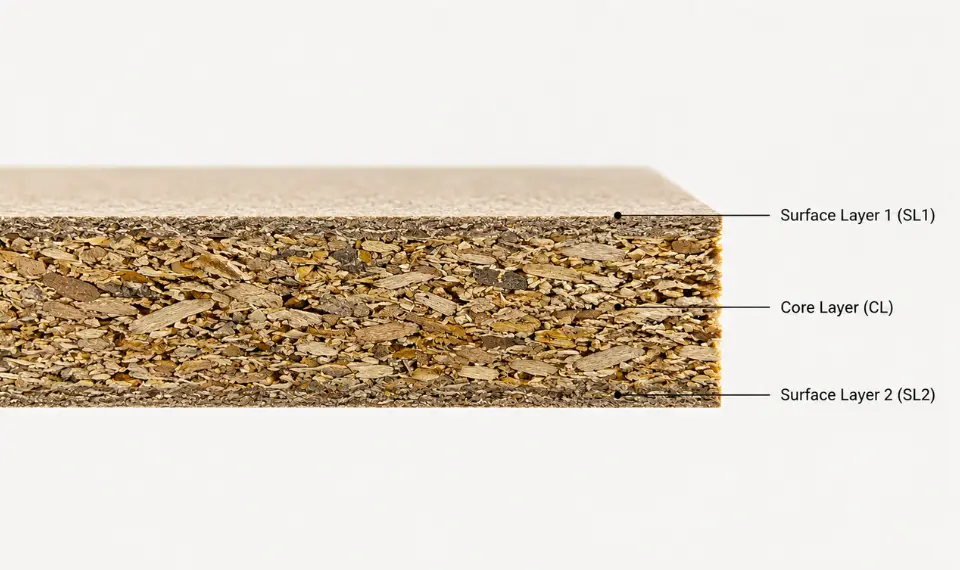
Density. Particle board density typically ranges from 0.40–0.90 g/cm³. Higher-density board within a supplier’s range generally offers better strength, screw holding, and machining performance — this is a real, testable number, unlike an informal “grade.”
JIS certification. JIS A 5908:2022 is the recognized standard governing particle board manufacturing — covering density, moisture content, bending strength (MOR), internal bond strength, and screw holding capacity. Board certified to this standard has been tested against consistent benchmarks, which is a more reliable quality signal than an uncertified “Grade A” label.
Formaldehyde emission grade. E0, E1, E2, E0S, and CARB Phase 2 are recognized emission classifications. Lower-emission grades (E0, E0S) indicate board suitable for stricter indoor air quality requirements, such as children’s furniture or green building certification.
Bonding type. Standard board is rated Type 13 or Type 18 depending on internal bond strength; HMR (moisture-resistant) type adds a denser resin system for humid-environment use.
How to Verify Quality When “Grade A” Is Used as a Marketing Term
- Ask for the actual density figure and JIS test report, not just a grade label
- Check the formaldehyde emission classification on the product spec sheet
- Confirm bonding type (13/18/HMR) matches your application’s moisture exposure
- Be cautious of suppliers using “Grade A” without backing it with certified test data — it’s a marketing shorthand, not a guarantee
Choosing Board by Real Specification, Not a Label
For structural or high-use furniture applications — cabinets, shelving, tables — specify board by its actual density range, JIS certification, and emission grade rather than relying on an informal “Grade A” claim. This gives you a specification you can hold a supplier to and compare consistently across quotes.
Certified Particle Board, Specified the Right Way
PT Rimba Partikel Indonesia (RPI) manufactures particle board in Kendal, Central Java to JIS A 5908:2022 standards, across a density range of 0.40–0.90 g/cm³, with emission grades from E2 through E0S and CARB Phase 2-EPA compliance. Every batch is produced on a ContiRoll Siempelkamp continuous press with consistent, testable specifications — not an informal grading claim.
To request current density and test specifications for your application, contact RPI on WhatsApp.