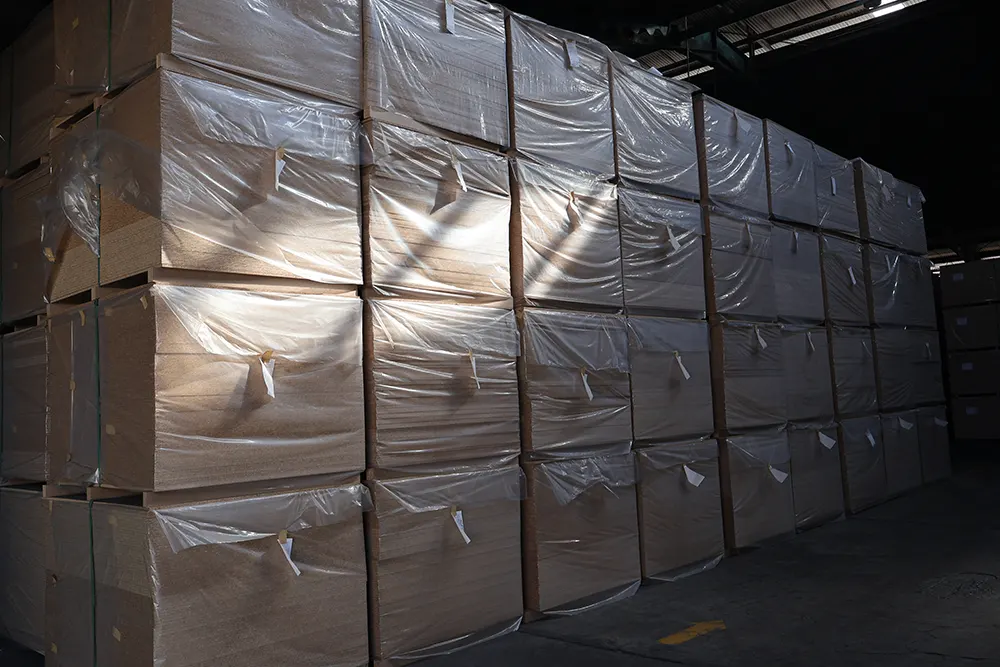



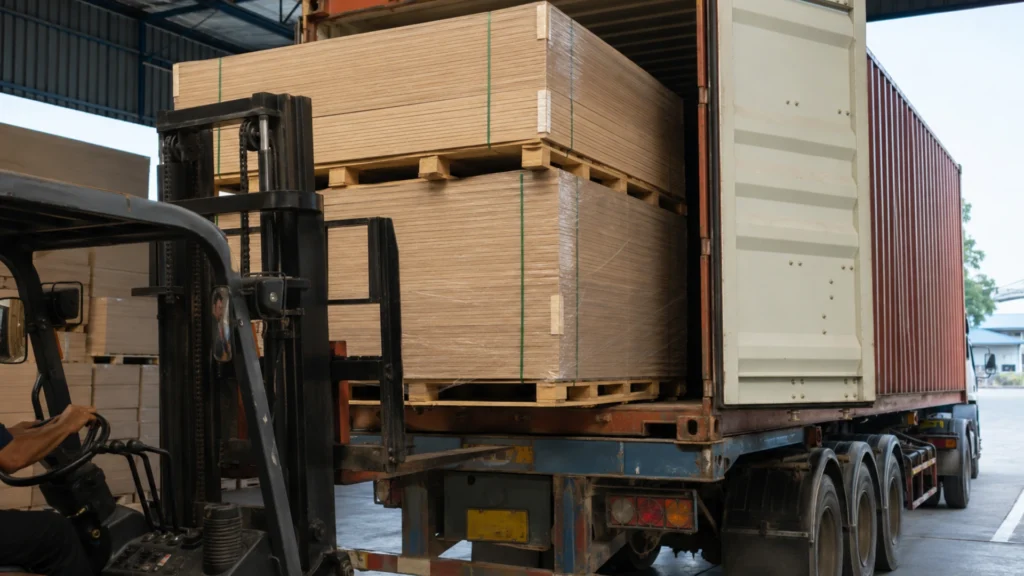
Quick answer: For standard 4×8 ft (1,220 x 2,440mm) panels, an 18mm particle board or MFC shipment typically loads several hundred sheets into a 40ft High Cube container, but the exact count depends on thickness, density, pallet configuration, and the container’s weight limit — not just its volume. Weight, not space, is usually what fills the container first.
Buyers sourcing particle board or melamine faced chipboard (MFC) for export almost always ask the same question early in negotiations: how many sheets fit in one container, and how many containers do I need for my order? Getting this right affects freight cost per unit, minimum order planning, and how you compare quotes between suppliers.
Why Weight Usually Fills the Container Before Space Does
A 40ft High Cube (40HQ) container has roughly 76 cubic meters of internal volume, but its maximum payload is limited to around 26,000–28,000 kg depending on the shipping line and route. Engineered wood panels are dense enough that most shipments hit the weight ceiling long before the container is physically full of space. This is why panel thickness and board density matter more to your final sheet count than the container’s dimensions.
Example Calculation
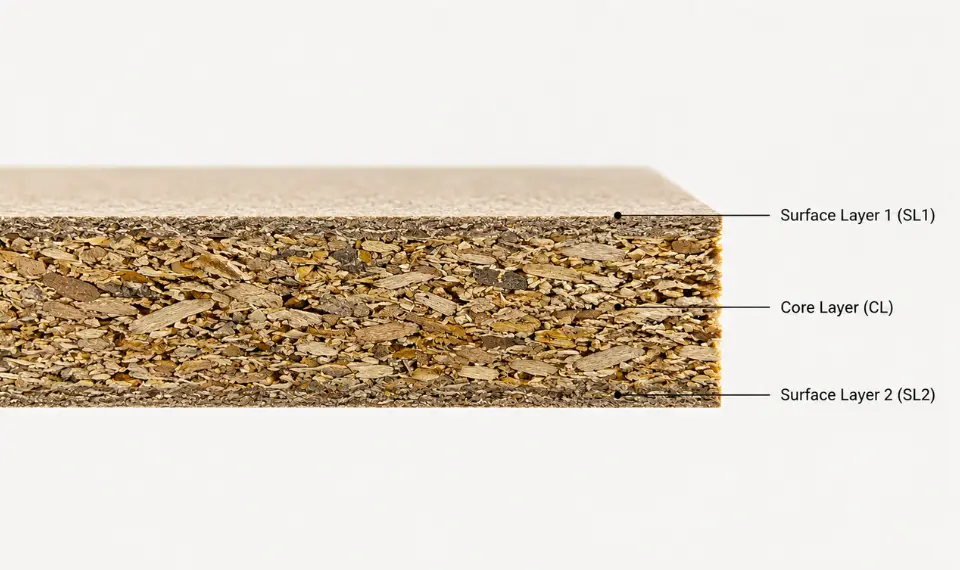
Using RPI’s standard particle board and MFC specifications (density range 0.40–0.90 g/cm³, with most commercial-grade board in the 0.60–0.70 g/cm³ range) and standard 1,220 x 2,440mm sheets, here is an illustrative estimate at a mid-range density of 0.65 g/cm³:
| Thickness | Approx. Weight per Sheet | Approx. Sheets in a 40HQ (weight-limited) |
|---|---|---|
| 9mm | ~17.4 kg | ~1,490 sheets |
| 18mm | ~34.8 kg | ~745 sheets |
| 25mm | ~48.4 kg | ~535 sheets |
These figures are for planning purposes only. Actual loadable quantity shifts with the specific density of the order, pallet height restrictions, whether sheets are loaded flat or on edge, packaging materials, and the carrier’s container weight allowance for your destination port. A supplier’s loading plan — built around your exact thickness, density grade, and destination — will always be more accurate than a generic formula.
What Affects Your Actual Container Count
Thickness and density. Thinner boards and lower-density cores pack more sheets per container by weight; thicker or higher-density boards (such as HMR grades) reach the weight limit with fewer sheets.
Pallet configuration. Sheets loaded on standard export pallets with corner protectors and strapping use slightly more volume than bulk-stacked sheets, but they load and unload far faster and arrive with less edge and corner damage — a trade-off most buyers accept.
Mixed-thickness orders. If your order combines several thicknesses or a mix of particle board and MFC, the total sheet count per container will not scale linearly from a single-thickness example; each combination needs its own loading calculation.
Destination port restrictions. Some ports and inland transport routes have stricter weight limits than the container’s rated payload, which can reduce the practical maximum below the theoretical figure.
Getting an Accurate Loading Plan
Because the real number depends on your specific order, the most reliable way to plan container quantities is to share your target thickness, density grade, and destination port with your supplier and request a loading plan calculated for that exact specification, rather than relying on a general rule of thumb.
Source Particle Board and MFC With a Loading Plan Built for Your Order
PT Rimba Partikel Indonesia (RPI) has manufactured particle board and MFC in Kendal, Central Java since 1990, with Sumitomo Forestry as a major shareholder and production on a ContiRoll Siempelkamp continuous press — the first of its kind in Asia. RPI is JIS-certified (since 2007), FSC-sourced, and holds CARB Phase 2, ISO 9001/14001/45001, and TKDN compliance, making it a reliable partner for buyers who need consistent specs shipment after shipment.
For an export loading plan matched to your specific order — thickness, density, container type, and destination — contact RPI’s export team on WhatsApp with your target volume and specifications.