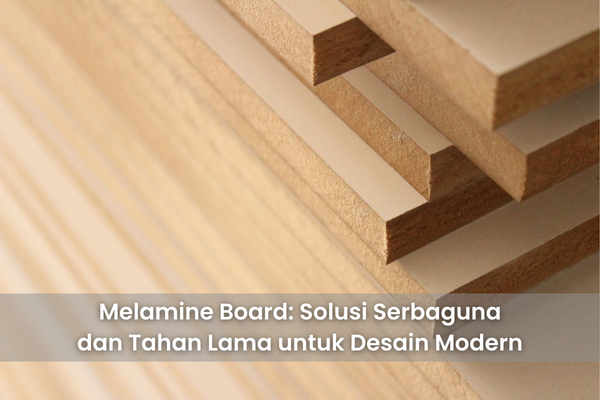



MFC board has become one of the most widely used materials in the furniture and interior industry and for good reason. From kitchen cabinets and office desks to wardrobes and wall panels, MFC combines durability, design flexibility, and cost-efficiency in ways that solid wood simply cannot match at scale.
In this guide, we break down the 8 key advantages of Melamine Faced Chipboard, how it compares to alternatives, and what to look for when choosing the right grade for your project. If you are evaluating materials for your next furniture build, this is what you need to know.
What is Melamine Faced Chipboard (MFC)?
MFC is an engineered wood panel made from a compressed particle board core, surfaced on both sides with a melamine resin layer. The melamine layer is heat-fused to the board under high pressure, creating a hard, smooth surface that is resistant to scratches, stains, and moisture.
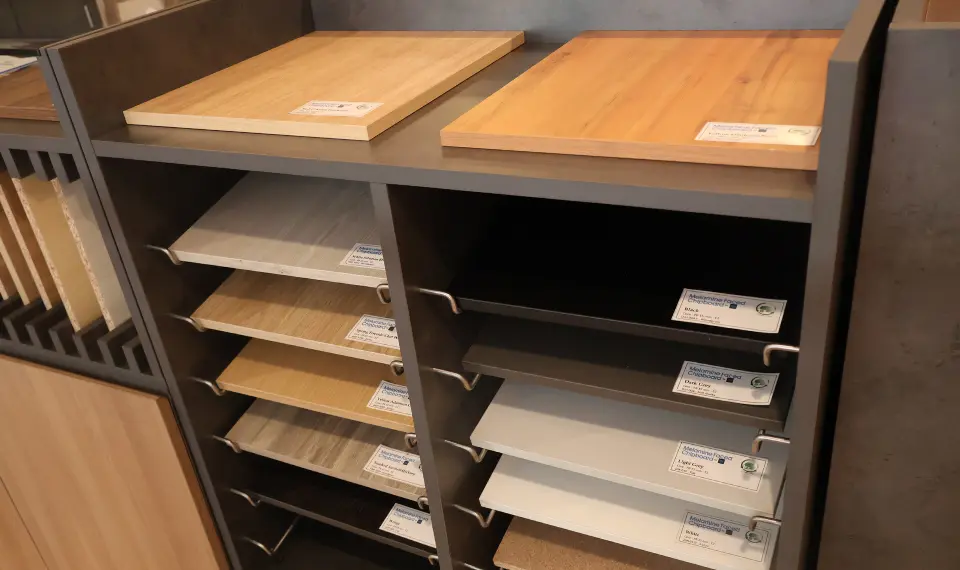
The result is a panel that looks and performs like premium material at a fraction of the cost of solid wood or veneer. MFC is available in thicknesses from 6mm to 30mm (6 / 9 / 12 / 15 / 18 / 20 / 25 / 30mm), and comes in over 150 colour and texture options including wood grain, solid colours, stone-effect, and high-gloss finishes.
For a full breakdown of RPI’s MFC board specifications and available sizes, see our MFC Board product page →
8 Key Advantages of Melamine Faced Chipboard
Melamine Faced Chipboard (MFC) offers a number of advantages that make it a desirable and popular material in furniture making.
First of all, MFC is highly resistant to scratches, stains, and wear. The strong and durable melamine coating on the surface of MFC, makes it more resistant to everyday damage, such as scratches from sharp objects or stains from liquid spillages.
The excellent durability of MFC makes it a preferred choice for frequently used furniture, such as tables, cabinets, and bookshelves. In detail, here are some of the main advantages of Melamine Faced Chipboard:
1. Scratch and Stain Resistant
The melamine surface on MFC board is significantly harder than painted MDF or standard wood finishes. The heat fused melamine layer creates a barrier that resists everyday scratches, spills, and stains from normal use.
This makes MFC particularly well suited for high traffic furniture kitchen worktops, office desks, retail counters where daily wear is unavoidable. Unlike painted surfaces that chip and peel over time, the melamine surface maintains its appearance through years of regular use.
2. Wide Design Variety
MFC is available in more than 150 colour and texture variants, from natural teak and walnut grain to contemporary solid tones and high gloss surfaces. No other material in the same price range offers this level of design flexibility.
RPI’s MFC catalogue includes wood grain, solid colours, high gloss, suede, and metallic finishes updated regularly to follow interior design trends. Browse the full MFC colour and texture catalogue →
3. Most Affordable Option
MFC is consistently less expensive than MDF, plywood, blockboard, and solid wood both in material cost and total production cost, since MFC requires no additional painting, laminating, or coating after cutting and assembly. For large scale furniture manufacturing, this cost difference is significant and directly impacts margin.
4. Strength and Stability
The particle board core of MFC provides sufficient strength for the vast majority of standard furniture applications. MFC panels from RPI meet JIS A 5908 standards for internal bond strength and modulus of rupture, making them reliable for load-bearing furniture applications including shelving, cabinet carcasses, and office desks.
Unlike solid wood, MFC maintains consistent dimensions in dry indoor environments no warping, shrinking, or expanding due to humidity changes.
5. Easy Maintenance
The smooth, non porous melamine surface is easy to clean, a damp cloth is all that is needed for most spills and stains. No special maintenance, re-coating, or periodic surface treatment is required, unlike solid wood furniture that needs regular polishing and occasional refinishing.
6. Environmentally Friendly
MFC board makes use of wood fibre that would otherwise be waste the wood chips, sawmill shavings, and off cuts that are by products of the timber industry. By using these materials as the particle board core, MFC is more resource efficient than materials that require whole timber.
RPI’s particle board core is produced using wood fibre from certified sustainable sources, supporting responsible forestry practices in Indonesia.
7. Moisture Resistance Options (HMR)
For applications in humid environments, bathrooms, kitchens, and laundry areas MFC boards are available with an HMR (High Moisture Resistance) core. HMR particle board contains a higher density of moisture-resistant resin binders, giving it significantly better performance in wet conditions compared to standard particle board.
The green-tinted core of HMR board is identifiable at a cut edge. In Indonesia’s tropical climate, HMR is recommended as the minimum specification for all kitchen and bathroom cabinetry.
Learn more: HMR Particle Board — What It Is and When to Use It →
8. Consistency at Scale
Unlike solid wood, MFC panels are manufactured to precise dimensions and tolerances. Every sheet from the same production batch will have identical thickness, surface finish, and colour which matters enormously for furniture manufacturers producing at volume.
There is no grain variation, no warping risk from drying, and no material waste from natural defects. This consistency translates directly into faster production, less off-cut waste, and more predictable quality control across large batches.
With these advantages, Melamine Faced Chipboard (MFC) has proven itself as a reliable and popular material in furniture making.
With a combination of beauty, strength, and affordability, MFC is the perfect solution for creating durable and visually appealing furniture.
MFC Technical Specifications
RPI produces MFC in two formats — ready stock for immediate availability, and custom orders for projects with specific design or performance requirements.
Size, Core & Design Options
| Parameter | Ready Stock | Custom Order |
|---|---|---|
| Size | 1,220 x 2,440 mm / 1,220 x 2,740 mm | 1,220 x 2,440 mm / 1,220 x 2,740 mm |
| Core | PB E2, E1, CARB P2, E0, E0S | MDF E2, E1, CARB P2, HMR |
| Thickness | 6 / 9 / 12 / 15 / 18 / 20 / 25 / 30 mm | By request (minimum order quantity applies) |
| Design | Solid color collection | Premium, stone, wood & non-wood collections |
| Emboss surface | — | Alutex, Rainy, Timber, Flat, Sand, Fabric, Woody, Stone |
| Face | Double-sided | Different design/color/emboss per face available |
Surface Performance
Every RPI MFC batch is tested against the following standards:
| Test | Method | Result |
|---|---|---|
| Chemical resistance | 5% acetic acid & 1% sodium carbonate | No discoloration or visible change after 24 hours |
| Scratch resistance | Diamond needle, 0.75N | No marks or visible change |
| Heat resistance | 180°C for 10 minutes | No marks or discoloration |
| Crack resistance | 70°C oven for 24 hours | No cracking observed |
| Steam resistance | Boiling water steam for 1 hour | No swelling or visible change |
| Stain resistance | Coffee, tea, soy sauce, sauce, milk, honey | No discoloration |
Need a moisture-resistant core for humid environments? See our HMR Particle Board guide →
MFC Board Applications in the Furniture Industry
Melamine Faced Chipboard (MFC) has a wide range of uses in the furniture industry. In this context, MFC serves as a base material for constructing various types of furniture and also functions as a material for wall panels, partitions, and inner doors.
The following are some common uses of MFC in the furniture industry:
- Kitchen Cabinets and Storage
MFC is the standard material for modern kitchen cabinets. The combination of surface durability, design options, and cost-efficiency makes it the preferred choice for cabinet carcasses, drawer fronts, and door panels. For kitchen applications, always specify MFC with an HMR core for reliable performance in humid conditions.
Why MFC is the perfect choice for kitchens → - Office Furniture
Desks, workstations, bookshelves, and storage units are commonly produced using MFC because of its scratch resistance, clean professional appearance, and cost efficiency. The wide range of neutral and wood-grain finishes suits modern office interiors well.
Creating attractive office furniture designs with MFC → - Wardrobes and Bedroom Furniture
MFC is ideal for wardrobe carcasses, door panels, and interior shelving. The ready-to-use surface means no additional finishing is required after assembly, reducing production time and cost. - Wall Panels and Partitions
MFC panels are used in both commercial and residential interiors as decorative wall panels, partition systems, and ceiling linings particularly in hospitality, retail, and office fit-out projects.

MFC vs Other Materials: Quick Comparison
Not sure if MFC is right for your project? Here is how it compares:
- MFC vs MDF: MFC has a harder, more durable pre-finished surface. MDF is better for intricate routing and painting. For most ready-to-use furniture, MFC is more practical and cost-effective. Full MFC vs MDF comparison →
- MFC vs Solid Wood: MFC is more affordable, more dimensionally stable, and easier to maintain at scale. Solid wood offers a premium natural aesthetic but at significantly higher cost and weight.
- MFC vs PVC Board: MFC offers more design variety and better surface hardness. PVC board has higher water resistance but fewer finish options. MFC vs PVC Board — which is better? →
Frequently Asked Questions
Is MFC board waterproof?
MFC has good moisture resistance on its surface, but the particle board core is not fully waterproof. For areas with regular humidity or steam kitchens and bathrooms always choose MFC with an HMR (High Moisture Resistance) core. For areas with direct water exposure, additional waterproofing measures are required. Is melamine chipboard waterproof? Full answer →
How thick should MFC board be for furniture?
The most common thicknesses are 16mm and 18mm for cabinet carcasses and shelving. 12mm is used for back panels and lightweight partitions. 25mm is recommended for worktops and heavy-load shelving. For kitchen base cabinets, 18mm HMR is the standard specification.
How does MFC compare to MDF?
MFC has a pre-finished melamine surface that is ready to use without painting. MDF requires additional finishing but machines more cleanly for shaped profiles and detailed routing. For most standard furniture applications, MFC is more practical and cost-effective. Full MFC vs MDF comparison →
Can MFC board be cut to size?
Yes. MFC can be cut cleanly using a fine-tooth saw blade. For chip-free edges, use a scoring saw or have it cut to size professionally →. Edge banding is then applied to cover the exposed particle board core on all cut edges.
What types of MFC board does RPI produce?
PT Rimba Partikel Indonesia produces MFC board with both standard and HMR particle board cores, available in 6mm to 30mm thicknesses and 150+ colour and texture variants. View the full MFC product range →
Where can I buy MFC board in Indonesia?
PT Rimba Partikel Indonesia manufactures and supplies MFC board directly from our facility in Kendal, Central Java. We serve furniture manufacturers, contractors, and distributors across Indonesia and internationally. Contact us at admin-rpi@rimbapartikel.com or WhatsApp +62 811-2679-094 for pricing and MOQ.
Related Articles
- 6 Types of Particle Board — MFC, HMR, Standard & More →
- MFC Board vs MDF: Full Comparison →
- HMR Particle Board: What It Is and Key Advantages →
- Particle Board: Advantages and Disadvantages (Bahasa Indonesia) →
Ready to Source MFC Board for Your Project?
PT Rimba Partikel Indonesia supplies high-quality MFC board directly from our manufacturing facility in Kendal, Central Java. Since 2019, RPI has produced MFC in-house in partnership with AICA, combining Japanese-standard quality control with a wide range of colors and finishes. We serve furniture manufacturers, contractors, and distributors across Indonesia and internationally.
📞 WhatsApp: +62 811-2679-094 📧 Email: admin-rpi@rimbapartikel.com 🔗 View MFC Board Specifications & Pricing → 🔗 View Particle Board Specifications →