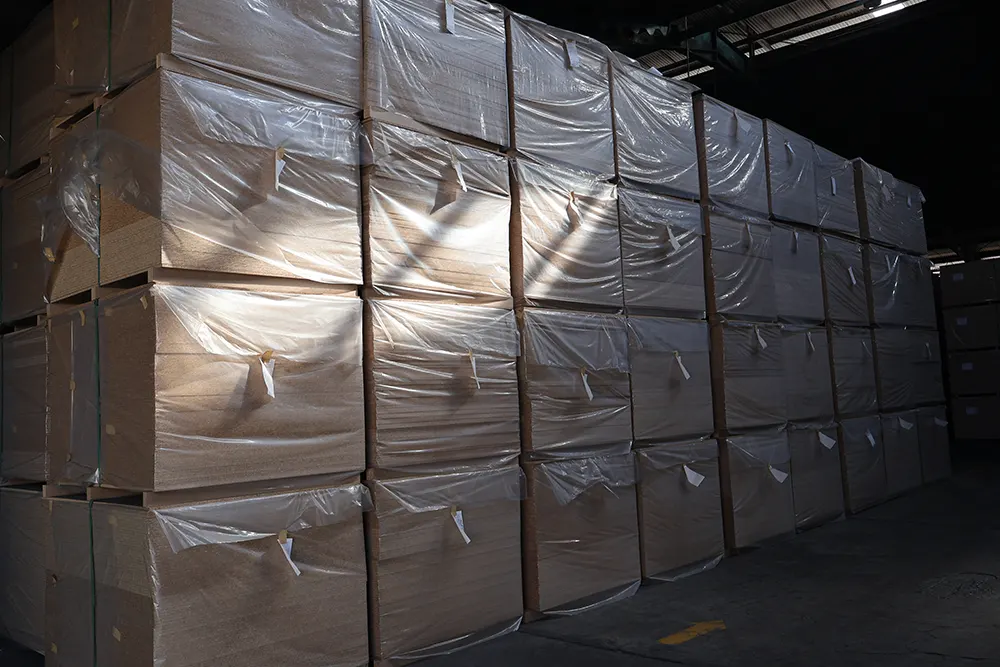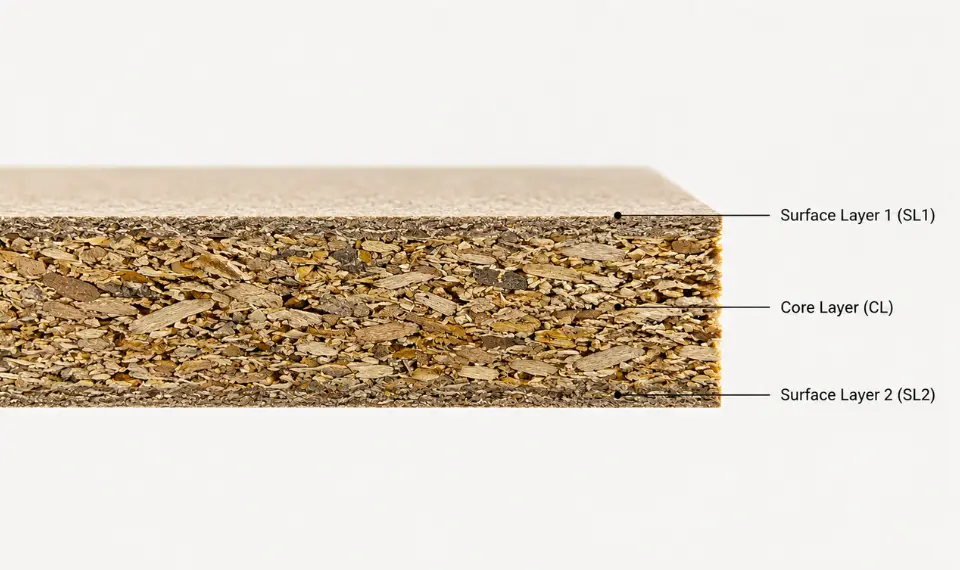



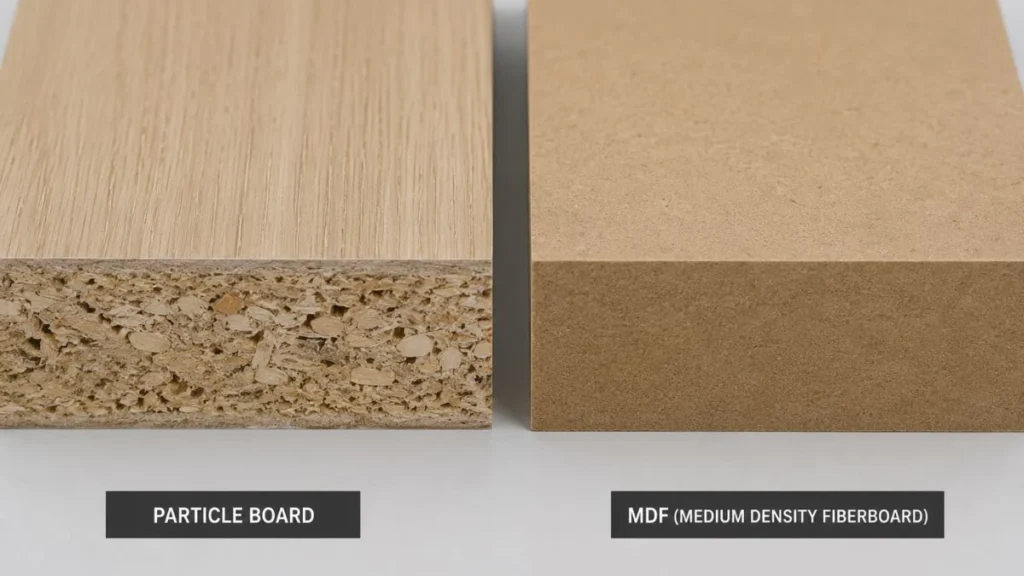
Particle board and MDF (Medium Density Fiberboard) are both engineered wood panels made from compressed wood material and resin — but they differ in composition, strength, and moisture resistance. Particle board uses coarser wood chips and shavings, making it lighter and more affordable, while MDF uses fine wood fibers, giving it a denser, smoother, and generally stronger panel. This guide compares both materials side by side to help you choose the right one for your project.
Partikel Board itu apa?
Particle board, also known as chipboard, is made by compressing wood chips, sawmill shavings, and other wood waste with a resin binder under heat and pressure. The result is an affordable, uniform panel with a surface that’s easy to paint, laminate, or finish with melamine. For a full breakdown of particle board types and grades, see our particle board types guide.
Apa itu MDF?
MDF (Medium Density Fiberboard) is made by breaking down wood residuals into fine wood fibers, then combining them with wax and resin binder and pressing them into panels under high temperature and pressure. This produces a smoother, denser, more uniform panel than particle board, with no visible wood grain — ideal for detailed machining, routing, and painted finishes.
Particle Board vs MDF: Side-by-Side Comparison
| Partikel Board | MDF | |
|---|---|---|
| Raw material | Wood chips, shavings, sawmill waste | Fine wood fibers |
| Kerapatan | Lower, less uniform | Higher, uniform |
| Permukaan | Rougher, requires laminate/melamine for finish | Smooth, paint-ready |
| Kekuatan | Lower load-bearing capacity | Stronger, more rigid |
| Ketahanan terhadap kelembapan | Lower (swells if untreated) | Moderate (still needs sealing in wet areas) |
| Machining | Prone to chipping on detailed cuts | Machines cleanly, ideal for routing/shaping |
| Biaya | Lebih terjangkau | Biaya lebih tinggi |
| Common use | Flat-pack furniture, cabinet carcasses, shelving | Painted furniture, moldings, detailed cabinet doors |
For projects requiring moisture resistance in either material, RPI offers HMR (High Moisture-Resistant) particle board — see our HMR particle board guide.
Technical Specifications (RPI Particle Board)
RPI’s particle board is tested against JIS A 5908:2022 and JIS A 1460:2021 standards:
| Titik Pemeriksaan | Standar |
|---|---|
| Kerapatan | 0.40 – 0.90 g/cm³ |
| Moisture Content | 5 – 13% |
| MOR (Modulus of Rupture) | Non-JIS min 12.0 N/mm² / JIS min 13.0 N/mm² |
| Internal Bond | Min 0.2 N/mm² |
| Screw Holding Face (15mm+ thickness) | Min. 400 N (Minimum 400 N) |
| Emisi Formaldehida | E2, E1 F**, E0 F***, E0S F**** grades available; CARB Phase 2-EPA compliant |
Available in thicknesses from 6mm to 30mm (6/9/12/15/18/20/25/30mm) and standard sizes up to 4×9 ft.
Which is Stronger: MDF or Particle Board?
MDF is generally stronger than particle board due to its higher density and uniform fiber structure, making it less prone to splitting or cracking under load. However, particle board with a quality melamine-faced surface (MFC) and the right grade — such as HMR for moisture-prone areas — can match or exceed MDF’s practical durability for standard furniture applications, at a lower cost. Neither material matches the strength of solid wood or plywood for heavy structural use.
Is MDF Cheaper Than Particle Board?
No — particle board is generally more affordable than MDF. The cost difference comes from raw material and processing: MDF’s fine-fiber production process requires more processing than particle board’s coarser wood chip composition. For budget-conscious, large-scale furniture production, particle board remains the more cost-effective choice.
Particle Board vs MDF vs Plywood: Quick Comparison
If you’re also considering plywood, here’s how it compares to both materials:
| Partikel Board | MDF | Plywood | |
|---|---|---|---|
| Structure | Compressed wood chips | Compressed wood fibers | Layered wood veneers (cross-grain) |
| Kekuatan | Paling rendah | Sedang | Paling tinggi |
| Ketahanan terhadap kelembapan | Lowest (untreated) | Sedang | Best (among the three) |
| Bobot | Light | Berat | Sedang |
| Paling cocok untuk | Budget furniture, flat-pack, cabinet carcasses | Painted furniture, moldings, detailed profiles | Structural applications, outdoor-adjacent use, higher-end furniture |
Plywood’s layered construction gives it superior strength and moisture resistance compared to both particle board and MDF, but at a higher price point. For projects requiring plywood-level durability at a lower cost, HMR particle board is often a practical middle ground.
Aplikasi Umum
Partikel Board is best suited for:
- Flat-pack and ready-to-assemble furniture
- Cabinet carcasses and shelving
- Budget-conscious interior projects
MDF is best suited for:
- Painted furniture and cabinet doors
- Decorative moldings and trim
- Projects requiring detailed routing or shaped profiles
Pertanyaan yang Sering Diajukan
Which is stronger, MDF or particle board? MDF is generally stronger due to its higher density and uniform fiber structure. Particle board with an HMR core and melamine finish can offer comparable practical durability for standard furniture use at a lower cost.
Is MDF more expensive than particle board? Yes, MDF typically costs more than particle board due to its more involved manufacturing process using fine wood fibers rather than coarser wood chips.
Can particle board be used in kitchens or bathrooms? Standard particle board is not recommended for humid areas. For kitchens and bathrooms, choose particle board with an HMR (High Moisture-Resistant) core, which is treated with water-resistant adhesives.
What is the difference between particle board and plywood? Plywood is made from layered wood veneers, giving it higher strength and moisture resistance than particle board, which is made from compressed wood chips. Plywood typically costs more.
Which material is better for painted furniture, MDF or particle board? MDF is better suited for painted finishes due to its smooth, uniform surface. Particle board’s rougher surface typically requires a laminate or melamine finish rather than paint.
Get Particle Board & MDF-Alternative Products from PT Rimba Partikel Indonesia
PT Rimba Partikel Indonesia (RPI) has manufactured high-quality particle board and MFC board since 1990, based in Kendal, Central Java. Our particle board is produced using ContiRoll continuous press technology from Siempelkamp — the first of its kind in Asia — and certified to JIS A 5908:2022 and JIS A 1460:2021 standards, with production capacity of 109,000 m³ per year.
Contact RPI for particle board pricing, specifications, and samples.