

Kitchen cabinet manufacturers should specify HMR (moisture-resistant) core as standard, not an upgrade — the sustained humidity and splash exposure in kitchen environments make standard-grade particle board or MDF a reliability risk. Beyond core grade, colour consistency across large orders and supplier lead-time reliability are the two factors that most affect production schedules.
Kitchen cabinets face a different set of demands than general furniture — sustained humidity, splash exposure near sinks, and heat near cooking areas. For manufacturers specifying material at production volume, getting the core grade and supplier relationship right matters more here than in most other furniture categories. This guide covers what kitchen cabinet manufacturers should look for in material sourcing.
Why Core Grade Isn’t Optional for Kitchen Cabinets
Unlike general furniture, kitchen cabinets are consistently exposed to moisture — from splashes, steam, humidity, and occasional spills. Standard-grade particle board or MDF will swell or delaminate under this kind of sustained exposure over time. HMR (High Moisture Resistant) particle board or HMR MDF core — the same “green MDF” used for MFF — should be the default specification for kitchen cabinet production, not an optional upgrade reserved for premium lines.
Colour and Finish Consistency Across Orders
For manufacturers running repeat production, colour matching between batches matters as much as the core material itself — a visible shade difference between cabinet doors from different production runs is a quality issue that shows up immediately to the end customer. This depends on:
- Press technology consistency at the supplier — continuous presses generally produce more uniform output across runs than older batch systems
- Ready-stock vs custom colour — ready-stock Solid Colours are easier to reorder consistently than custom finishes, which are produced per batch
- Clear reorder specifications — keeping a documented colour/code reference for repeat orders reduces the risk of mismatch
Specification Checklist for Kitchen Cabinet Production
- Core: HMR particle board or HMR MDF (MFF) — not standard grade
- Thickness: typically 15–18mm for cabinet carcasses; thinner options available for door faces or panel surfacing
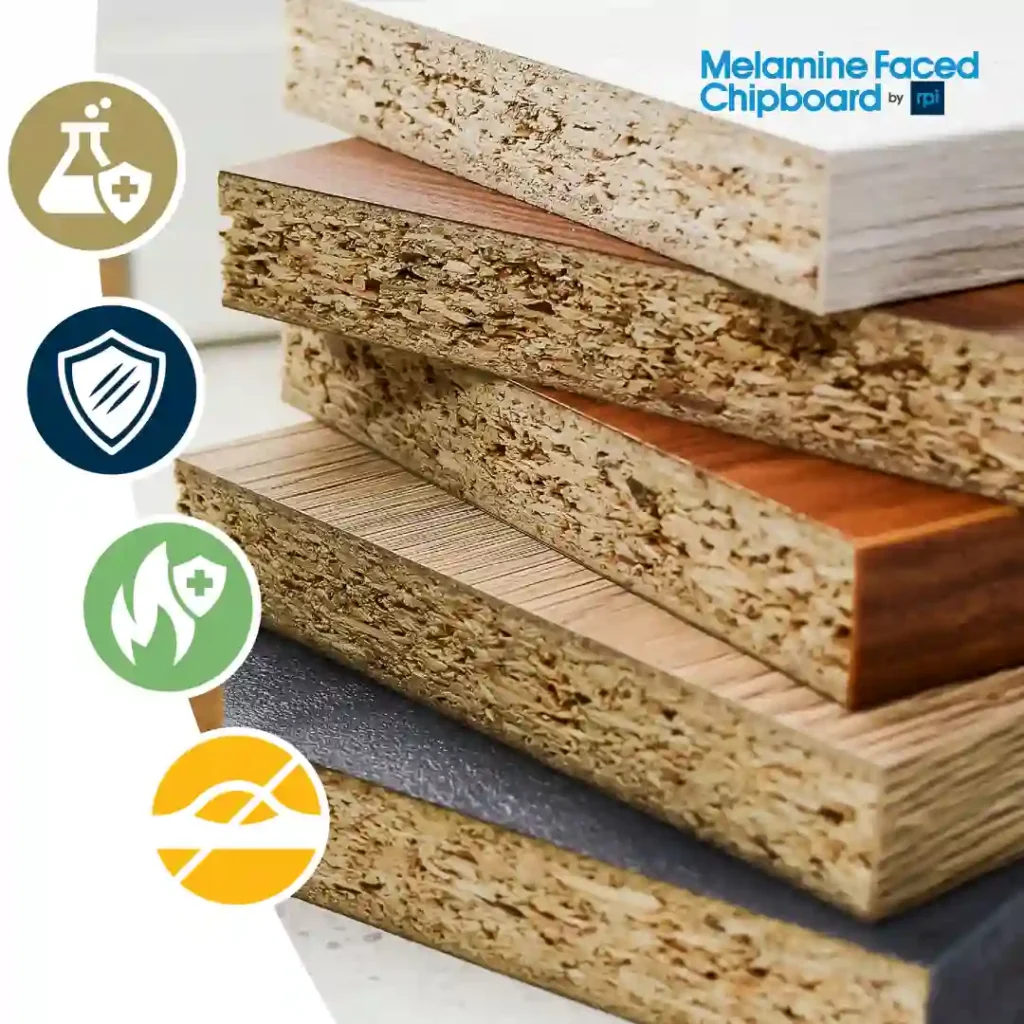
- Surface: melamine finish (MFC or MFF) for a durable, pre-finished surface that doesn’t require separate painting
- Emission grade: confirm the formaldehyde emission grade required by your destination market — this varies by country and retailer policy
- Edge treatment: exposed edges near sinks and cooktops benefit from PVC or matching edge banding regardless of core grade, since edges are the most moisture-vulnerable point on any panel
Common Mistakes in Kitchen Cabinet Material Sourcing
- Using standard-grade core to reduce cost, then absorbing the cost of warranty claims or replacements from moisture damage down the line
- Mixing suppliers for different production batches without confirming colour/finish consistency, leading to visible mismatches in finished cabinet runs
- Underspecifying edge protection, since even HMR core benefits from sealed or banded edges at direct splash zones
- Not confirming emission grade compliance early, especially for export orders where the requirement can vary significantly by destination
Sourcing Kitchen-Grade Material from RPI
PT Rimba Partikel Indonesia (RPI) supplies HMR particle board and HMR MDF (MFF) — both suited to kitchen cabinet production — from a JIS-certified facility with FSC-certified material sourcing. RPI’s melamine surfaces (MFC and MFF) are tested for chemical, heat, scratch, and stain resistance relevant to kitchen environments, and production on a continuous ContiRoll press supports colour consistency across large manufacturing orders.
Contact RPI’s team at admin-rpi@rimbapartikel.com or chat with us on WhatsApp to discuss specification for your cabinet production line.
FAQ
Do all kitchen cabinets need HMR core, or just base cabinets near water?
HMR core is generally recommended for the full cabinet run in a kitchen, not just cabinets directly adjacent to sinks — ambient humidity affects the whole space over time, not just direct splash zones.
What’s the difference between HMR particle board and HMR MDF for kitchen cabinets?
Both offer moisture resistance; particle board (with MFC finish) is typically more cost-efficient for cabinet carcasses, while HMR MDF (MFF) suits painted doors or components needing finer edge detail.
How do I keep colour consistent across multiple cabinet production orders?
Specify ready-stock Solid Colours where possible, since they’re easier to reorder consistently, and confirm your supplier’s press technology — continuous presses generally deliver more consistent output across production runs.