


Particle board furniture is durable enough for everyday use when the right density, thickness, and grade are matched to the application — it’s a standard core material for wardrobes, cabinets, and office furniture worldwide, especially when faced with melamine (MFC) for a finished surface.
Particle board gets an unfair reputation in some furniture conversations, often based on low-density, unbranded board rather than the material itself. In reality, particle board is the core material behind a huge share of modern furniture — from flat-pack wardrobes to built-in kitchen cabinetry — because it’s stable, consistent, and cost-effective at scale. This guide covers where particle board furniture performs well, how to choose the right grade, and what to check before you buy.
What Is Particle Board Furniture?
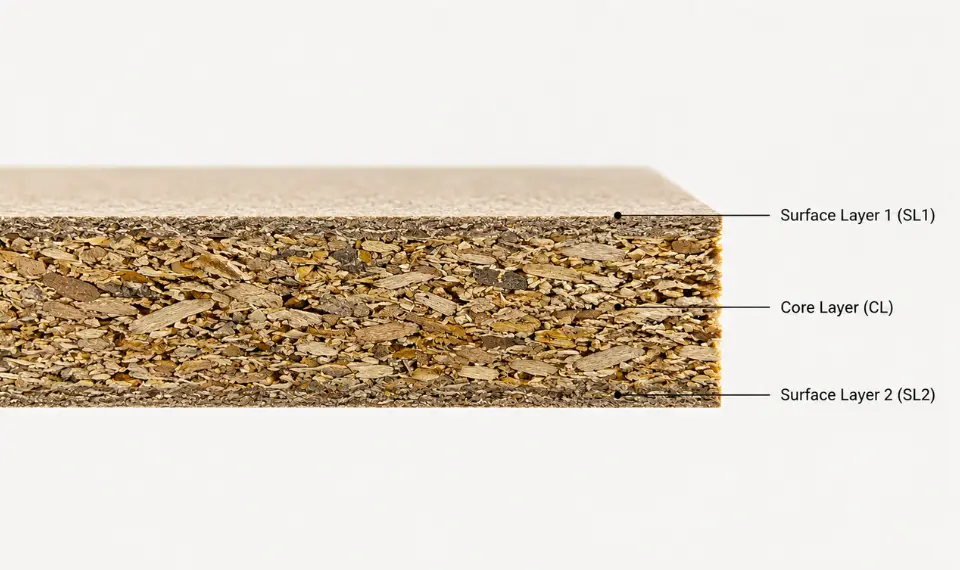
Particle board furniture uses compressed wood particles bonded with resin as the core structural material, usually finished with a decorative surface — most commonly melamine faced chipboard (MFC), veneer, or laminate. The core provides structure and stability; the surface layer provides the finish, colour, and day-to-day durability against scratches and moisture.
Why Particle Board Is Used in Furniture
Under the JIS A 5908:2022 standard, particle board is manufactured to defined strength benchmarks:
- Kerapatan — 0.40–0.90 g/cm³, chosen based on the furniture’s structural demands
- Ikatan Internal (IB) — minimum 0.2 N/mm², which determines resistance to delamination under load
- Screw holding strength — minimum 400N for boards 15mm and thicker, relevant for hinges, brackets, and fittings
- Kadar Air — kept within 5–13%, which keeps panel dimensions stable after manufacturing
These properties are why particle board holds up under the repeated stress of drawers, hinges, and shelving — it’s engineered for consistency in a way that natural wood, with its grain variation, isn’t.
Common Particle Board Furniture Applications
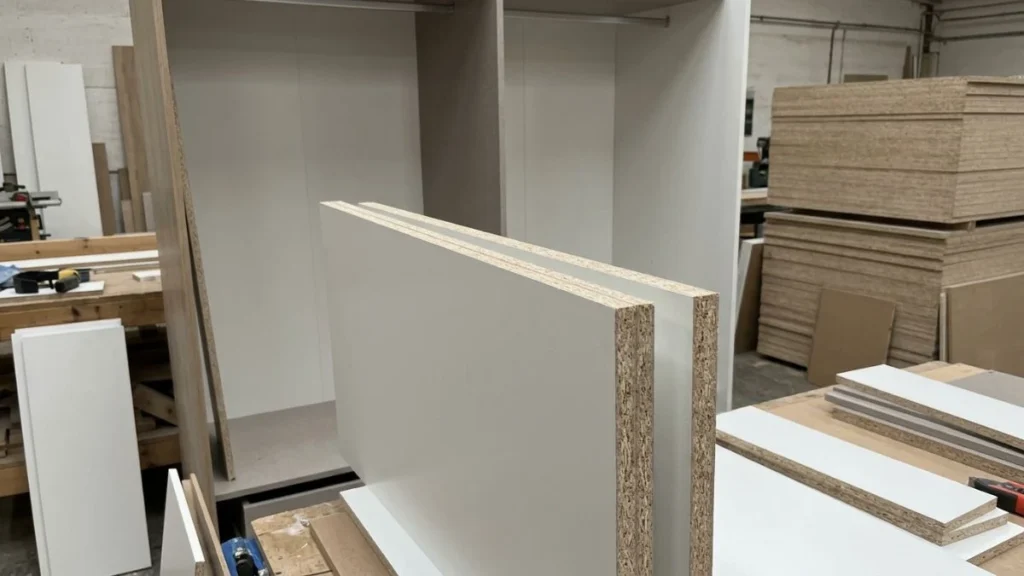
Wardrobes and cabinetry. Large flat panels benefit from particle board’s dimensional stability — it won’t warp or twist the way solid wood can across a wide panel.
Office desks and workstations. Particle board cores with a laminate or MFC surface are standard in commercial office furniture, balancing cost, weight, and durability for high-turnover environments.
Shelving and bookcases. Mid-range thicknesses (15–18mm) with standard bonding strength handle typical shelving loads without excessive cost.
Kitchen and bathroom furniture. For moisture-exposed applications, HMR (High Moisture Resistant) particle board is the right core choice rather than standard grade — the resin formulation is specifically designed to resist swelling from humidity and splashing.
Choosing the Right Grade for Furniture
Not every piece of furniture needs the same specification:
- Load-bearing furniture (shelving, desks) — prioritize density and internal bond strength over emission grade.
- Furniture near moisture (kitchen cabinets, bathroom vanities) — use HMR core, regardless of finish.
- Furniture for regulated export markets — confirm the formaldehyde emission grade required (E1, E0, E0S, or CARB Phase 2/EPA) before production, since this varies by destination country.
- Visible/finished surfaces — pair the core with an MFC or laminate face rather than leaving raw particle board exposed, both for appearance and added surface durability.
Particle Board vs Solid Wood and Plywood for Furniture
Particle board isn’t a direct substitute for solid wood or plywood in every application — each has different strengths. For a detailed side-by-side comparison of strength, cost, and best-use cases, see our particle board vs MDF comparison. In general, particle board suits flat, large-panel furniture well, while solid wood remains preferable for load-bearing joinery like chair frames or table legs that rely on grain strength.
Tips for Longer-Lasting Particle Board Furniture
- Avoid prolonged standing water on any exposed edge, even with HMR core — edges are more vulnerable than the faced surface.
- Use the correct screw type and pilot holes for fittings, since particle board’s screw-holding strength depends on proper installation, not just board grade.
- Keep furniture on a level surface — uneven weight distribution stresses joints and fixings over time more than the board material itself.
FAQ
Is particle board furniture durable enough for daily use?
Yes, when the density and grade are matched to the application — furniture-grade particle board is manufactured to defined strength standards under JIS A 5908:2022, not an inferior byproduct material.
Should I choose HMR particle board for all furniture?
No — HMR is worth the extra cost specifically for moisture-exposed furniture like kitchen or bathroom cabinetry. For dry indoor furniture, standard core is sufficient.
What’s the difference between particle board furniture and MDF furniture?
Particle board and MDF differ in density, internal structure, and screw-holding characteristics — see our full comparison for application-specific guidance.
Get Furniture-Grade Particle Board from RPI
Need particle board specified for a furniture production line or project? Contact RPI’s team at admin-rpi@rimbapartikel.com or chat with us on WhatsApp. RPI is a JIS-certified manufacturer based in Kendal, Central Java, established in 1990, producing particle board and MFC to JIS A 5908:2022 standards with FSC-certified materials.