


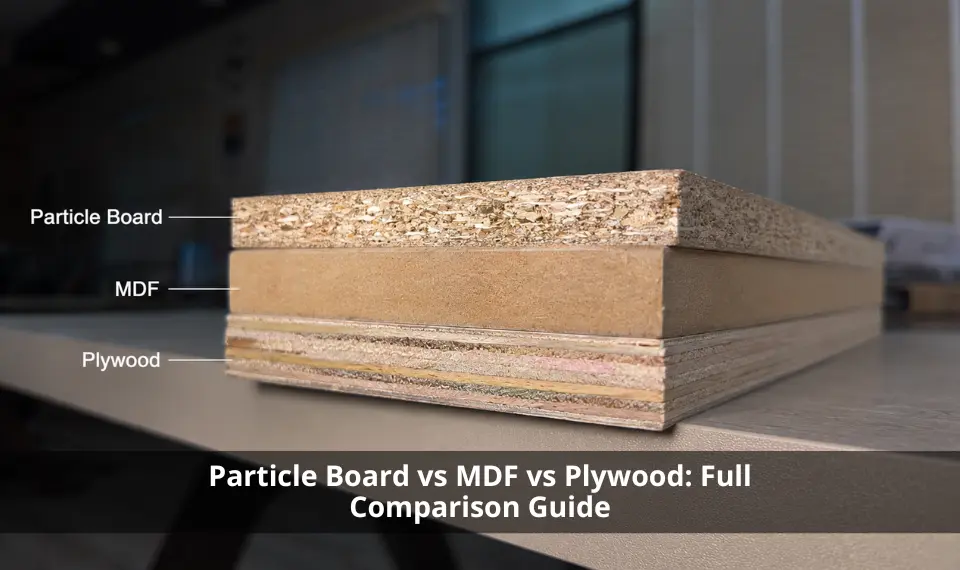
Choosing between particle board, MDF, and plywood is one of the most common material decisions in furniture and construction — and getting it wrong means either overpaying for performance you don’t need, or using a material that fails in its application.
All three are engineered wood products. All three are widely available. But they are made differently, perform differently, and belong in different situations. This guide gives you a direct, honest comparison across every factor that matters cost, strength, moisture resistance, workability, and best applications, so you can make the right call for your project.
Quick Answer: At a Glance Comparison
| Factor | Particle Board | MDF | Plywood |
|---|---|---|---|
| Cost | ⭐⭐⭐ Lowest | ⭐⭐ Medium | ⭐ Highest |
| Weight | Medium | Heavy | Medium |
| Surface smoothness | Good | Excellent | Moderate |
| Screw holding (face) | Good | Good | Very Good |
| Screw holding (edge) | Poor | Poor | Excellent |
| Moisture resistance | Low (HMR = High) | Low | Medium–High |
| Strength & stiffness | Low–Medium | Medium | High |
| Machinability | Good | Excellent | Good |
| Best surface finish | MFC / Laminate | Paint / Veneer | Veneer / Paint |
| Best for | Furniture carcasses | Painted furniture | Structural & outdoor |
| Worst for | Wet areas (standard) | Wet areas | Budget projects |
What is Particle Board?
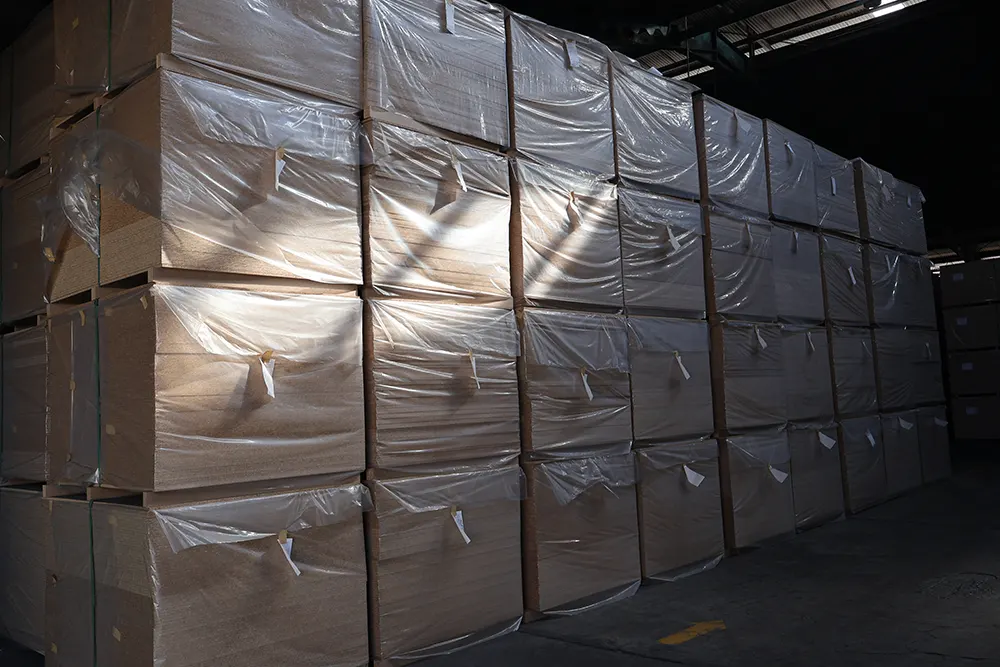
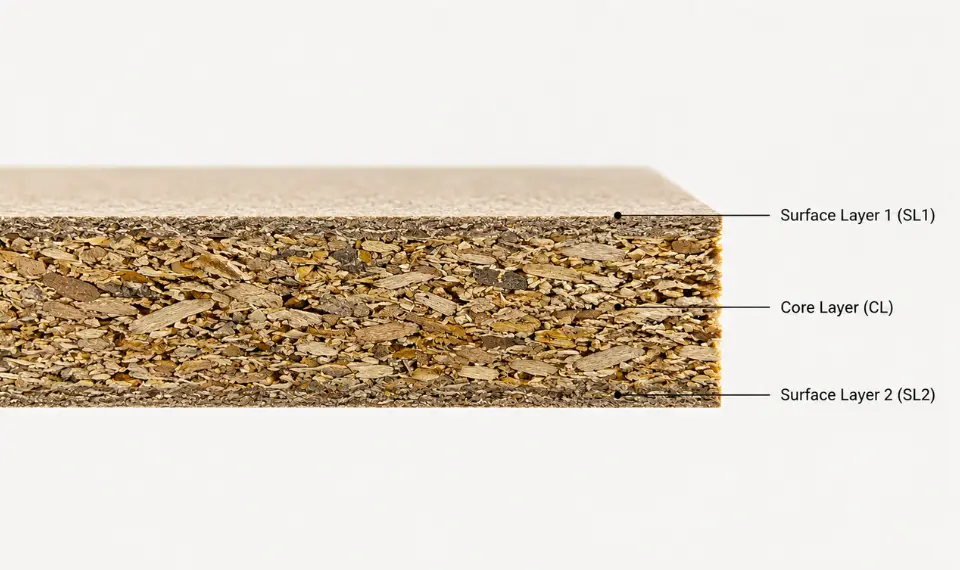
Particle board also called chipboard or particleboard is made by combining wood chips, sawdust, and sawmill shavings with synthetic resin binders, then pressing the mixture under heat and high pressure into flat sheets.
It is the most affordable of the three materials and the most widely used in flat-pack and volume furniture manufacturing. Its smooth, consistent surface makes it ideal as a substrate for MFC (Melamine Faced Chipboard) and HPL laminate.
Key variants relevant to furniture:
- Standard particle board — for dry indoor applications
- HMR particle board — for humid environments (kitchens, bathrooms)
- MFC board — particle board with factory-applied melamine surface, ready to use
Full guide: 6 Types of Particle Board Explained →
What is MDF?
Manufacturers produce MDF (Medium Density Fiberboard) by combining very fine wood fibres smaller and more uniform than particle board chips with wax and resin binders under heat and pressure.
The result is a dense, very smooth panel with no grain variation and consistent properties throughout. MDF must be painted, veneered, or laminated to be used as finished furniture it has no decorative surface of its own.
Key variants:
- Standard MDF — for dry indoor applications
- Moisture-resistant MDF — for humid environments, at higher cost
- Thin MDF (3mm–6mm) — for backing panels, drawer bottoms, decorative profiles
What is Plywood?
Plywood is made from thin layers (veneers) of wood peeled from logs, with each layer glued perpendicular to the one below. This cross-grain construction gives plywood its defining characteristic: strength in multiple directions simultaneously.
Unlike particle board and MDF, plywood retains real wood grain structure and can accept screws in edges almost as well as in faces. It is significantly stronger and more water-resistant than both particle board and MDF.
Key variants:
- Interior plywood — for dry indoor structural use
- Exterior / Marine plywood — for outdoor and wet applications
- Structural plywood — for construction and load-bearing use
- Decorative plywood — with hardwood veneer face for visible applications
Head-to-Head Comparison
1. Cost
Particle board is the cheapest of the three by a significant margin. MDF sits in the middle. Plywood especially structural and marine grades is the most expensive.
For large-scale furniture production, this cost difference has a direct impact on margin. A full bedroom set produced in particle board MFC costs considerably less than the same design in plywood.
Order: Particle Board < MDF < Plywood
For current pricing in Indonesia, contact RPI directly: View particle board pricing →
2. Strength and Load Capacity
Plywood wins clearly here. Its cross-grain construction gives it superior strength in both directions, making it the correct choice for structural applications, load-bearing shelving, and furniture that will carry heavy or dynamic loads.
MDF is denser and more uniform than particle board, giving it slightly better compressive strength and resistance to sagging under load. However, both MDF and particle board are significantly weaker than plywood.
For standard furniture shelving in particle board or MDF, the maximum safe span without a centre support is 600–700mm at 18mm thickness. Plywood of the same thickness can span 900–1000mm safely.
Order: Plywood > MDF > Particle Board
3. Moisture Resistance
This is where material selection is most critical especially in Indonesia’s tropical climate.
Standard particle board has low moisture resistance and will swell and delaminate when exposed to humidity over time. HMR particle board significantly improves on this suitable for kitchens and bathrooms. MFC surface adds further protection.
Standard MDF is actually more sensitive to moisture than standard particle board, it swells faster at edges when exposed to humidity. Moisture resistant MDF grades exist but are expensive.
Plywood provides the best natural moisture resistance among the three materials, and manufacturers can use marine grade plywood in fully wet environments.
What is HMR particle board and when should you use it? →
Order (dry): Plywood > HMR Particle Board > Standard MDF ≈ Standard Particle Board Order (humid): Plywood > HMR Particle Board >> Standard MDF ≈ Standard Particle Board
4. Surface Quality and Finish Options
MDF has the smoothest, most consistent surface of the three no grain, no voids, completely uniform. This makes it ideal for painting, as it accepts paint without raised grain or surface irregularities.
Particle board has a smooth, consistent surface suitable for laminating and MFC application, but it is not suitable for direct painting without a specialist primer.
Plywood has a natural wood grain surface that varies depending on the face veneer species. It accepts veneer, paint, and stain well, but its surface is less uniform than MDF for fine painting work.
For painting: MDF, For MFC/laminate: Particle Board, For natural wood appearance: Plywood.
5. Screw Holding and Edge Performance
This is one of the most practically important differences.
Particle board and MDF both hold screws well in their faces, but perform poorly at edges screws driven into the edge of particle board or MDF have limited holding power and can pull out under load. This is why edge joining particle board and MDF requires special hardware (cam locks, dowels, confirmat screws) rather than conventional screws.
Plywood holds screws excellently in both faces and edges its cross grain construction distributes load through multiple layers. This makes plywood far superior for any application where screws need to go into the edge of a panel.
Order: Plywood >> MDF ≈ Particle Board (face) Order (edge): Plywood >> MDF ≈ Particle Board
6. Workability and Machinability
MDF is the easiest to machine for detailed work.Its fine, uniform fibre structure allows manufacturers to route cleanly, create shaped profiles, and mould decorative edges easily. “Manufacturers typically make cabinet doors with shaped profiles from MDF.
Particle board cuts cleanly with a fine-tooth blade and machines reasonably well for straight cuts and standard furniture production. It does not route as cleanly as MDF.
“Workers can cut and shape plywood easily.” but its layered structure means edges show the alternating veneer layers (known as “voids” in lower grades). High-quality plywood routes reasonably well but not as cleanly as MDF for decorative profiles.
For detailed routing: MDF, For straight-cut production: Particle Board, For structural cutting: Plywood.
7. Weight
MDF is the heaviest of the three at the same thickness, due to its high density. This matters for wall-hung cabinets, where heavy panels increase load on fixings, and for furniture that needs to be moved or transported.
Particle board is lighter than MDF. Plywood varies by species and grade but is generally similar weight to particle board or slightly lighter.
Order (lightest to heaviest): Plywood ≈ Particle Board < MDF
8. Environmental Considerations
All three materials use wood more efficiently than solid timber, as they use smaller pieces, off-cuts, and fibre that would otherwise be waste.
Particle board has the highest recycled/waste wood content of the three up to 100% of the core can come from wood manufacturing by products.
The key environmental consideration for all three is formaldehyde emission. Always specify panels with a certified emission rating: E0 (lowest), E1, or CARB P2 for any enclosed or residential application.
RPI’s particle board and MFC board are produced with controlled formaldehyde emission levels meeting JIS A 5908 standards.
When to Choose Each Material
Choose Particle Board (MFC) when:
- Cost efficiency is a priority
- The surface will be covered with MFC melamine or HPL laminate
- The application is standard indoor furniture: kitchen cabinets, wardrobes, office desks, shelving
- In humid environments: always specify HMR particle board as minimum
- You need consistent colour and texture across a large production batch
View RPI particle board and MFC board specifications →
Choose MDF when:
- The furniture will be painted in a custom colour and a smooth, grain-free surface is essential
- Intricate routing, shaped profiles, or decorative edge work is required
- The application is painted cabinet doors, skirting boards, decorative wall panels, or mouldings
- The environment is dry and controlled
Choose Plywood when:
- Structural strength is required: stair treads, flooring, load-bearing shelving
- Screw holding in edges is critical: cabinet frames, structural boxes
- The application involves moisture or outdoor exposure: exterior cladding, marine use, bathroom subfloors
- You want a natural wood grain appearance with veneer face
Application-by-Application Guide
| Application | Best Choice | Why |
|---|---|---|
| Kitchen cabinet carcass | Particle Board HMR + MFC | Cost, moisture resistance, ready surface |
| Kitchen cabinet doors (painted) | MDF | Smooth paint surface, no grain |
| Wardrobe carcass | Particle Board + MFC | Cost, consistency |
| Office desk | Particle Board + MFC | Scratch resistance, cost |
| Structural shelving (heavy load) | Plywood | Strength, screw holding |
| Flooring underlayment | Plywood or HDP Particle Board | Strength, stability |
| Decorative wall panels | MDF | Routing, paint finish |
| Outdoor furniture | Exterior Plywood | Moisture resistance |
| Retail display fixtures | Particle Board + MFC | Design variety, cost |
| Bathroom vanity | Particle Board HMR + MFC | Moisture resistance |
Frequently Asked Questions
Is particle board stronger than MDF?
For most standard furniture applications, they perform comparably. MDF is denser and more uniform; particle board is lighter and cheaper. For structural or load-bearing applications, neither is as strong as plywood.
Can particle board be used instead of plywood?
For standard indoor furniture carcasses, yes. For structural applications, flooring, outdoor use, or anywhere screw holding in edges is critical — no. Plywood is the correct choice for those applications.
Which is best for kitchen cabinets — particle board, MDF, or plywood?
Particle board with an HMR core and MFC surface is the industry standard for kitchen cabinets in Indonesia. It offers the best combination of moisture resistance, ready-to-use surface, and cost efficiency. MDF is used for painted cabinet doors. Plywood is used where structural strength is required. Full kitchen MFC guide →
Which is cheapest — particle board, MDF, or plywood?
Particle board is consistently the cheapest. MDF is mid-range. Plywood — especially structural and marine grade — is the most expensive. For volume furniture production, particle board offers the best cost efficiency.
Is MDF waterproof?
No. Standard MDF is actually more sensitive to moisture than standard particle board — it swells quickly when exposed to humidity or water. Moisture-resistant MDF grades are available but expensive. For wet areas, HMR particle board with MFC surface is a more cost-effective solution. HMR particle board guide →
What is the difference between particle board and chipboard?
They are the same material. “Particle board,” “chipboard,” and “particleboard” are interchangeable terms used in different markets.
Related Articles
- 6 Types of Particle Board: Full Guide →
- MFC Board: 8 Key Advantages →
- Melamine Board vs MDF: Full Comparison →
- HMR Particle Board: What It Is and When to Use It →
- Kelebihan dan Kekurangan Particle Board (Bahasa Indonesia) →
Source Particle Board and MFC Direct from the Manufacturer
PT Rimba Partikel Indonesia manufactures particle board (standard and HMR) and MFC board at our facility in Kendal, Central Java. We supply direct to furniture manufacturers, contractors, and distributors across Indonesia and internationally with full technical documentation, consistent quality, and export capability.
📞 WhatsApp: +62 811-2679-094 📧 Email: admin-rpi@rimbapartikel.com 🔗 View Particle Board Specifications → 🔗 View MFC Board Specifications → 🔗 Contact Us →