


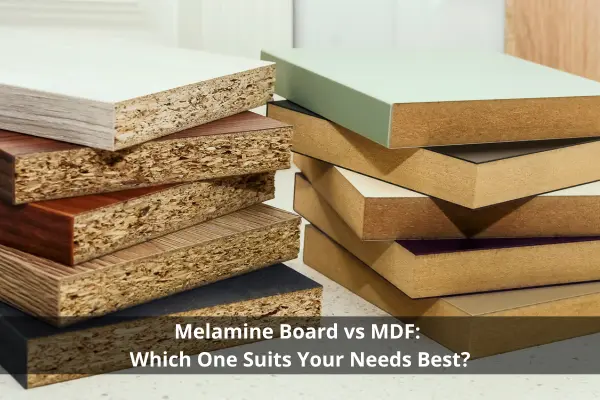
Melamine board and MDF are two of the most widely used materials in furniture manufacturing and they are often confused because both start from engineered wood. But they are fundamentally different in how they are made, how they perform, and where they belong. For a full three-way comparison: Particle Board vs MDF vs Plywood →
Choosing the wrong one means either overpaying for a surface finish you don’t need, or ending up with furniture that warps, chips, or looks unfinished. This guide gives you a clear, direct comparison across every factor that matters.
Quick Answer: Melamine Board vs MDF at a Glance
| Factor | Melamine Board (MFC) | MDF |
|---|---|---|
| Surface finish | Ready to use decorative surface | Requires painting or veneering |
| Cost | Lower | Higher |
| Moisture resistance | Medium–High | Low (swells easily) |
| Scratch resistance | High | Low–Medium |
| Machinability | Good — straight cuts | Excellent — routing, curves, profiles |
| Weight | Medium | Medium–Heavy |
| Best for | Cabinets, wardrobes, office furniture | Painted furniture, decorative panels, detailed carving |
| Edge finish | Needs edge banding | Can be routed and painted directly |
What is Melamine Board (MFC)?
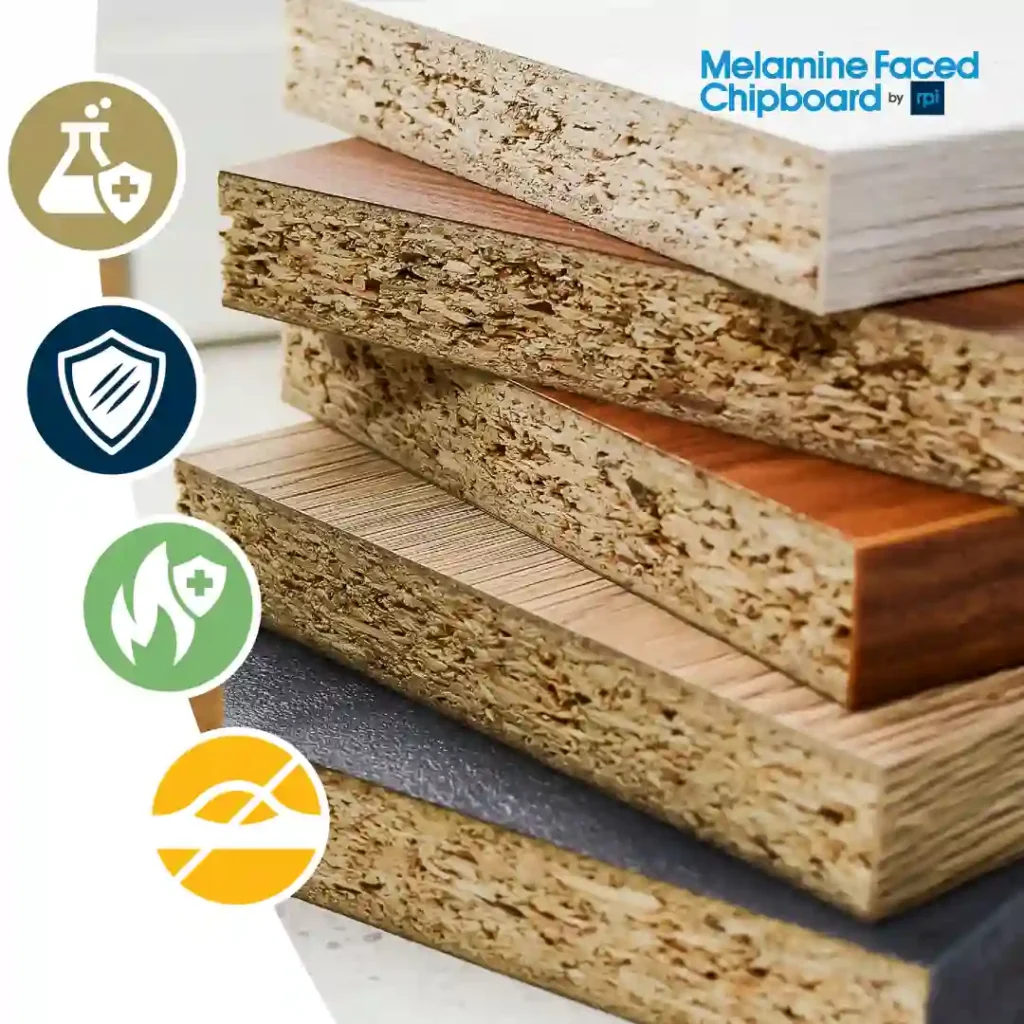
Melamine board also known as MFC or Melamine Faced Chipboard is a particle board core with a melamine resin layer heat-fused to both surfaces under high pressure. The melamine layer creates a hard, smooth, decorative finish that requires no additional painting, laminating, or coating.
The core is typically standard or HMR particle board. The surface is available in hundreds of colours and textures wood grain, solid colours, high gloss, suede, and metallic finishes. What you see when you buy it is what you use no extra finishing process needed.
Full guide: MFC Board Advantages and Specifications →
What is MDF?
MDF (Medium Density Fiberboard) is made from very fine wood fibres smaller and more uniform than the wood chips used in particle board combined with wax and resin binders, then compressed under heat and pressure into dense, smooth sheets.
The result is a panel with no grain, no knots, and a highly consistent surface throughout. MDF has no decorative surface layer of its own, it must be painted, veneered, or laminated to be used as finished furniture.
Melamine Board vs MDF Head-to-Head Comparison
1. Surface Finish
Melamine board arrives with a finished, decorative surface ready to use. There is no need for painting, laminating, or additional treatment. This makes it significantly faster and cheaper to produce finished furniture at scale.
MDF has no surface layer, it must be finished after cutting and assembly. This adds time and cost (primers, paints, multiple coats) but also gives complete freedom to choose any colour or paint finish.
Winner for ready-to-use furniture: Melamine board. Winner for custom paint finishes: MDF.
2. Cost
Melamine board is less expensive than MDF in almost all markets. The particle board core costs less to produce than the finer wood fibre core of MDF, and the melamine surface eliminates the need for post-production finishing costs. For large-scale furniture manufacturing, this cost difference is significant.
MDF costs more per sheet and typically requires additional finishing materials and labour time on top of the board price.
Winner: Melamine board.
3. Moisture Resistance
This is one of the most important factors and where melamine board has a clear advantage. The melamine surface layer is inherently resistant to moisture, and when the core is HMR particle board, the panel performs reliably in kitchens and bathrooms.
MDF is notably sensitive to moisture. Even standard indoor humidity can cause MDF to swell at edges and joints over time. Moisture resistant MDF grades exist but add considerable cost.
In Indonesia’s tropical climate, this difference is especially relevant melamine board with an HMR core is the practical standard for kitchen and bathroom cabinetry.
Winner: Melamine board, especially with HMR core. What is HMR Particle Board? →
4. Scratch and Stain Resistance
The melamine surface on MFC board is significantly harder than a painted MDF surface. It resists scratches, stains, and heat from daily household use. Kitchen cabinets and office desks made from MFC can withstand years of regular use without visible surface degradation.
MDF with a painted surface is comparatively soft and prone to chipping, denting, and scratching. Keeping a painted MDF surface looking good requires more careful handling and occasional touch-ups.
Winner: Melamine board.
5. Machinability and Workability
This is where MDF has a genuine advantage. The fine, uniform fibre structure of MDF makes it ideal for detailed routing, curved profiles, and decorative edge work. Cabinet doors with shaped profiles, skirting boards, and decorative wall panels are typically made from MDF because it machines cleanly without chipping.
Melamine board can be cut cleanly with a fine-tooth blade, but it does not route as well as MDF. The melamine surface can chip at edges during cutting if the wrong blade or technique is used. Cut edges always need edge banding to cover the exposed particle board core.
Winner for detailed shaping: MDF. Winner for straight-cut production furniture: Melamine board.
6. Weight
MDF is denser than standard particle board, making melamine board slightly lighter for the same thickness. This matters in applications like wall-hung cabinetry, where reducing weight reduces structural load on fixings.
Winner: Melamine board (marginally).
7. Environmental Performance
Both materials are engineered wood products that make use of wood waste and by-products. MFC board from RPI uses a particle board core made from certified sustainable wood fibre sources. Both materials are more resource-efficient than solid wood in terms of material yield from raw timber.
For projects requiring low-formaldehyde emission standards such as children’s furniture or certified green buildings check the specific emission rating (E0, E1, or CARB P2) regardless of which material you choose.
When to Choose Melamine Board
Choose melamine board (MFC) when:
- You need finished, ready-to-use furniture panels without additional painting or coating
- The application is kitchen cabinets, wardrobes, office furniture, retail fixtures, or wall panels
- Cost efficiency is a priority in production
- The environment involves humidity (use MFC with HMR core)
- You are manufacturing furniture at volume and consistency across batches matters
View RPI’s MFC Board product range →
When to Choose MDF
Choose MDF when:
- You need intricate routing, curved profiles, or shaped edges
- The furniture will be painted in a custom colour and a smooth, grain-free paint surface is essential
- The application is decorative wall paneling, skirting boards, or mouldings
- The environment is dry and controlled, MDF should not be used in kitchens or bathrooms without significant moisture protection
What About MFC vs MDF for Specific Applications?
Kitchen cabinets: Melamine board with HMR core is the clear choice. Better moisture resistance, ready-to-use surface, lower cost. Why MFC is the perfect choice for kitchens →
Office furniture: Melamine board. Scratch resistance, clean appearance, and cost efficiency make it the standard in office desk and storage production.
Wardrobe carcasses: Melamine board. Same reasons as office furniture, no finishing needed, consistent appearance.
Painted cabinet doors: MDF. A painted MDF door gives a smoother, grain free result than painted particle board.
Wall panels with routed detail: MDF. The fine fibre structure machines cleanly for decorative profiles.
Retail display fixtures: Melamine board. Durability, design variety, and cost efficiency suit retail environments well.
Frequently Asked Questions
Is melamine board stronger than MDF?
For surface hardness and scratch resistance, melamine board is stronger. For internal density and fine machining, MDF is more uniform. High-density particle board can match or exceed MDF in load-bearing capacity. For most furniture applications — cabinets, shelves, desks — both materials perform comparably in structural terms.
Can MDF be used in kitchens?
Standard MDF is not recommended for kitchen use due to its sensitivity to moisture and steam. Moisture-resistant MDF grades exist but are expensive. For kitchens, melamine board with an HMR core is the more practical and cost-effective solution.
Which is cheaper, melamine board or MDF?
Melamine board is consistently less expensive than MDF, both in material cost and total production cost (since MFC requires no additional finishing). For large-scale furniture manufacturing, the cost difference is significant.
Can you paint melamine board?
Yes, but it requires proper preparation, sanding the surface, applying a bonding primer, and then topcoating. MDF accepts paint more easily due to its smooth, porous surface. If a painted finish is the goal from the start, MDF is the more practical choice.
What is the difference between MFC and MDF?
MFC (Melamine Faced Chipboard) has a particle board core with a factory-applied melamine decorative surface. MDF (Medium Density Fiberboard) has a finer wood fibre core with no surface layer, it must be finished after production. MFC is ready to use; MDF requires additional finishing steps. Full comparison of all engineered wood types →
Conclusion
For the majority of furniture applications kitchen cabinets, wardrobes, office furniture, retail fixtures melamine board is the better choice: lower cost, ready-to-use surface, better moisture resistance, and better scratch resistance.
MDF earns its place in specific situations: painted furniture requiring a smooth grain-free surface, decorative panels with routed profiles, and shaped components where clean machining is the priority.
The decision comes down to what the furniture needs to do and what the surface needs to look like. Get those two right and the material choice is straightforward.
Source MFC Board Direct from the Manufacturer
PT Rimba Partikel Indonesia manufactures MFC board and particle board at our facility in Kendal, Central Java. We supply direct to furniture manufacturers, contractors, and distributors across Indonesia and internationally.
📞 WhatsApp: +62 811-2679-094 📧 Email: admin-rpi@rimbapartikel.com 🔗 View MFC Board Specifications → 🔗 View Particle Board Specifications →