

If you’re specifying materials for kitchen cabinets, bathroom vanities, or any furniture in a humid environment HMR chipboard is one of the most important terms you need to understand.
Standard particle board performs well in dry indoor conditions. But expose it to the humidity levels found in a kitchen or bathroom or the ambient moisture of Indonesia’s tropical climate and it will swell, delaminate, and eventually fail. HMR particle board is engineered specifically to solve this problem.
This guide covers everything: what HMR means, how it differs from standard particle board, its technical specifications, when to use it, and when it’s not enough.
What Does HMR Stand For?
HMR stands for High Moisture Resistance. It refers to a type of particle board manufactured with a higher proportion of moisture-resistant resin binders typically melamine urea formaldehyde (MUF) resin compared to the standard urea-formaldehyde (UF) resin used in regular particle board.
The result is a panel that has significantly better resistance to swelling, delamination, and structural degradation when exposed to humid conditions.
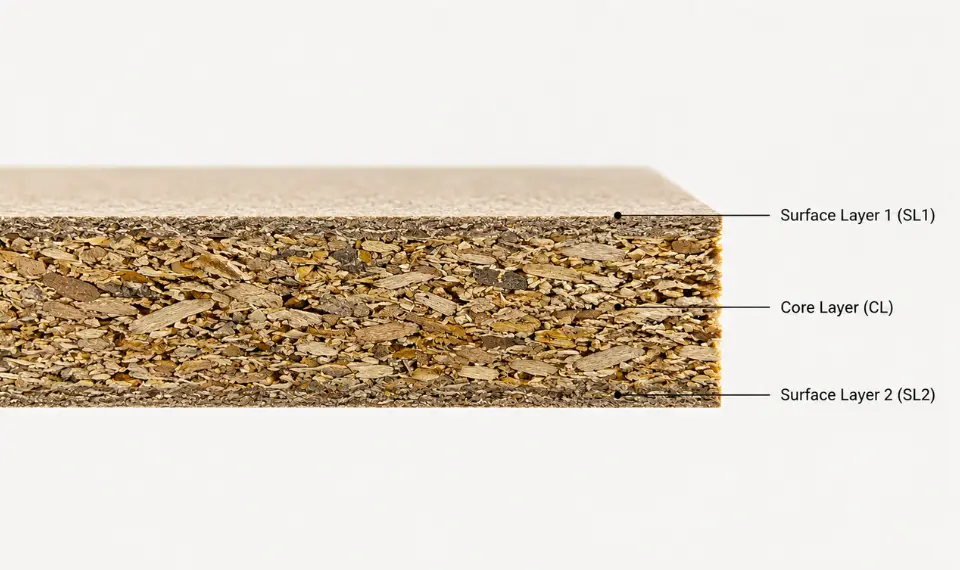
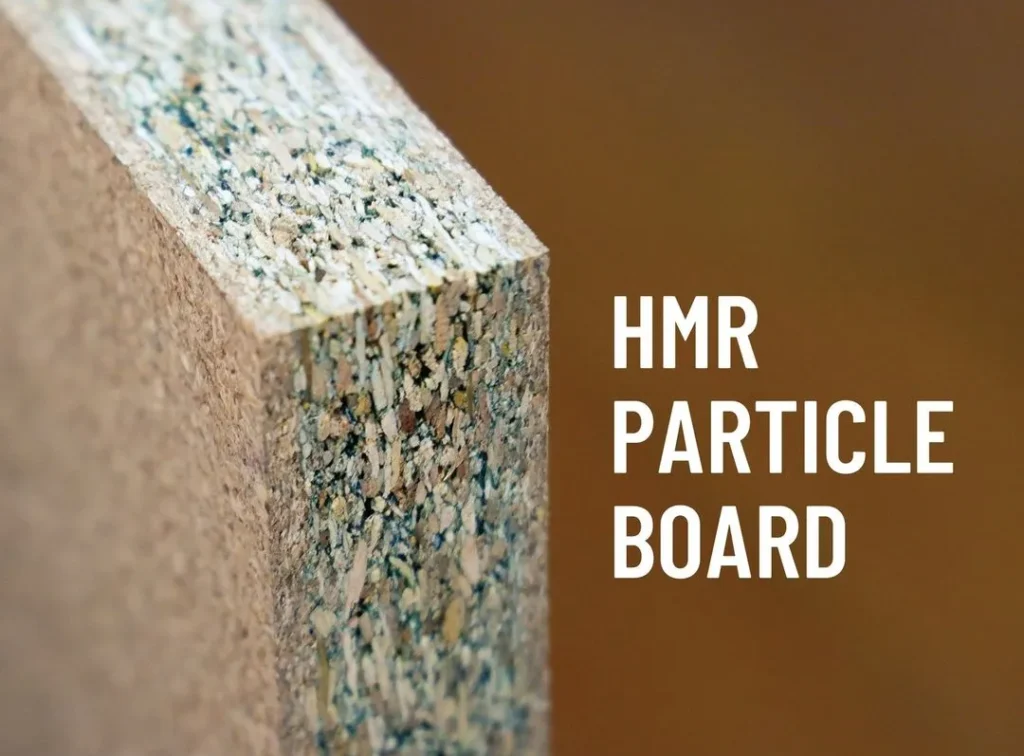
How to identify HMR chipboard: Look at the cross-section of a cut panel. HMR chipboard has a distinctive green tint in the core this comes from the green coloured moisture resistant resin. Standard particle board has a pale beige or yellow brown core.
HMR vs Standard Particle Board: Technical Comparison
| Property | Standard Particle Board | HMR Particle Board |
|---|---|---|
| Core resin | Urea-formaldehyde (UF) | Melamine-urea-formaldehyde (MUF) |
| Core colour | Beige / pale brown | Green tint |
| Density | 600–680 kg/m³ | 640–700 kg/m³ |
| Thickness swelling (24h water immersion) | ≤12% | ≤8% |
| Internal bond strength | Standard | Higher |
| Suitable for humid environments | ❌ No | ✅ Yes |
| Price | Lower | Slightly higher |
| Standard | JIS A 5908, EN 312 P2 | JIS A 5908, EN 312 P5 |
The key metric is thickness swelling after 24-hour water immersion: HMR board swells ≤8% vs ≤12% for standard board. This difference is what determines whether your kitchen cabinets hold their shape after years of steam and humidity exposure.
Key Advantages of HMR Particle Board
1. Significantly Better Moisture Resistance
The core of HMR chipboard contains moisture-resistant resin binders that reduce the rate at which the panel absorbs water. When exposed to humidity steam from cooking, condensation in bathrooms, or the general ambient humidity of tropical climates HMR chipboard maintains its structural integrity far better than standard particle board.
This is not just a marginal improvement. In high-humidity environments, standard particle board can begin to show edge swelling within 12–18 months. HMR board in the same conditions can last 10–15 years with proper surface protection.
2. Higher Structural Stability
Because HMR board uses a denser resin system, it also achieves higher internal bond strength the force required to pull the panel apart perpendicular to its surface. This means better screw retention, better resistance to impact, and a more stable panel overall compared to standard board of the same thickness.
For kitchen base cabinets that carry the weight of countertops, sinks, and heavy cookware, this structural advantage matters.
3. Compatible with All Standard Surface Finishes
HMR chipboard is available in raw form ready to be surfaced with MFC melamine, HPL laminate, or veneer and also pre surfaced as MFC board with an HMR core. It machines, cuts, and drills exactly like standard particle board, so no changes to production processes or tooling are required.
4. The Right Standard for Tropical Climates
In countries like Indonesia where ambient humidity regularly exceeds 70–80%, HMR chipboard should be the minimum specification for all indoor furniture not just kitchens and bathrooms. Standard particle board that might last 15 years in a dry European climate may deteriorate in 5–7 years in tropical conditions.
RPI manufactures HMR chipboard specifically calibrated for Southeast Asian climate conditions, using raw materials and resin formulations suited to tropical humidity levels.
5. Cost-Effective Compared to Alternatives
HMR chipboard costs slightly more than standard board typically 10–15% more per sheet but significantly less than the alternatives: moisture-resistant MDF, plywood, or solid wood. For kitchen and bathroom furniture where moisture resistance is non-negotiable, HMR chipboard delivers the best performance-to-cost ratio available.
When to Use HMR Particle Board
Use HMR chipboard as the minimum specification for:
- Kitchen base cabinets and wall cabinets
- Bathroom vanities, sink cabinets, and storage units
- Laundry room furniture and utility cabinets
- Any furniture in rooms without air conditioning in tropical climates
- Furniture in commercial kitchens, hotel bathrooms, and hospitality fit-outs
- Flooring underlayment in areas with potential moisture ingress
For all of these applications, the slightly higher cost of HMR over standard board is justified and in many cases, specifying standard board in these environments is a specification error that will result in premature failure.
When HMR Particle Board Is Not Enough
HMR chipboard is moisture-resistant it is not waterproof. There are applications where HMR is still not the right choice:
- Direct water exposure: Areas where the panel will be repeatedly wet shower interiors, pool surrounds, exterior applications require waterproof materials such as marine plywood or moisture-resistant MDF with full surface sealing.
- Subfloor in wet areas: For bathroom floors where water may pool, specify tile backer boards or waterproof plywood rather than any particle board type.
- Outdoor furniture: No particle board type is suitable for outdoor use where rain exposure is possible.
The rule is simple: HMR handles humidity and occasional moisture contact. It does not handle sustained or direct water exposure.
HMR Particle Board with MFC Surface
The most common application of HMR chipboard is as the core of MFC (Melamine Faced Chipboard) for kitchen and bathroom furniture. The MFC melamine surface provides the decorative finish and an additional layer of moisture protection, while the HMR core ensures the panel performs in humid conditions.
When buying MFC board for kitchen use, always confirm with your supplier whether the core is standard particle board or HMR. Not all MFC board uses an HMR core and for kitchen applications, the difference matters significantly.
RPI’s MFC board for kitchen applications uses an HMR core as standard. View MFC Board specifications →
HMR Particle Board vs Other Moisture-Resistant Materials
| Material | Moisture Resistance | Cost | Best For |
|---|---|---|---|
| Standard particle board | Low | Lowest | Dry indoor furniture only |
| HMR particle board | High | Low–Medium | Kitchens, bathrooms, humid climates |
| Moisture-resistant MDF | High | Medium–High | Painted kitchen doors, detailed routing |
| Plywood (marine grade) | Very High | High | Wet areas, structural use, outdoor |
| Solid wood (treated) | Medium–High | Highest | Premium furniture, outdoor structures |
For most kitchen and bathroom furniture production in Indonesia, HMR particle board surfaced with MFC is the optimal specification: better moisture performance than standard board, significantly lower cost than moisture-resistant MDF or plywood.
Frequently Asked Questions
What does HMR mean in particle board?
HMR stands for High Moisture Resistance. It refers to particle board manufactured with moisture resistant resin binders that reduce swelling and structural degradation when exposed to humidity. HMR board is identifiable by its green tinted core cross section.
Is HMR particle board waterproof?
No. HMR particle board is moisture resistant, not waterproof. It performs well in humid environments and can tolerate occasional moisture contact, but it will still be damaged by prolonged direct water exposure. For areas with direct water contact, use waterproof rated materials.
How can I tell if particle board is HMR?
Cut or look at the cross section of the panel. HMR particle board has a distinctive green tint in the core from the moisture resistant resin. Standard particle board has a pale beige or yellow-brown core.
Is HMR particle board more expensive than standard?
Yes, but only marginally, typically 10–15% more per sheet. Given the significantly better performance in humid environments, HMR is almost always the more cost-effective choice for kitchens and bathrooms when you factor in the long-term durability difference.
Can HMR particle board be used for flooring?
HMR particle board can be used as flooring underlayment in areas with moderate moisture risk. For wet areas where water may pool bathrooms, laundry rooms waterproof-rated plywood or tile backer boards are more appropriate.
What thickness of HMR particle board should I use for kitchen cabinets?
- For kitchen cabinet carcasses: 18mm HMR as standard.
- For shelving inside cabinets: 16mm is sufficient for spans under 600mm; use 18mm for longer spans.
- For cabinet back panels: 9mm or 12mm HMR.
Does RPI manufacture HMR particle board?
Yes. PT Rimba Partikel Indonesia produces HMR particle board at our facility in Kendal, Central Java, using a ContiRoll continuous press system — the first of its kind in Asia. Our HMR board meets JIS A 5908 standards and is available in standard sheet sizes and thicknesses. Contact us for specifications and pricing →
Related Articles
- 6 Types of Particle Board Explained — Including HMR →
- MFC Board: 8 Key Advantages for Furniture →
- Melamine Board vs MDF: Full Comparison →
- Kelebihan dan Kekurangan Particle Board (Bahasa Indonesia) →
Source HMR Particle Board Direct from the Manufacturer
PT Rimba Partikel Indonesia manufactures HMR and standard particle board, and MFC board at our production facility in Kendal, Central Java. We supply direct to furniture manufacturers, contractors, and distributors across Indonesia and internationally.
📞 WhatsApp: +62 811-2679-094 📧 Email: admin-rpi@rimbapartikel.com 🔗 View Particle Board Specifications → 🔗 View MFC Board Specifications →