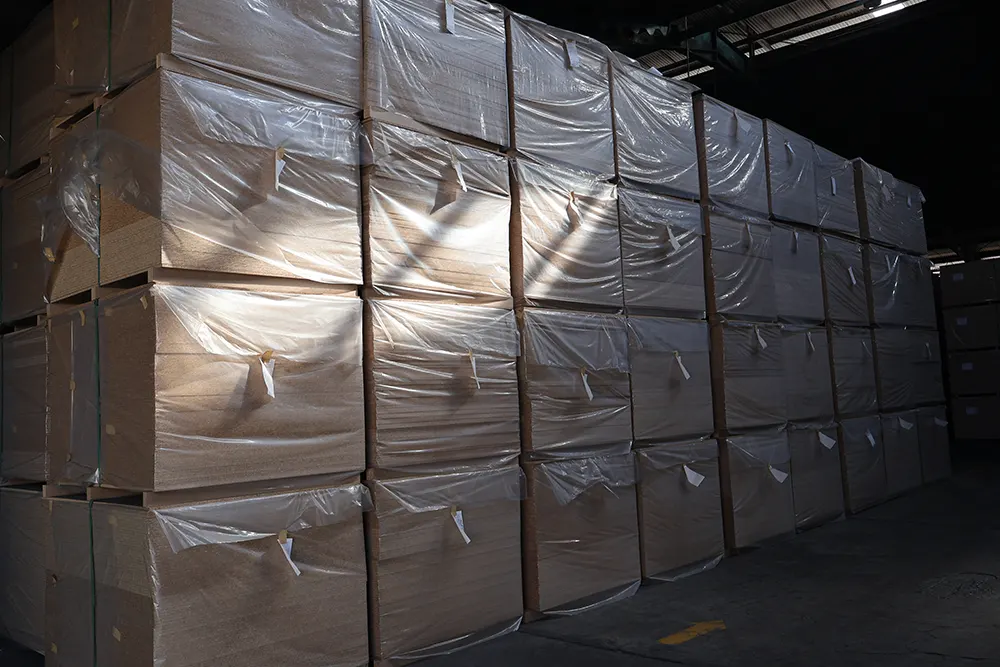



Not all particle board is the same and choosing the wrong type for your project can lead to warped cabinets, moisture damage, or panels that fail under load.
Particle board comes in six main types, each engineered for different conditions: standard board for general furniture, HMR for humid environments, MFC for finished decorative surfaces, laminated board for countertops, fire-retardant board for commercial spaces, and high-density board for heavy-load applications.
This guide explains what each type is, where it works best, and what specs matter when you’re sourcing material. For a complete introduction to particle board as a material, read: What is Particle Board? Full Guide
Types of Particle Board
1. Standard Particle Board
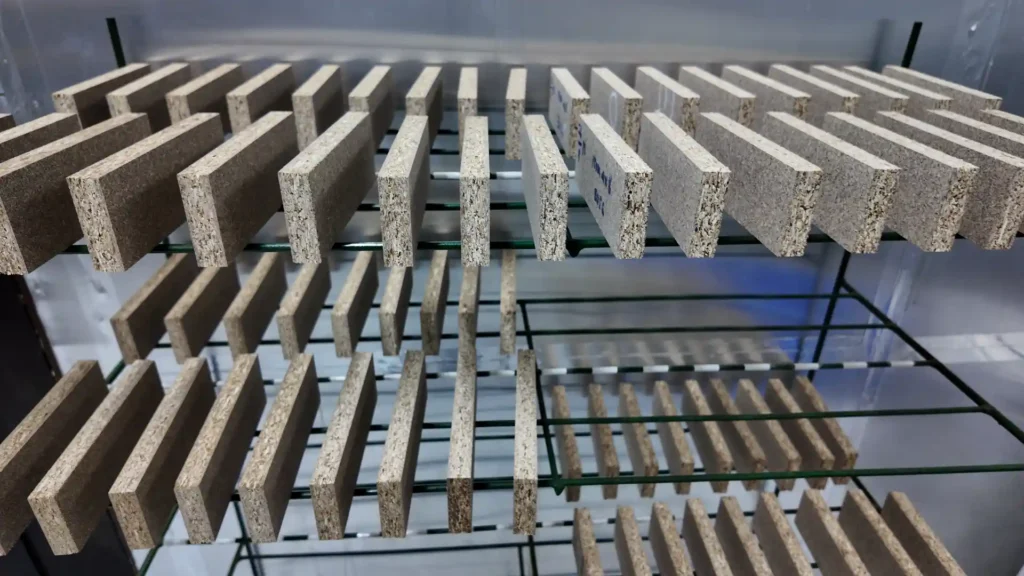
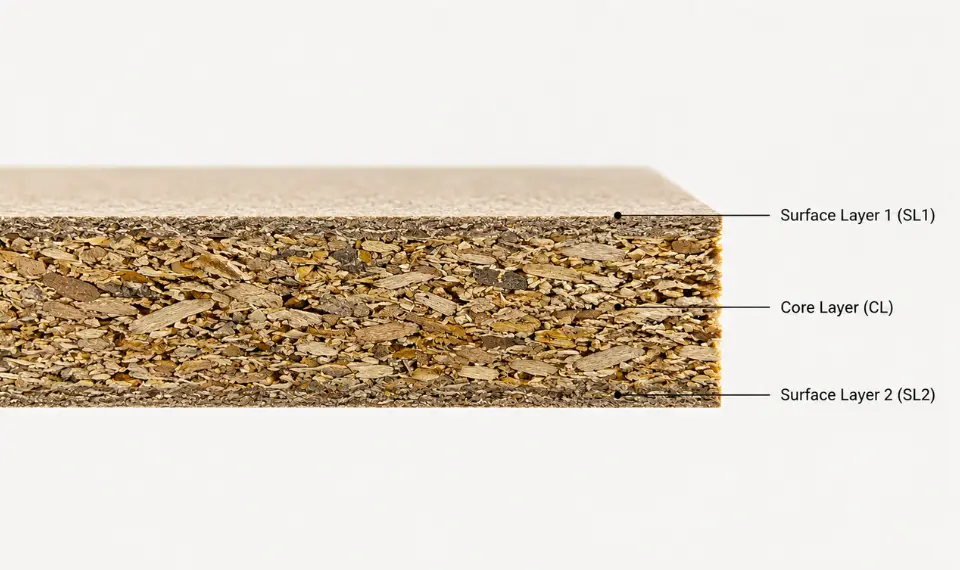
Standard particle board also called chipboard is the most widely used engineered wood panel in the furniture industry. It is made by combining wood chips, sawmill shavings, and sawdust with a synthetic resin binder, then pressing the mixture under heat and pressure into flat sheets.
Typical specs: thickness 9mm–25mm, density 600–680 kg/m³, certified to JIS A 5908.
Best for: cabinet carcasses, bedroom wardrobes, bookshelves, TV units, and wall paneling in dry indoor environments.
Not suitable for: kitchens, bathrooms, or any space with regular moisture exposure.
PT Rimba Partikel Indonesia supplies standard particle board in full sheet sizes with consistent density and surface quality. View particle board specifications
2. HMR (High Moisture Resistance) Particle Board
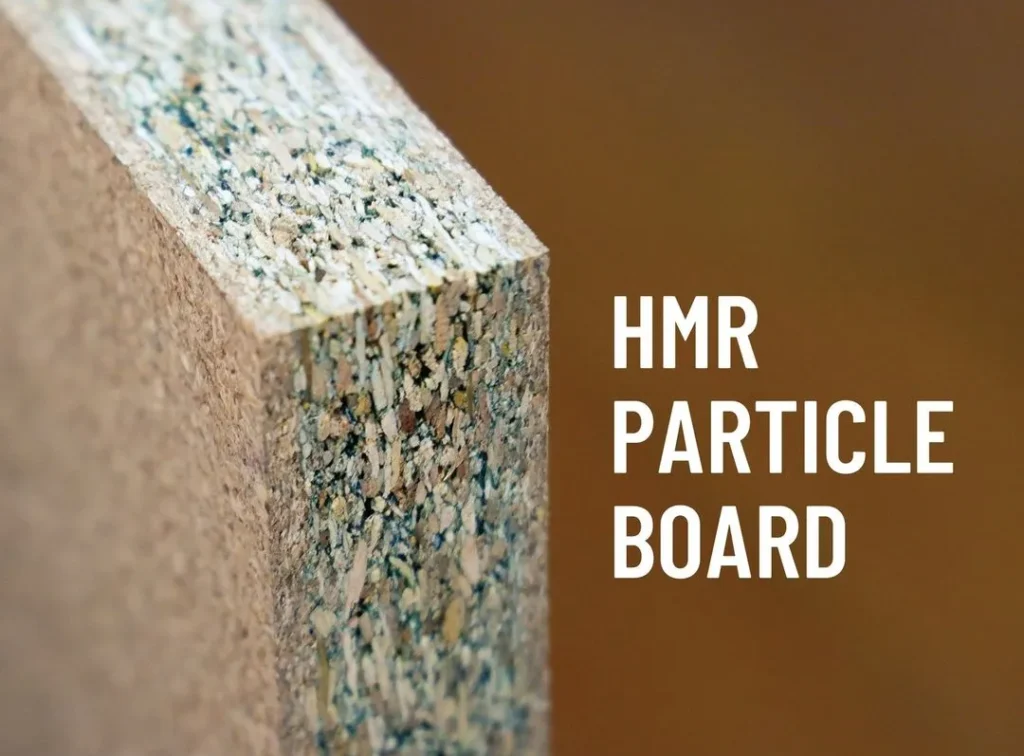
HMR particle board is manufactured using a higher proportion of moisture resistant resin binders. This gives the core significantly better resistance to swelling and delamination when exposed to humidity without changing the external dimensions of the panel. The easiest way to identify HMR board is its cross section: the core has a distinctive green tint from the moisture resistant resin.
Typical specs: thickness 12mm–25mm, density 640–700 kg/m³, thickness swelling after 24h water immersion ≤8% (vs ≤12% for standard board), certified to EN 312 P5.
Best for: kitchen cabinets, bathroom vanities, laundry rooms, and any furniture in Indonesia’s tropical humid climate.
Not suitable for: direct water immersion or exterior use, HMR is moisture resistant, not waterproof.
HMR Particle Board — What It Is and 3 Key Advantages →
3. MFC (Melamine Faced Chipboard)
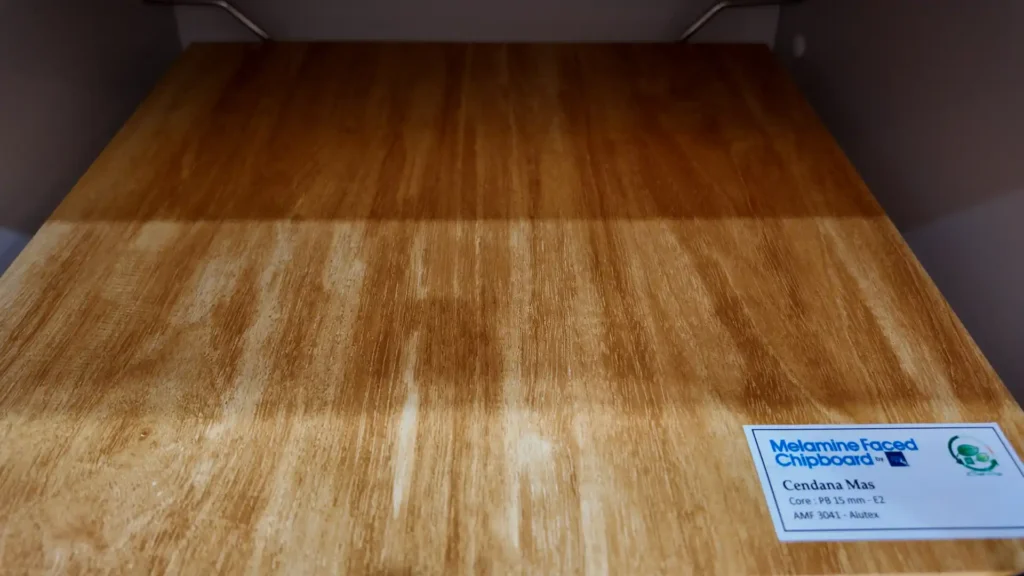
MFC board is particle board with a melamine resin layer heat-fused to both surfaces under high pressure. The result is a hard, smooth, decorative panel that is ready to use without any additional painting, laminating, or veneering. This makes MFC the most practical choice for finished furniture production at scale.
Typical specs: thickness 12mm–25mm, melamine surface weight 120–180 g/m², available in 100+ colour and texture variants including wood grain, solid colours, high gloss, and suede finishes.
Best for: kitchen cabinets, office desks, wardrobes, retail display fixtures, and wall paneling.
Key advantage over solid wood: every sheet from the same production batch has identical colour, texture, and dimensions no grain variation, no warping, no material waste from natural defects.
Full guide to MFC Board advantages → Browse RPI’s MFC colour catalogue →
4. Laminated Particle Board
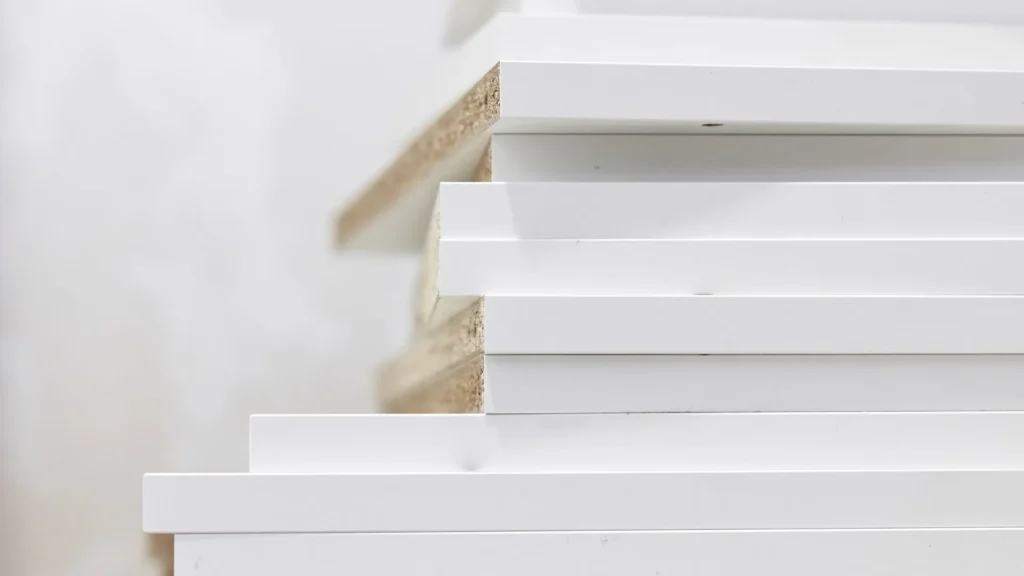
Laminated particle board is produced by bonding a layer of high pressure laminate (HPL) or low-pressure laminate (LPL) onto a standard particle board core. The laminate layer is thicker and harder than standard melamine, providing better resistance to impact and surface abrasion.
Typical specs: laminate thickness 0.5mm–1.5mm (HPL) or 0.2mm–0.5mm (LPL), available in gloss, matte, and textured finishes.
Best for: kitchen and office countertops, table tops, and any surface with heavy daily use where hardness is a priority.
The key difference from MFC: laminated board uses a mechanically bonded surface layer rather than a heat fused melamine layer. It offers slightly better impact resistance but fewer colour and texture options.
5. Fire Retardant Particle Board
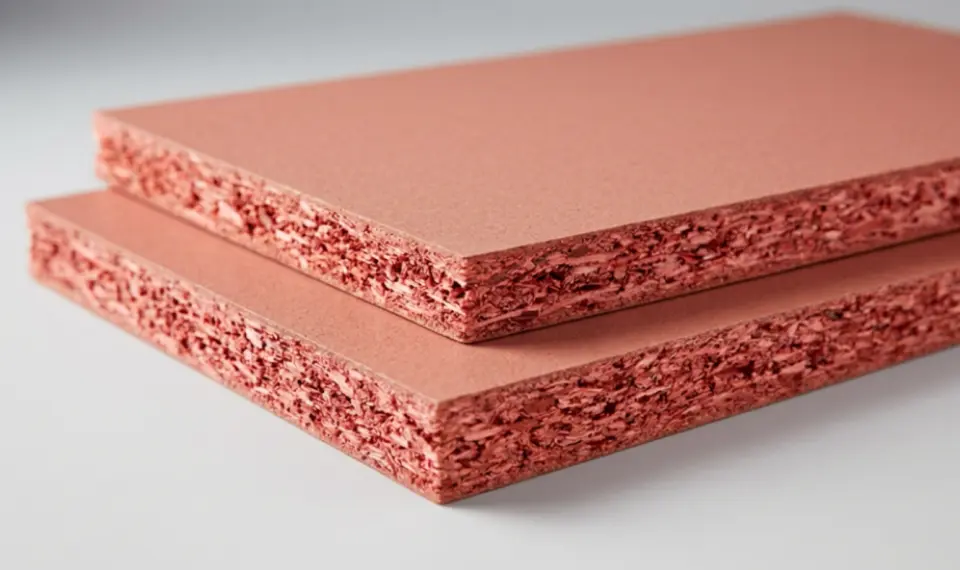
Fire-retardant particle board is standard particle board treated with fire-inhibiting chemicals during or after manufacturing. As a result, the treatment slows flame spread and reduces smoke emission. In addition, it does so without significantly changing the board’s workability or dimensions.
Typical specs: fire rating EN 13501-1 Class B or Class C depending on treatment, available in standard thicknesses.
Best for: hotels, hospitals, schools, shopping centres, and any public building where local building codes require a minimum fire performance rating.
Important: fire retardant treatment adds meaningful cost. Only specify this type where regulations explicitly require it for residential furniture, standard or HMR board is appropriate.
6. High Density Particle Board (HDP)
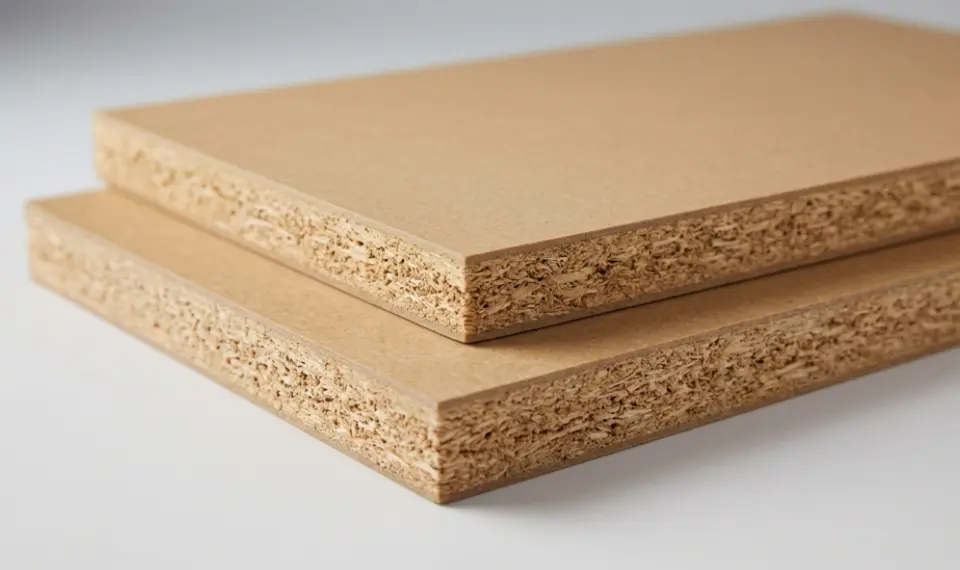
High density particle board is manufactured under higher compression with greater resin content, producing a panel that is significantly denser and stronger than standard board. The higher density gives better screw holding performance, greater load capacity, and improved surface hardness.
Typical specs: density 750–900 kg/m³ (vs 600–680 kg/m³ for standard), approximately 20–30% heavier per sheet at the same thickness.
Best for: flooring underlayment, heavy load shelving in libraries or warehouses, industrial furniture, and speaker cabinets.
Trade-off: HDP is heavier and more expensive specify it only where the performance advantage justifies the cost.
Types of Particle Board Flooring — Which Is Best? →
How to Choose the Right Type: 5 Step Framework
Step 1 — Assess the environment. Dry indoor space? Standard particle board is sufficient. Kitchen, bathroom, or tropical climate? Specify HMR as a minimum.
Step 2 — Decide on surface finish. Need a ready-to-use decorative surface? Choose MFC. Applying your own laminate or paint? Raw particle board gives more flexibility.
Step 3 — Check load requirements. Shelving carrying more than 20kg per shelf, or flooring? Specify high-density board. Standard furniture? Medium-density is fine.
Step 4 — Check regulatory requirements. For commercial or public buildings, verify whether local fire codes require fire-retardant rated board.
Step 5 — Match thickness to application.
- Cabinet carcasses: 16mm or 18mm
- Back panels: 9mm or 12mm
- Worktops and countertops: 22mm or 25mm
- Flooring underlayment: 18mm or 22mm
Still unsure? Contact RPI’s team for a technical consultation →
Particle Board vs MDF vs Plywood: When to Use Each
Particle board is not always the right answer. Here’s a quick guide to when alternatives make more sense.
Choose particle board when cost efficiency is the priority, the surface will be covered with MFC or laminate, and the application is standard indoor furniture in a dry environment.
Choose MDF when you need intricate routing, curved profiles, or a paintable surface. MDF has a finer, more uniform structure that machines more cleanly and accepts paint without raised grain.
Choose plywood when structural strength, screw-holding in edges, or semi-outdoor use is required. Plywood significantly outperforms particle board in these areas.
For a detailed side-by-side breakdown: Particle Board vs MDF vs Plywood — Complete Comparison →
Frequently Asked Questions
What is the most common type of particle board used in furniture?
Standard particle board is the most widely used for furniture carcasses. MFC board is the most common choice for finished furniture with a decorative surface. In tropical markets like Indonesia, HMR board is increasingly used as the default for kitchen and bathroom applications.
What does HMR mean in particle board?
HMR stands for High Moisture Resistance. HMR particle board is made with a higher proportion of moisture-resistant resin binders and is identifiable by its green-tinted core. Full HMR guide →
Is particle board the same as chipboard?
Yes — particle board, chipboard, and particleboard all refer to the same material. The terms are used interchangeably. In the UK and Australia, “chipboard” is more common; in North America and Asia, “particle board” is the standard term.
What thickness should I use for kitchen cabinets?
For kitchen cabinet carcasses: 18mm HMR. Cabinet doors and drawer fronts: 16mm or 18mm MFC. For shelving inside cabinets: 16mm, or 18mm if the shelf span exceeds 800mm.
Can particle board be used outdoors?
No. Standard particle board is not designed for outdoor or high-moisture environments. As a result, it will swell and delaminate when exposed to rain or prolonged humidity. Even HMR particle board is not rated for exterior use. For outdoor applications, use exterior-grade plywood or solid timber.
Source Particle Board Direct from the Manufacturer
PT Rimba Partikel Indonesia is a leading manufacturer of Grade A Particle Board in Kendal, Central Java, Indonesia, delivering Japanese quality engineered wood panels certified to JIS A 5908 standards. Since 1990, we have earned the trust of customers across various industries through our commitment to consistent quality, innovation, and reliable supply. With an annual production capacity of 150,000 m³, we are well-equipped to meet the demands of both domestic and international markets. We supply direct to furniture manufacturers, contractors, and distributors across Indonesia and internationally. In addition, our particle board is certified with TKDN (Domestic Component Level), supporting government and local-content procurement requirements in Indonesia.
📞 WhatsApp: +62 811-2679-094 📧 Email: admin-rpi@rimbapartikel.com 🔗 View Particle Board Specifications → 🔗 View MFC Board Specifications →
For information on sourcing from Indonesia: Particle Board Manufacturer Guide →