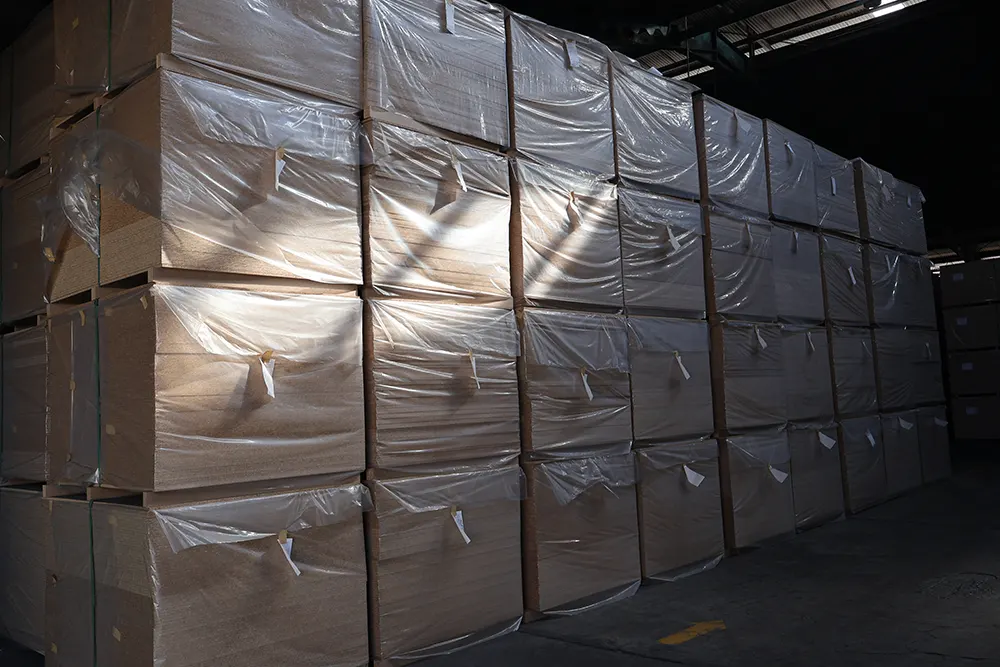



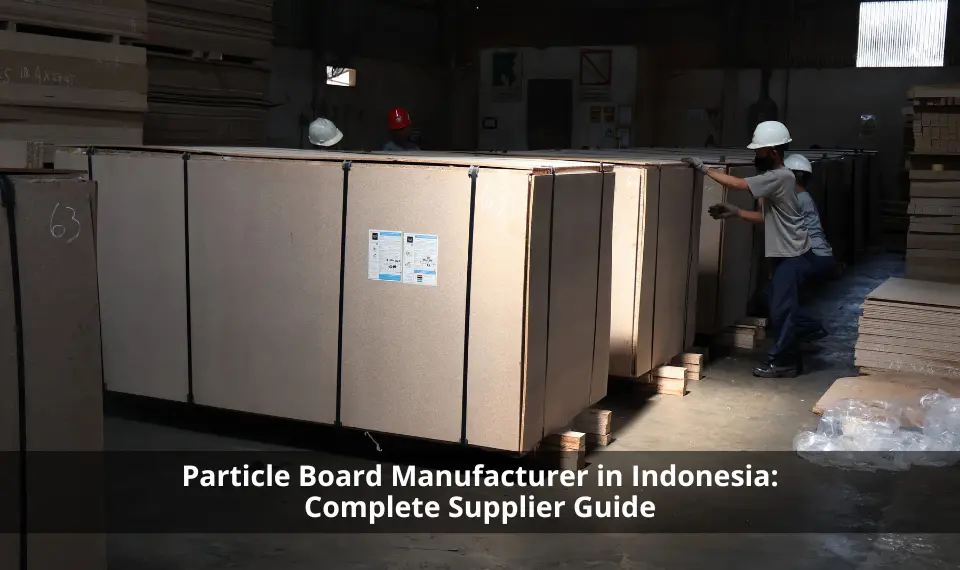
If you are sourcing particle board or MFC board for furniture manufacturing, construction, or distribution — Indonesia is one of the most competitive supply markets in Asia. Raw material is abundant, several manufacturers operate at international quality standards with export certification, and production technology has advanced significantly over the past decade.
This guide covers what to look for when choosing a particle board manufacturer in Indonesia, what certifications matter, what questions to ask before placing an order, and how PT Rimba Partikel Indonesia (RPI) fits as a supply option.
Why Source Particle Board from Indonesia?
Indonesia has a long-established base of engineered wood manufacturing, supported by abundant plantation wood supply and continuous investment in production technology. Several factors make it a strong sourcing market for buyers across Asia and beyond.
Raw material availability
Indonesia has abundant supply of plantation wood, which forms the primary raw material for particle board production. Leading manufacturers source from certified plantation suppliers, ensuring both supply continuity and traceability.
Advanced production technology
Indonesian particle board manufacturers have invested in modern continuous press technology — the same ContiRoll systems used in Europe — enabling consistent quality and tight dimensional tolerances at high volume output.
Export infrastructure
Central Java’s manufacturing cluster is well-connected to international shipping routes through Tanjung Emas Port in Semarang, enabling efficient export logistics for buyers across Asia and beyond.
Competitive pricing
Indonesian particle board is consistently price-competitive, particularly for buyers who require certified, export-grade product at volume.
Certifications
Leading Indonesian manufacturers hold internationally recognised certifications including JIS, CARB Phase 2, FSC-COC, US EPA, ISO 9001, ISO 14001, and ISO 45001 — meeting import requirements across multiple markets.
What to Look for in an Indonesian Particle Board Manufacturer
Not all manufacturers are equal. Before placing an order, evaluate suppliers on these criteria:
1. Production Technology
The two main pressing technologies used in particle board manufacturing are:
- Continuous Press (ContiRoll): High-output, consistent density throughout the panel, tighter thickness tolerances. This is the gold standard for quality particle board production.
- Multi-Opening Press (MOP): Older batch technology, more density variation between panels.
For consistent quality at scale, always ask whether the manufacturer uses a continuous press system.
2. Certifications
| Certification | What It Means | Required For |
|---|---|---|
| JIS A 5908 | Japanese Industrial Standard for particle board | Japan market |
| CARB Phase 2 | California Air Resources Board — formaldehyde emission | US market |
| US EPA | United States Environmental Protection Agency standard | US market |
| FSC-COC | Forest Stewardship Council Chain of Custody | EU, retail chains |
| SVLK | Indonesian legal timber verification | All Indonesian wood exports |
| ISO 9001 | Quality management system | General quality assurance |
| ISO 14001 | Environmental management system | Environmental compliance |
| ISO 45001 | Occupational health and safety | Workplace safety compliance |
Always request a copy of the current certificate — not just a logo on a brochure. Valid certificates have issue dates, expiry dates, and certificate numbers that can be verified with the issuing body.
3. Product Range and Specification Consistency
A reliable manufacturer should be able to supply:
- Standard particle board across all standard thicknesses
- HMR (High Moisture Resistance) particle board for kitchen and bathroom applications
- MFC board with consistent melamine surface quality across colour and texture variants
- Consistent density and surface quality across production batches
Ask for a technical data sheet for each product, not just a price list.
4. Minimum Order Quantity and Lead Time
For export orders, RPI works with a minimum order quantity of one 40-foot High Cube (40HC) container per shipment. For customers with specific project requirements or custom specifications, a minimum order of 100 m³ — equivalent to approximately three containers — applies. Standard export lead time from order confirmation to ready-for-shipment is one month. Contact RPI’s sales team directly to discuss your order requirements and confirm current availability.
5. Quality Control Process
Ask specifically:
- What thickness tolerance do they hold?
- How is density tested — per batch or per production run?
- What is the process for handling quality claims?
A manufacturer confident in their quality control will answer these questions directly.
6. Bespoke Capability
If your project requires non-standard specifications — custom thickness, density, or emission grade — ask whether the manufacturer has an R&D division that can develop custom product variants. Not all manufacturers offer this.
Standard vs HMR vs MFC: What to Order
Understanding the product range before contacting a supplier avoids confusion and speeds up the quoting process. For a complete technical guide on HMR: HMR Particle Board — Full Guide →
Standard Particle Board
Raw engineered wood panel, smooth surface, ready for laminating or finishing. Used for furniture carcasses in dry indoor environments. Available in a range of thicknesses and sizes. Full guide: 6 Types of Particle Board →
HMR Particle Board
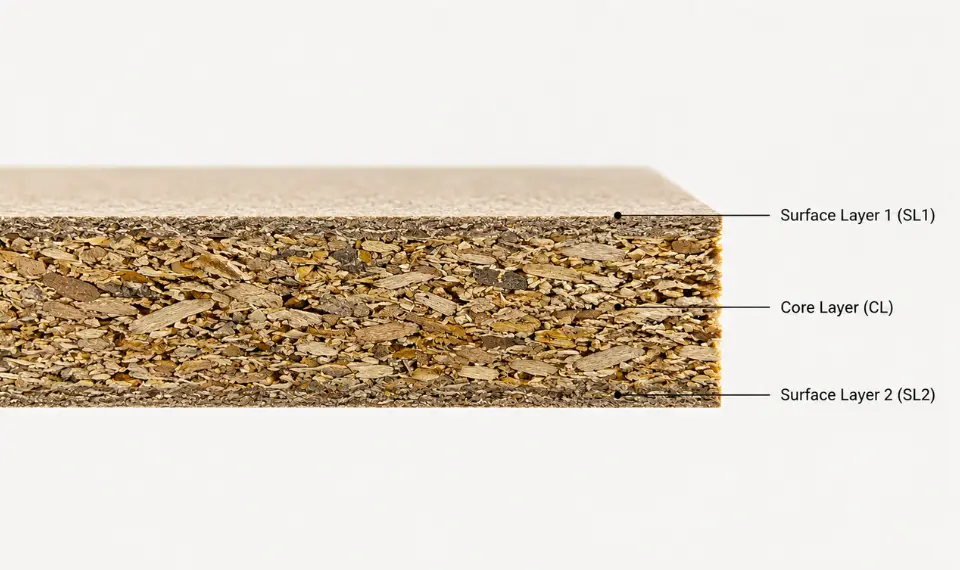
High Moisture Resistance core — identifiable by its green-tinted cross-section. For kitchen cabinets, bathroom furniture, and applications in humid tropical climates. HMR Particle Board: What It Is and When to Use It →
MFC Board (Melamine Faced Chipboard)
Particle board core with factory-applied melamine decorative surface. Ready to use — no additional finishing required. Available in hundreds of colour and texture variants with standard or HMR core. MFC Board: Key Advantages for Furniture →
About PT Rimba Partikel Indonesia (RPI)
PT Rimba Partikel Indonesia has been one of Indonesia’s leading particle board and MFC board manufacturers since its establishment in 1990. The company is strategically located in Desa Mororejo, Kaliwungu, Kendal, Central Java — near Semarang, the provincial capital — with access to Tanjung Emas Port for domestic distribution and international export.
RPI operates on a total facility area of 11 hectares, encompassing a full production line, warehouse, log yard, spare parts facility, and offices. The company runs three working shifts per day across 250 operating days per year, with a workforce of approximately 300 employees as of January 2025. Annual production capacity reaches 109,000 m³ of board.
RPI’s current shareholders consist of Sumitomo Forestry Co., Ltd. (50%), Finance Planning Ltd. (45%), and PT Power Energy Indonesia (5%). As part of the Sumitomo Forestry Group, RPI operates under a strict wood procurement policy — conducting legality investigations on all raw material suppliers and maintaining a reliable, traceable supply chain.
Production Technology
RPI’s production facility is equipped with a 9-feet wide ContiRoll continuous press system by Siempelkamp (Germany) — the first installation of its kind in Asia. This technology enables the production of particle board up to 8–9 feet in width with consistent density throughout each panel and tight thickness tolerances across production runs.
Product Range
RPI produces two main product lines. Particle board is available in standard and HMR grades, across thicknesses of 6mm, 9mm, 12mm, 15mm, 18mm, 20mm, 25mm, and 30mm, in sheet sizes of 4×6, 4×8, 4×9, 3×6, 3×8, 3×9, and 3×10 feet. Raw material consists of 95% plantation wood and 5% FSC-certified material.
MFC board was introduced into production in 2019 in cooperation with AICA. It is available with standard or HMR particle board core, in a range of standard thicknesses, and in over 100 colour and texture variants. RPI also offers bespoke particle board specifications through its R&D division for customers with custom requirements.
Formaldehyde Emission Standards
RPI particle board is available across multiple emission grades to meet different market requirements:
| Grade | Standard |
|---|---|
| JIS F★★★★ (E0S) | Lowest emission — Japan premium grade |
| JIS F★★★ (E0) | Very low emission |
| JIS F★★ (E1) | Standard emission — European and general market |
| CARB-P2 / EPA | US market requirement |
Certifications
RPI holds the following certifications:
- ISO 9001 — Quality Management System
- ISO 14001 — Environmental Management System
- ISO 45001 — Occupational Health and Safety
- JIS U-13 — acquired 2007
- JIS M-18 — acquired 2018
- CARB Phase 2 — acquired 2009
- US EPA — acquired 2017
- FSC-COC — renewed 2020
Sales Distribution
RPI serves both domestic and international markets, with 40% of sales directed to the domestic Indonesian market and 5% to overseas export. Custom and bespoke orders are accommodated through direct contact with RPI’s sales team.
View full particle board specifications → View MFC board specifications → Learn more about RPI →
Frequently Asked Questions
Where is PT Rimba Partikel Indonesia located?
RPI is located at Desa Mororejo, Kaliwungu, Kendal, Central Java, Indonesia — near Semarang, the capital city of Central Java. The facility has access to Tanjung Emas Port in Semarang for export shipments.
What certifications does RPI hold?
RPI holds ISO 9001, ISO 14001, ISO 45001, JIS U-13, JIS M-18, CARB Phase 2, US EPA, and FSC-COC certifications. Full certification details are available on the RPI About page →
What particle board thicknesses does RPI produce?
RPI produces particle board in thicknesses of 6mm, 9mm, 12mm, 15mm, 18mm, 20mm, 25mm, and 30mm, in sheet sizes ranging from 3×6 to 4×9 feet.
Does RPI produce HMR particle board?
Yes. RPI produces HMR (High Moisture Resistance) particle board, identifiable by its green-tinted core. HMR board is available in standard thicknesses and is recommended for all kitchen, bathroom, and humid-environment applications.
Does RPI offer custom or bespoke particle board specifications?
Yes. RPI’s R&D division can develop custom product specifications based on specific requirements. Contact RPI’s sales team to discuss your project needs.
What emission grades does RPI particle board meet?
RPI particle board is available in JIS F★★★★ (E0S), JIS F★★★ (E0), JIS F★★ (E1), and CARB-P2/EPA grades, depending on the specification required for your market.
What is the minimum order quantity for export?
For export orders, the minimum order quantity is one 40-foot High Cube (40HC) container per shipment. For special project requirements or custom specifications, a minimum of 100 m³ — equivalent to approximately three containers — applies. Contact RPI directly to confirm current MOQ and availability. Contact RPI →
How do I request a quote or sample from RPI?
Contact RPI directly via phone, email, or WhatsApp with your required specifications — thickness, type (standard/HMR/MFC), emission grade, and intended application. RPI’s team will advise on the most suitable product and arrange next steps.
Contact RPI to Request a Quote or Sample
PT Rimba Partikel Indonesia supplies particle board and MFC board direct from our manufacturing facility in Kendal, Central Java. We serve furniture manufacturers, contractors, and distributors across Indonesia and internationally — with full technical documentation, consistent quality, and export capability.
📞 Phone: +62 24 866 2990 📧 Email: admin-rpi@rimbapartikel.com 🔗 View Particle Board Specifications → 🔗 View MFC Board Specifications → 🔗 Contact Us →