


Chipboard is one of the most widely used engineered wood products in furniture, construction, and packaging industries. It is valued for its affordability, versatility, and sustainability. But how is chipboard made? Understanding the production process helps in appreciating its benefits and how it compares to other materials like MDF and plywood.
This article explores the step-by-step process of chipboard manufacturing, the materials involved, and its common applications.
Table of Contents
1. What Is Chipboard?
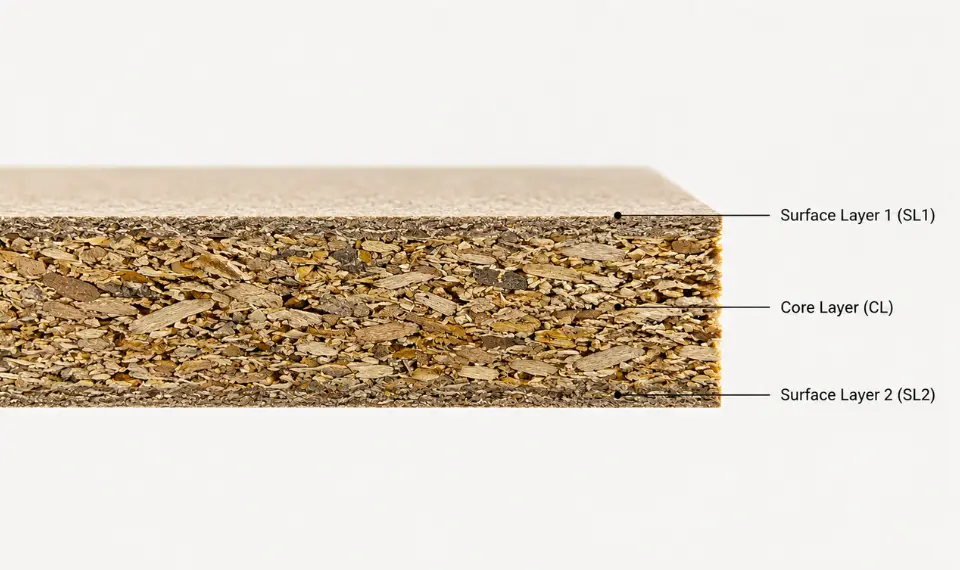
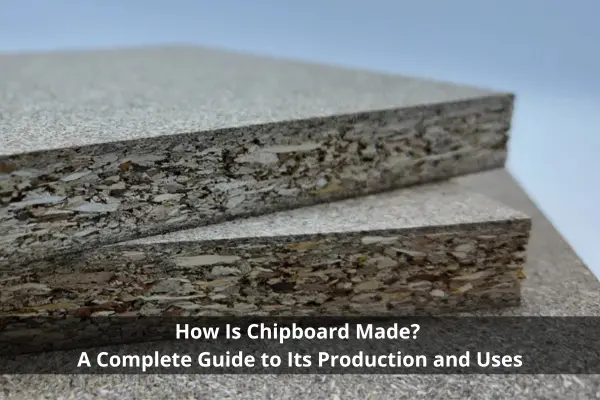
Chipboard, also known as particle board, is an engineered wood product made from wood chips, sawdust, and resin. These materials are compressed under heat and pressure to form solid panels. As a cost-effective alternative to solid wood, chipboard is widely used in furniture, cabinetry, and interior design.
Key Characteristics of Chipboard:
- ✔ Made from recycled wood particles, making it an eco-friendly choice.
- ✔ Available in different grades and thicknesses for various applications.
- ✔ Can be laminated with melamine for a smooth and decorative surface.
- ✔ More affordable than plywood or MDF, making it a cost-effective material.
2. The Step-by-Step Process of Making Chipboard
Manufacturers follow several key stages to produce high-quality chipboard.
1: Collecting and Preparing Raw Materials
- Sawmills and woodworking industries supply wood chips, sawdust, and recycled wood particles.
- The materials go through a screening process to remove dirt and metal contaminants.
2: Drying the Wood Particles
- Rotary dryers reduce the moisture content to 5-7%, ensuring better bonding in later stages.
3: Mixing with Resin and Adhesives
- They coat dried wood particles with a binding agent, typically urea-formaldehyde resin.
- The resin acts as a glue, allowing the particles to bond effectively.
4: Forming the Chipboard Panel
- A machine spreads resin-coated wood chips into layers, ensuring a uniform structure.
5: Pressing Under Heat and High Pressure
- A hydraulic hot press applies high temperature (150-200°C) and pressure to bond the layers. The heat activates the resin, causing it to harden and solidify.
- PT Rimba Partikel Indonesia uses ContiRoll continuous press technology from Siempelkamp — the first of its kind in Asia — allowing precise, consistent pressure and temperature control across the full length of every panel, rather than pressing in smaller batches.
6: Cooling and Cutting
- The pressed panels cool down to stabilize their structure.
- Cutting machines trim the boards into standard or custom sizes.
7: Sanding and Surface Finishing
- Chipboard panels go through sanding machines for a smooth and even surface.
- Some undergo lamination with melamine or veneer for extra durability.
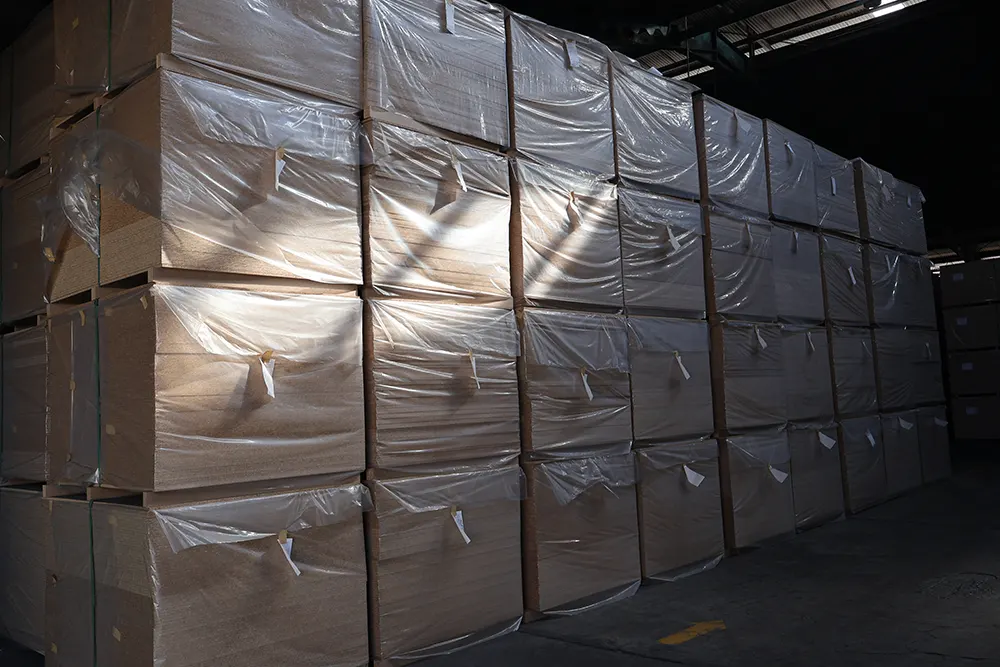
8: Quality Control and Distribution
- Quality checks ensure strength, density, and moisture resistance meet industry standards. RPI’s particle board core is tested against JIS A 5908:2022 (density, internal bond, screw holding strength) and JIS A 1460:2021 (formaldehyde emission, down to E0S/F**** grade), in addition to CARB Phase 2-EPA compliance for export markets.
- Once approved, they package and ship the final particle board panels for commercial use.
3. Different Types of Chipboard
Chipboard comes in different types based on density, surface treatment, and moisture resistance.
1. Standard Chipboard (Raw Chipboard)
- A basic, uncoated version used for furniture frames, shelves, and packaging.
- Requires additional finishing, such as painting or laminating.
2. Melamine Faced Chipboard (MFC)
- Features a decorative melamine layer for added durability and aesthetics.
- Popular in kitchen cabinets, wardrobes, office furniture, and shelving. See the full advantages of MFC →
3. Moisture-Resistant Chipboard (MR Chipboard)
- Treated with water-resistant adhesives for better protection against moisture, identifiable by its distinct core color at a cut edge.
- Suitable for bathroom vanities, kitchen furniture, and flooring substrates. Learn more about HMR particle board →
4. Fire-Retardant Chipboard
- Contains special resins that slow down fire spread.
- Used in public buildings, hotels, and fire-rated doors.
Read more:
Types of Particle Board Flooring: A Guide to Choosing the Best Option
4. Common Applications of Particle Board
Its affordability and adaptability make particle board useful across various industries:
- 🔹 Furniture Manufacturing: Suitable for tables, cabinets, wardrobes, and shelving. See standard panel sizes and thicknesses →
- 🔹 Interior Design: Frequently used for wall panels, partitions, and decorative elements.
- 🔹 Packaging Industry: Ideal for heavy-duty boxes, pallets, and protective shipping layers.
- 🔹 Construction: Used in flooring underlays, roofing, and insulation boards.
Its cost-effectiveness and sustainability make chipboard a preferred choice in both commercial and residential projects.
Frequently Asked Questions
Is chipboard the same as particle board?
Yes — chipboard and particle board refer to the same engineered wood product made from compressed wood chips and resin. The terms are used interchangeably, though “chipboard” is more common in the UK/Australia and “particle board” in the US/Indonesia.
How long does it take to make chipboard?
The full production cycle, from raw material preparation to final quality control, typically takes a few hours per batch, depending on panel thickness and press cycle time.
Is chipboard production environmentally friendly?
Yes — chipboard is made primarily from recycled wood particles, sawdust, and off-cuts that would otherwise go to waste, making it more resource-efficient than materials requiring whole timber.
What temperature is used to press chipboard?
Hot presses typically operate between 150-200°C, activating the resin to bond wood particles into a solid panel.
How is chipboard different from MDF?
Chipboard uses larger wood particles and chips, giving it a coarser core, while MDF (Medium-Density Fibreboard) uses finer wood fibers for a smoother, more uniform core. See the full particle board vs MDF comparison →
5. Particle Board from PT. Rimba Partikel Indonesia
PT. Rimba Partikel Indonesia is a leading manufacturer and supplier of high-quality Particle Board, serving furniture manufacturers, interior designers, and construction industries. Their Particle Board is produced using premium-grade wood particles and processed with state-of-the-art technology to ensure durability, consistency, and sustainability.
They offer Particle Board in various thicknesses and sizes, suitable for furniture production, shelving, office interiors, and decorative panels. Their commitment to quality and innovation ensures that customers receive the best engineered wood products for their projects.
📞 Contact Us for more information about product stock or specifications at admin-rpi@rimbapartikel.com or WhatsApp +62 811-2679-094.
Conclusion
The chipboard manufacturing process transforms recycled wood materials into a versatile, cost-effective, and sustainable product. Through drying, pressing, and finishing techniques, particle board becomes a durable material suitable for furniture, construction, and packaging industries.
Among different types of particle board, Particle Board from PT. Rimba Partikel Indonesia is a superior choice due to its high quality, durability, and precision manufacturing. Whether you need chipboard cut to size for furniture, office interiors, or industrial applications, PT. Rimba Partikel Indonesia offers the best solutions for your needs.
🌿 Looking for premium Particle Board? Contact PT. Rimba Partikel Indonesia for the best-engineered wood panels tailored to your specifications! 🚀