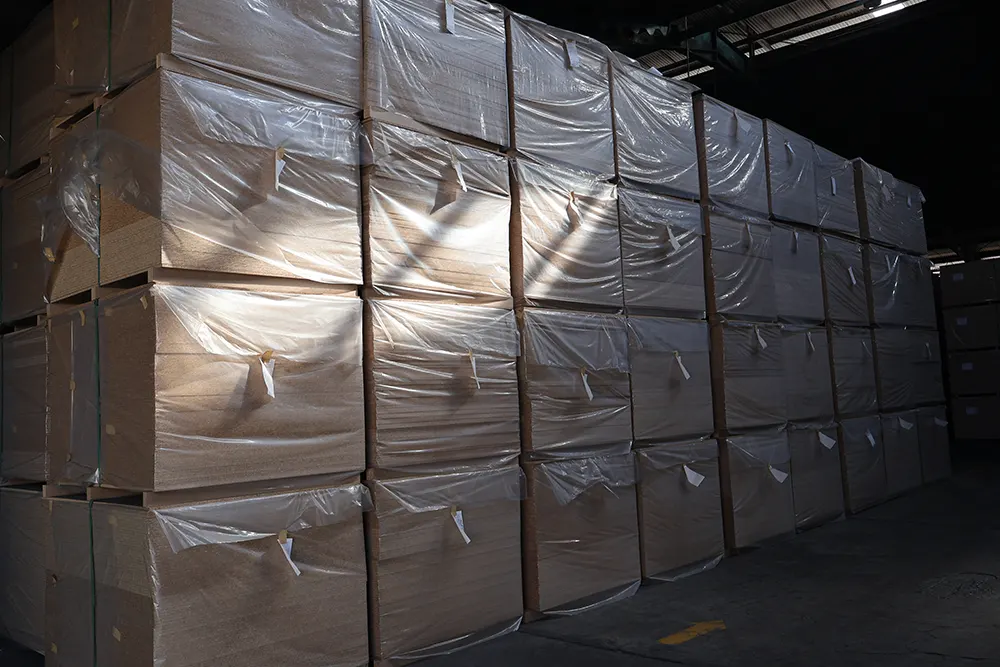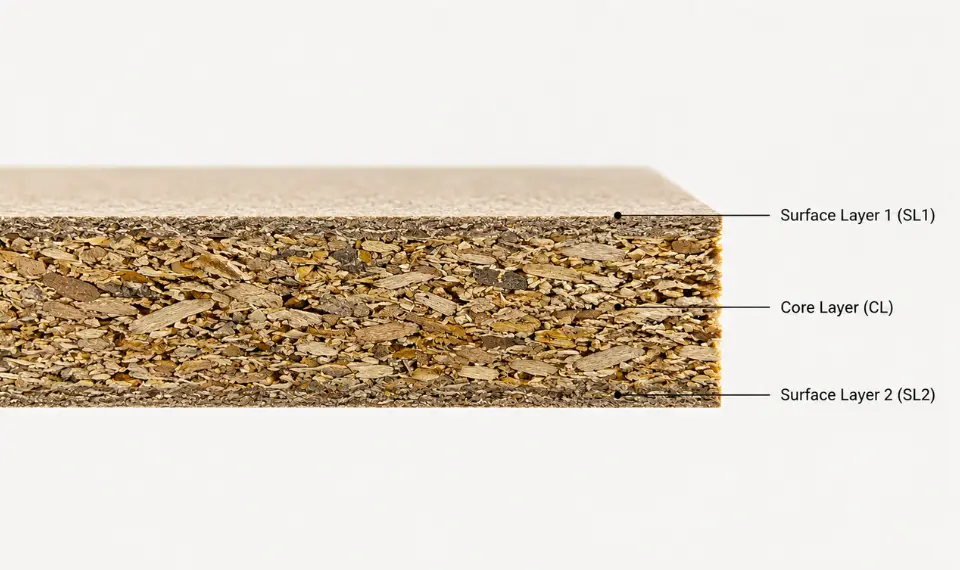



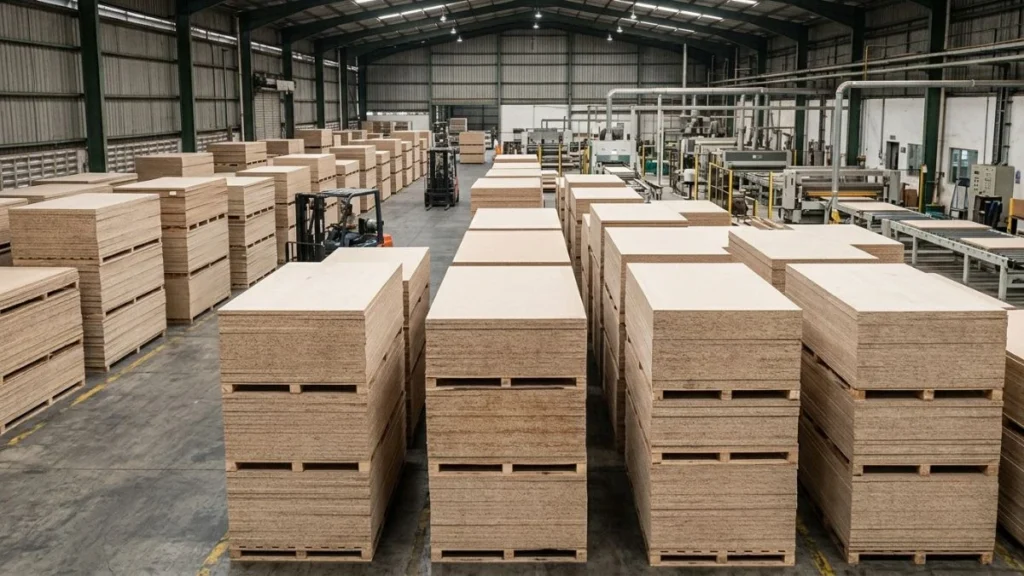
Particle board price is driven by six main factors: thickness, density/grade, formaldehyde emission standard, core type (standard vs HMR), order volume, and shipping distance. There’s no single “market price” — get a quote based on your exact specifications rather than a generic price list.
If you’ve searched for particle board price and found wildly different numbers, that’s normal — particle board isn’t a single product with one price. A 6mm E2-grade sheet and an 18mm JIS-certified HMR sheet aren’t comparable, and neither is a small retail order versus a container-load export order. This guide breaks down what actually drives the cost, so you know what to ask for when you request a quote.
What Determines Particle Board Price?
Thickness and Size
Particle board is typically available from 6mm up to 30mm (common increments: 6/9/12/15/18/20/25/30mm), in sizes like 4×8, 4×9, or 3×10 feet. Thicker boards use more raw material per sheet, so price scales with thickness — but not always linearly, since production efficiency changes at different thicknesses too.
Density and Grade
Particle board density typically ranges from 0.40 to 0.90 g/cm³ under the JIS A 5908:2022 standard. Higher-density boards generally cost more, but also perform better on strength metrics like internal bond and screw-holding strength — density is a spec to compare, not just a cost driver.
Formaldehyde Emission Standard
This is one of the biggest hidden price factors. Particle board is graded from E2 (higher emission, lowest cost) through E1, E0, E0S, and CARB Phase 2/EPA-compliant grades (lowest emission, highest cost). If your market or end client requires CARB P2 or E0S certification, expect a higher price than standard E2 board — but also stricter compliance for markets like the US, EU, or environmentally-regulated projects.
Core Type: Standard vs HMR
HMR (High Moisture Resistant) particle board costs more than standard core because of the specialized resin formulation. It’s worth the premium for kitchens, bathrooms, and humid climates — but an unnecessary cost for dry indoor furniture applications.
Order Volume and Customization
Standard sizes and thicknesses ordered in bulk are priced more efficiently than small, mixed, or custom-cut orders. If you’re comparing particle board types for a large project, standardizing on fewer thickness/grade combinations can meaningfully reduce per-unit cost.
Shipping and Logistics
For international buyers, freight, container loading efficiency, and destination port fees often account for a significant share of landed cost — sometimes more than the board itself for smaller orders. This is why the same board can have very different delivered prices to different countries.
Particle Board Specifications That Affect Your Quote
When requesting a price, having these details ready gets you a faster, more accurate quote:
| Spec | Options |
|---|---|
| Ketebalan | 6 / 9 / 12 / 15 / 18 / 20 / 25 / 30 mm |
| Size | 4×6 / 4×8 / 4×9 / 3×6 / 3×8 / 3×9 / 3×10 ft |
| Jenis Perekat | Urea Formaldehyde or Melamine Urea Formaldehyde |
| Kekuatan Rekat | Type 13, Type 18, or HMR Type |
| Emission grade | E2 / E1 / E0 / E0S / CARB P2 / EPA |
How to Get an Accurate Particle Board Quote
- Specify end use first — furniture core, flooring underlay, cabinetry, or construction. This determines which thickness and bonding type actually matters.
- Confirm the emission grade your market requires. Some countries and retailers mandate CARB P2 or E0S; ordering a lower grade than required can mean re-doing the order.
- Decide standard vs HMR core based on moisture exposure, not just cost — the price difference is usually smaller than the cost of water damage.
- Get landed cost, not just factory price, especially for international orders — ask for a quote that includes shipping to your destination.
- Compare against total project cost, not per-sheet price. A slightly higher-grade board that reduces waste or rework can be cheaper overall.
Common Buying Mistakes
- Choosing the lowest emission grade available without checking market requirements — then failing compliance checks at import.
- Assuming all “18mm particle board” is the same product — density, glue type, and bonding strength all vary at the same thickness.
- Comparing particle board price directly to MDF or plywood without accounting for different strength and application profiles — see our particle board vs MDF comparison for an apples-to-apples breakdown.
- Not accounting for shipping when comparing supplier quotes from different countries.
FAQ
Does thickness affect particle board price the most?
Thickness is a major factor, but formaldehyde emission grade and order volume often affect price just as much, especially for export orders requiring specific compliance certifications.
Is HMR particle board significantly more expensive than standard board?
It costs more due to the specialized resin, but the premium is generally smaller than the cost of replacing water-damaged standard board in humid environments.
Can I get a custom thickness or size?
Custom sizing is available from most manufacturers but typically requires a minimum order quantity, since it falls outside standard production runs.
Get a Particle Board Quote from RPI
For an accurate quote based on your exact thickness, grade, and volume requirements, contact RPI’s team at admin-rpi@rimbapartikel.com atau chat with us on WhatsApp. RPI is a JIS-certified particle board manufacturer based in Kendal, Central Java, established in 1990, producing to JIS A 5908:2022 standards with FSC-certified materials.